
Granite Countertops Vancouver
Granite has been the serious cook’s countertop for decades, and despite a long stretch where engineered quartz claimed the spotlight, it has quietly come back into favour in Vancouver. Heritage homes in Shaughnessy and Kerrisdale, traditional kitchens in Point Grey, and statement-island projects across the West Side are all asking for natural stone again — partly because every slab is genuinely unique, partly because granite handles real cooking better than almost anything else in the market. Alpine Countertops has been fabricating granite from our Richmond facility since 2015. We are BBB A+ accredited, we work with leading BC slab importers, and we hand-select stone for our clients before any cuts are made.
Why granite works in Vancouver kitchens
Granite is an igneous rock — quartz, feldspar, mica, and accessory minerals crystallized from molten rock under enormous pressure. That mineral mix is what gives every slab its visual identity, and what makes granite genuinely hard. The quartz component sits at 7 on the Mohs hardness scale and feldspar at 6 to 6.5. In practical Vancouver-kitchen terms, that means a surface that will not scratch from normal knife use and will not blister from a hot pan straight off the stove. No engineered material handles direct heat better.
The Vancouver kitchens granite suits best are the ones where cooking is a serious activity, not a styling exercise. Traditional and transitional kitchens in West Side heritage homes — Shaughnessy, Kerrisdale, Dunbar, Point Grey — frequently sit in cabinetry from the 1980s and 1990s renovation cycles, with deeper wood tones and more substantial profiles. Stark cool quartz can look stranded in those rooms; a warm-toned granite sits right at home. We see the same dynamic in older homes around Mount Pleasant, Riley Park, and Kitsilano, where original character is being preserved through a sympathetic kitchen update rather than a wholesale modernisation.
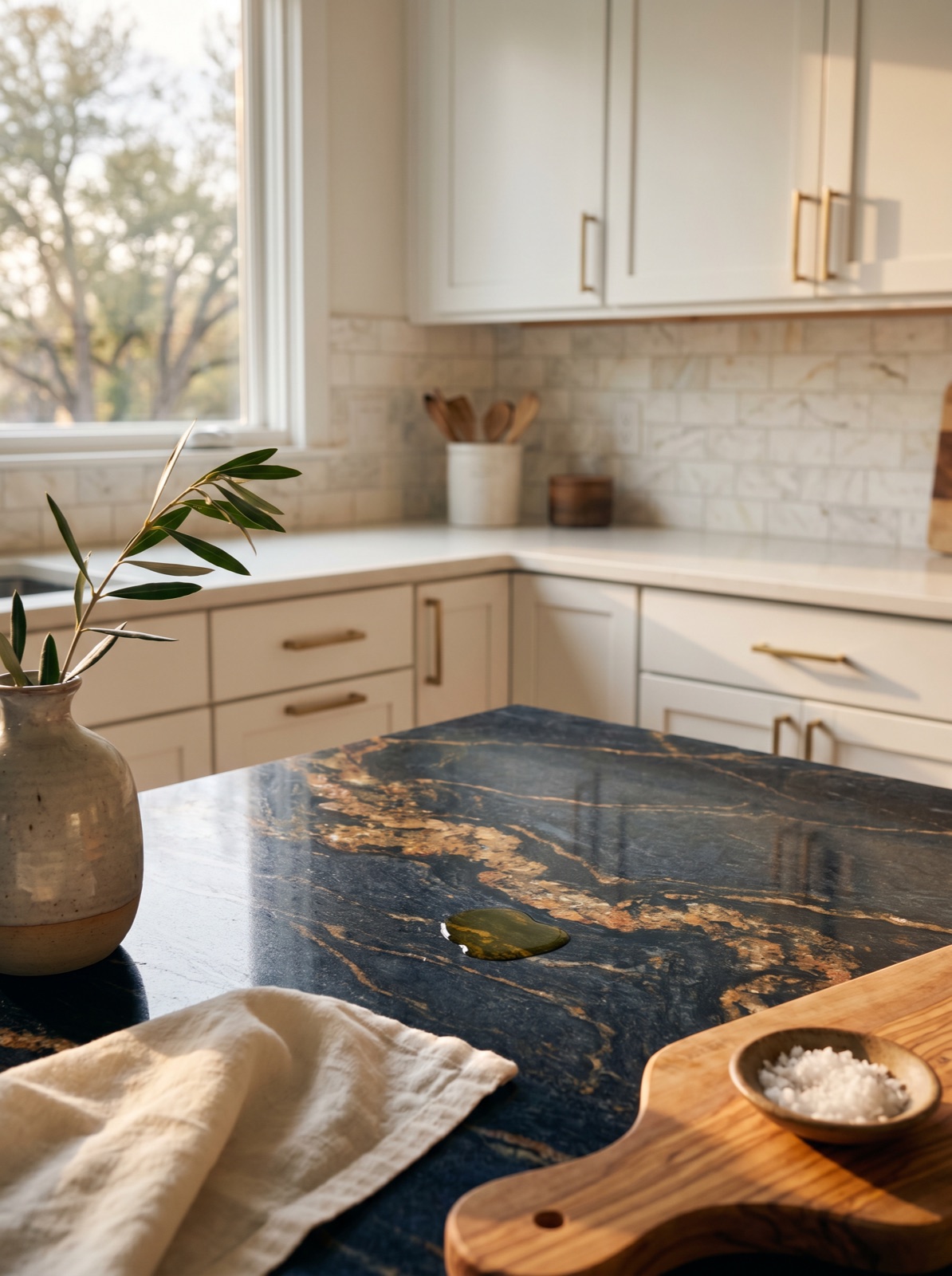
The other reason granite is back: every slab is unique. A high-movement granite — Blue Bahia, Golden Persa, Black Galaxy, Volga Blue, Magma Gold — does something no engineered surface can. It produces a one-of-one statement piece, particularly on a feature island where the stone is meant to be the visual centre of the room. We hand-pick slabs at the supplier yard with our clients for projects where this matters, so you see your specific piece before fabrication starts. For a side-by-side comparison with engineered quartz, see our quartz vs. granite Vancouver guide.
Granite varieties and options at Alpine
Granite is sold by named variety, almost always tied to the quarry of origin (Brazil, India, China, and Italy supply most of what reaches Vancouver). We work with a network of BC importers including Margranite to bring in slabs across the spectrum, from quiet everyday neutrals to dramatic exotics. Our showroom in Richmond holds samples of stocked varieties, and we arrange yard visits for clients selecting specific slabs.
- Black Galaxy — an Indian granite with a deep black background and small reflective gold-bronze flecks (actually bronzite mineral inclusions). Reads sharp and modern under pendant lighting, and remains one of the most-requested island stones in Vancouver. Highly consistent slab to slab.
- Blue Bahia — a rare and genuinely striking Brazilian granite with bright blue feldspar against a darker background. A true statement stone for a feature island where the homeowner wants the counter to lead the room. Limited supply means availability comes and goes.
- Golden Persa — a Brazilian granite with cream, gold, and burgundy movement. Particularly suited to traditional and transitional kitchens in West Side homes with warm wood cabinets, aged-bronze hardware, and tumbled-stone backsplashes.
- Volga Blue and Blue Pearl — Norwegian and Ukrainian granites with reflective blue-grey crystals (the iridescence comes from labradorite). Reads cool and contemporary, and works well as a perimeter run paired with a calmer island.
- Absolute Black and Steel Grey — quieter, cleaner, near-uniform granites that read more like engineered stone. Strong choices when granite’s heat resistance and durability are wanted but the visual movement of an exotic would be too busy.
- Colonial White, Bianco Romano, and Alaska White — pale granites with grey, black, and burgundy speckling. Practical neutrals for transitional kitchens with white or pale cabinets, and far more forgiving of crumbs and light staining than a solid white quartz.
Because every granite slab is unique, the slab you see at the yard is the slab you get. We mark up your selected piece, lay out the cuts to optimize movement across the seams, and walk you through the layout before fabrication. Browse current stock context on our products and suppliers page.
Granite care in Vancouver’s climate
Granite is a natural stone, which means it has a small but real porosity. To keep liquids from soaking in and discolouring the surface, granite needs periodic sealing — typically every 6 to 12 months for a normal-use kitchen. The test is simple: sprinkle a few drops of water on the counter. If they bead up, the seal is intact; if they soak in within a few minutes and darken the stone, it is time to reseal. The sealing process itself is straightforward — wipe on a penetrating stone sealer, let it absorb for the time the manufacturer specifies, then buff off the residue.
Vancouver’s damp winter climate does not affect granite directly, but a kitchen with poor ventilation can drive sealer breakdown a bit faster, particularly above a steam-heavy cooktop. Day-to-day cleaning is warm water with a stone-safe pH-neutral cleaner. Avoid acidic cleaners (vinegar, lemon-based products) and harsh alkalines (oven cleaner, bleach), which can degrade the seal or, over time, dull the polish. See our broader product care page for full guidance.
Pricing — what affects granite cost
Granite pricing in Vancouver runs across a wide range because granite itself runs across a wide range. A common, plentiful neutral and a rare imported exotic can differ by a factor of three or more on the same square footage. We itemize quotes so the variables are visible rather than buried in a flat rate. The major drivers:
- Variety and origin. Common neutrals (Colonial White, Steel Grey, Absolute Black) sit at the accessible end. Exotics with limited quarry supply (Blue Bahia, Volga Blue, Magma Gold) sit considerably higher and fluctuate with import availability.
- Slab thickness. Most kitchen tops are fabricated from 3 cm slabs. Some clients choose 2 cm with a built-up edge to manage cost; others choose stacked or mitred edges for a more substantial look, which adds material and labour.
- Edge profile. Eased and quarter-round are baseline. Ogee, dupont, mitred waterfall, and full-bullnose profiles add fabrication time.
- Cut-outs and complexity. Undermount sinks, cooktop cut-outs, and integrated drainboards each add labour. Granite’s hardness means cut-outs take longer than in softer materials.
- Removal and disposal. Tearing out an existing tile, laminate, or stone surface is its own line item, billed separately.
Our process — template to installation
A granite project at Alpine moves through four stages. First, a free in-home consultation with physical samples. For a granite-led project we then arrange a yard visit so you can choose your specific slab in person — for an exotic island stone, this matters. Second, digital laser templating once cabinets are installed. Third, fabrication in our Richmond shop on our own equipment. Standard turnaround is 2 to 3 weeks from template to install. Fourth, installation by Alpine crews, including first-application sealing before we leave. Read more on the about page.
Granite countertop FAQs
How often does granite actually need to be resealed?
For a normal residential kitchen in Vancouver, every 6 to 12 months is a reasonable cadence. Heavy-use kitchens or homes near the coast may benefit from the shorter end of that range. The water-bead test (a few drops on the surface — do they bead, or soak in?) tells you when the seal is breaking down. Sealing itself takes about 30 minutes for a typical kitchen.
Can granite handle a hot pan straight off the stove?
Yes. Granite is one of the most heat-resistant countertop materials available and will not blister, scorch, or discolour from contact with a hot pan or baking sheet. We still recommend trivets for very prolonged contact and for protecting the seal, but granite tolerates direct heat far better than engineered quartz, solid surface, or laminate.
Is every granite slab really unique?
Yes. Granite is a natural stone, and even within a named variety from a single quarry, slabs vary in pattern density, vein direction, and background tone. For a feature island we always recommend an in-person yard visit so you can pick the specific slab you want — and so we can map out the cuts to put the best movement where the eye lands.
Get a quote
Ready to talk through granite for your Vancouver home? Call 604-630-5700 or email info@alpinecountertops.com to book a free in-home consultation. We bring samples, measure the space, arrange a yard visit if you are considering an exotic, and send a detailed itemized quote within 48 hours. You can also reach us through our contact page or browse our broader Vancouver countertops page.