
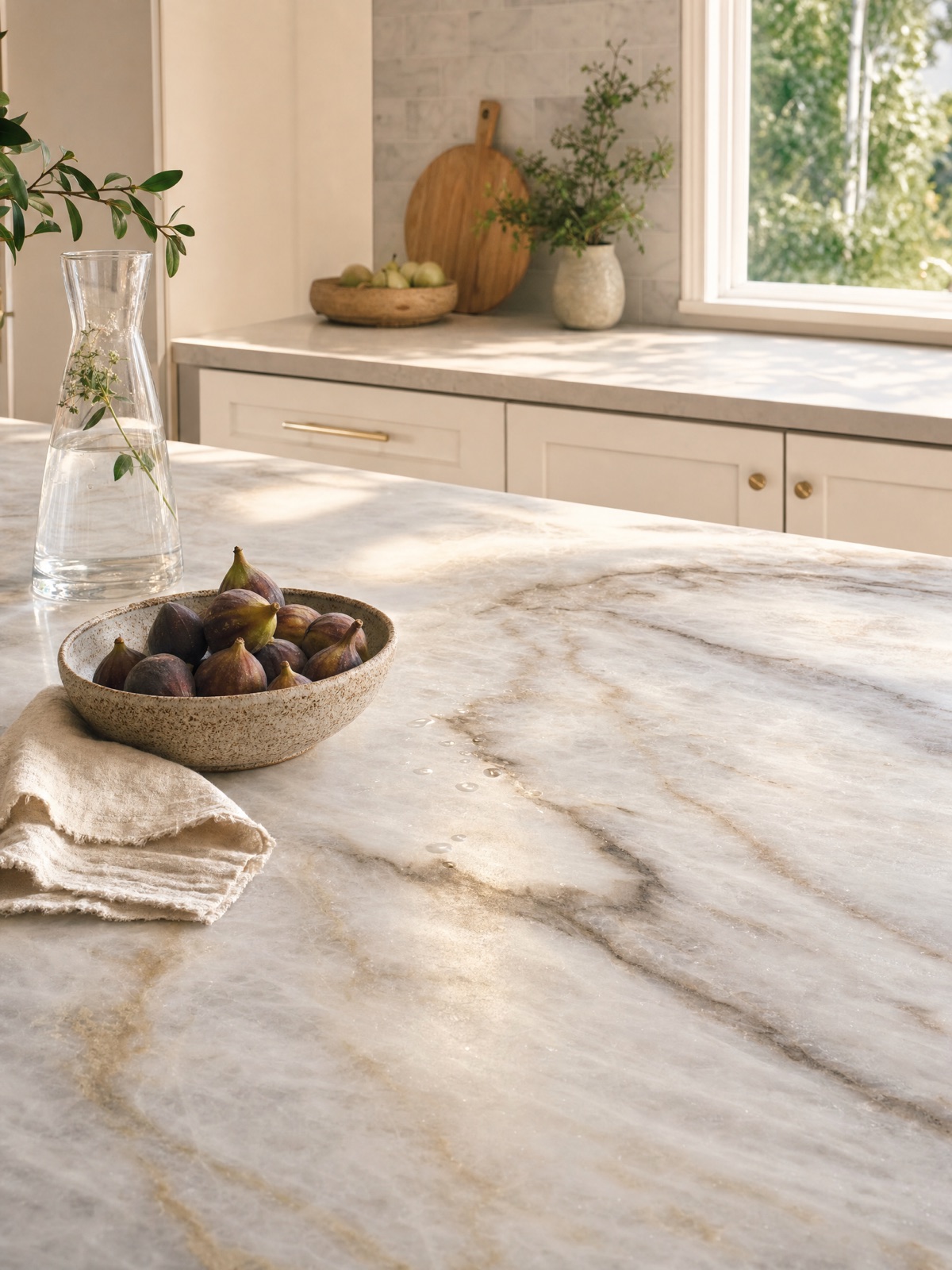
Quartzite vs Marble Countertops: Look-Alikes With Very Different Durability
Quick answer: Quartzite and marble can look almost identical — both are natural stone with soft, flowing veins — but they behave very differently. Quartzite is much harder and acid-resistant; true quartzite shrugs off scratches and won’t etch from lemon, wine or vinegar. Marble is soft and acid-sensitive; it scratches more easily and etches (dull spots) when acidic foods touch it. If you want the marble look in a busy kitchen but can’t accept etching, choose quartzite. If you love marble’s unmatched elegance and will embrace its patina, marble is timeless — just go in with eyes open.
At Alpine Countertops, this is the comparison where homeowners are most often surprised. Two slabs on our Richmond racks can look like twins, yet one will live happily through years of cooking while the other shows every splash of citrus. Here’s how to tell them apart and choose well.
Last updated: June 2026
Why do quartzite and marble look so similar?
Both are natural stones with white-to-grey backgrounds and elegant veining, which is exactly why buyers confuse them — and why some quartzites are marketed as the “durable marble.” But their makeup is different:
- Marble is metamorphosed limestone, composed mostly of calcite (calcium carbonate). Calcite is soft and reacts chemically with acid — that reaction is what causes etching.
- Quartzite is recrystallized sandstone, composed mostly of quartz. Quartz is hard and chemically inert to common kitchen acids, so true quartzite doesn’t etch.
That single difference — calcite vs quartz — drives almost everything below.
Quartzite vs marble at a glance
Cost figures below are typical Metro Vancouver installed ranges; exotic/premium slabs and complex fabrication run higher — request a quote.
| Dimension | Quartzite | Marble |
|---|---|---|
| Main mineral | Quartz (hard, acid-resistant) | Calcite (soft, acid-sensitive) |
| Look | Marble-like veining; whites, greys, blues, beiges | Classic luxurious veining; Carrara, Calacatta, Statuario |
| Hardness (Mohs) | ~7–8 — very hard | ~3–5 (calcite ~3; dolomitic marble higher) — soft |
| Scratch resistance | Excellent | Low — scratches relatively easily |
| Etching (from acids) | Resists etching (true quartzite) | Etches from lemon, vinegar, wine, tomato |
| Heat resistance | Highly heat-resistant | Solid stone, but the polished surface marks easily and can suffer thermal shock |
| Stain resistance | Good when sealed | Lower — porous; seal and wipe spills fast |
| Maintenance | Periodic sealing (~every 1–2 years); mild soap & water | More frequent sealing; immediate spill cleanup; gentle care |
| Cost (installed, Metro Van) | ~$110–$180/sq ft (rare exotics higher) | ~$80–$150/sq ft (Carrara at the low end; premium Calacatta $150 and up) |
| Best for | Marble look in a hard-working kitchen | Showpiece kitchens, baking stations, patina lovers |
Which is more durable, quartzite or marble?
Quartzite, by a wide margin. It’s one of the hardest countertop stones (Mohs ~7–8) and acid-resistant, so it handles a busy kitchen with ease. Marble is much softer (Mohs ~3–5, with calcite around 3) and acid-sensitive, so it scratches more readily and — the big one — etches.
Etching isn’t a stain; it’s a tiny chemical burn where acid has dulled the polished surface, leaving a matte mark. Crucially, sealing does not stop etching — a sealer slows staining only, while etching is a chemical reaction with the stone itself. On marble it’s normal and expected: spill lemon juice or set down a glass of wine, and over time you’ll see it. Many marble lovers embrace this patina as part of the stone’s character; others find it maddening. True quartzite simply doesn’t etch from common kitchen acids, which is its headline advantage for cooks.
The mislabeling trap: “soft quartzite” that’s really marble
Here’s a fabricator warning worth its weight. There is no such thing as “soft quartzite.” Some slabs sold as “quartzite” are actually a softer stone — commonly dolomitic marble (or marble) — which etches. Mislabeling is a known issue in the stone industry. The simple test is definitive: true quartzite will not etch from acid. If a sample dulls when you put lemon juice or vinegar on it, it isn’t true quartzite, no matter what the label says.
This is exactly why buying from an experienced fabricator matters. At our Richmond shop we verify a slab’s identity before we sell it as quartzite, so you get the durability you’re paying for. Ask us how we test — we’re happy to show you.
It’s worth being clear that this isn’t a knock on marble — marble is a wonderful stone and etching is simply its nature, not a defect. The problem is only when a softer, etch-prone stone is sold under the “quartzite” name at quartzite prices, and the buyer expects bulletproof durability they won’t get. Knowing which stone you’re actually buying is what lets you set the right expectations and care routine from day one.
Which is more heat resistant?
Quartzite has the practical advantage here. Quartzite is highly heat-resistant and tolerates hot cookware set briefly on the surface. Marble is solid stone, but its polished surface marks easily and can suffer thermal shock — once it’s dulled or etched, it shows. Quartzite’s harder surface holds up better to the realities of a working kitchen. As with any stone, we recommend trivets to protect the sealer and avoid repeated thermal shock; that’s especially worth doing on marble.
How do they compare on maintenance?
Both are natural stone and both need sealing, but marble asks more of you day to day:
- Quartzite: Very dense; seal periodically (often around every 1–2 years), wipe with mild soap and water, avoid acidic or abrasive cleaners. Low fuss.
- Marble: Seal more often, wipe acidic spills immediately, use cutting boards and trivets, and accept that etching and the occasional scratch are part of living with it — remember sealing limits staining but does not prevent etching. Our marble care guide covers this in depth.
How do they compare on looks and cost?
On looks it’s close to a tie — that’s the whole point. Marble has a depth and pedigree (Carrara, Calacatta, Statuario) that designers prize, and certain marble veining is hard to match exactly. Quartzite gets remarkably close while adding toughness. Because both are natural, choose your actual slab in person.
If you look closely, marble veins often have a softer, more diffuse, painterly quality, while many quartzites show crisper, more crystalline movement — though the two overlap enough that even pros sometimes need to test a slab to be sure. For a designer chasing a very specific Calacatta look, marble may still win on pure aesthetics; for nearly everyone else, quartzite delivers the same impression without the worry.
On cost, the two overlap. Marble runs roughly $80–$150/sq ft installed (Carrara at the low end; premium Calacatta $150 and up), while quartzite typically runs $110–$180/sq ft (rare exotics higher) — both typical Metro Vancouver planning ranges, with exotic/premium slabs and complex fabrication running higher, so request a quote. The real cost difference is long-term: marble’s sensitivity may mean more careful upkeep (and a higher tolerance for patina). See our quartzite cost guide and full countertop cost comparison for local ranges.
Which should you choose?
- Choose quartzite if you want the marble look but cook regularly and can’t live with etching or scratches. It’s the practical way to get marble’s beauty in a hard-working kitchen.
- Choose marble if you adore its classic elegance, you’re using it somewhere lower-impact (a baking station, a powder room, a low-traffic island), or you genuinely like the lived-in patina that etching creates over time.
- For a bathroom vanity, both can work beautifully since acid exposure is lower — our marble vs quartz vanity guide is a useful companion read.
Weighing other materials too? Our complete countertop materials guide compares quartzite, granite, quartz, marble and porcelain side by side in one place.
Frequently asked questions
Is quartzite better than marble for a kitchen?
For durability, yes — quartzite is much harder and resists etching and scratching, so it handles cooking far better. Marble is softer and etches from acids. Marble can still be a stunning choice if you accept its patina or use it in lower-traffic spots.
Does quartzite etch like marble?
True quartzite does not etch from common kitchen acids, because it’s mostly hard quartz rather than soft calcite. If a stone labeled “quartzite” etches from lemon or vinegar, it’s likely dolomitic marble or another soft, mislabeled stone — not true quartzite.
How can I tell quartzite from marble?
The reliable test is an acid spot test on a sample: marble (and soft “quartzite”) will etch or dull; true quartzite won’t. Hardness also differs — quartzite resists scratching from a steel blade far better. A trusted fabricator can verify a slab for you.
Do both quartzite and marble need sealing?
Yes, both are natural stone and benefit from sealing. Marble is more porous and acid-sensitive, so it typically needs more attentive sealing and faster spill cleanup than quartzite. Note that sealing limits staining but does not stop etching on marble.
Is quartzite more expensive than marble?
Often, slightly. Quartzite typically runs about $110–$180/sq ft installed while marble runs about $80–$150 (premium Calacatta higher), so the bands overlap. The bigger long-term difference is upkeep — marble’s sensitivity often means more careful maintenance over the years.
See real slabs side by side at Alpine
Alpine Countertops has fabricated quartzite and marble for Metro Vancouver and the Fraser Valley since 2015, from our Richmond facility (BBB A+). We’ll help you compare slabs in person, verify your quartzite is the real thing, and template, fabricate and install it. Call 604-630-5700, email info@alpinecountertops.com, or contact us to book a showroom visit. Explore our marble countertops and Vancouver countertops pages for more.
Last updated: June 2026