
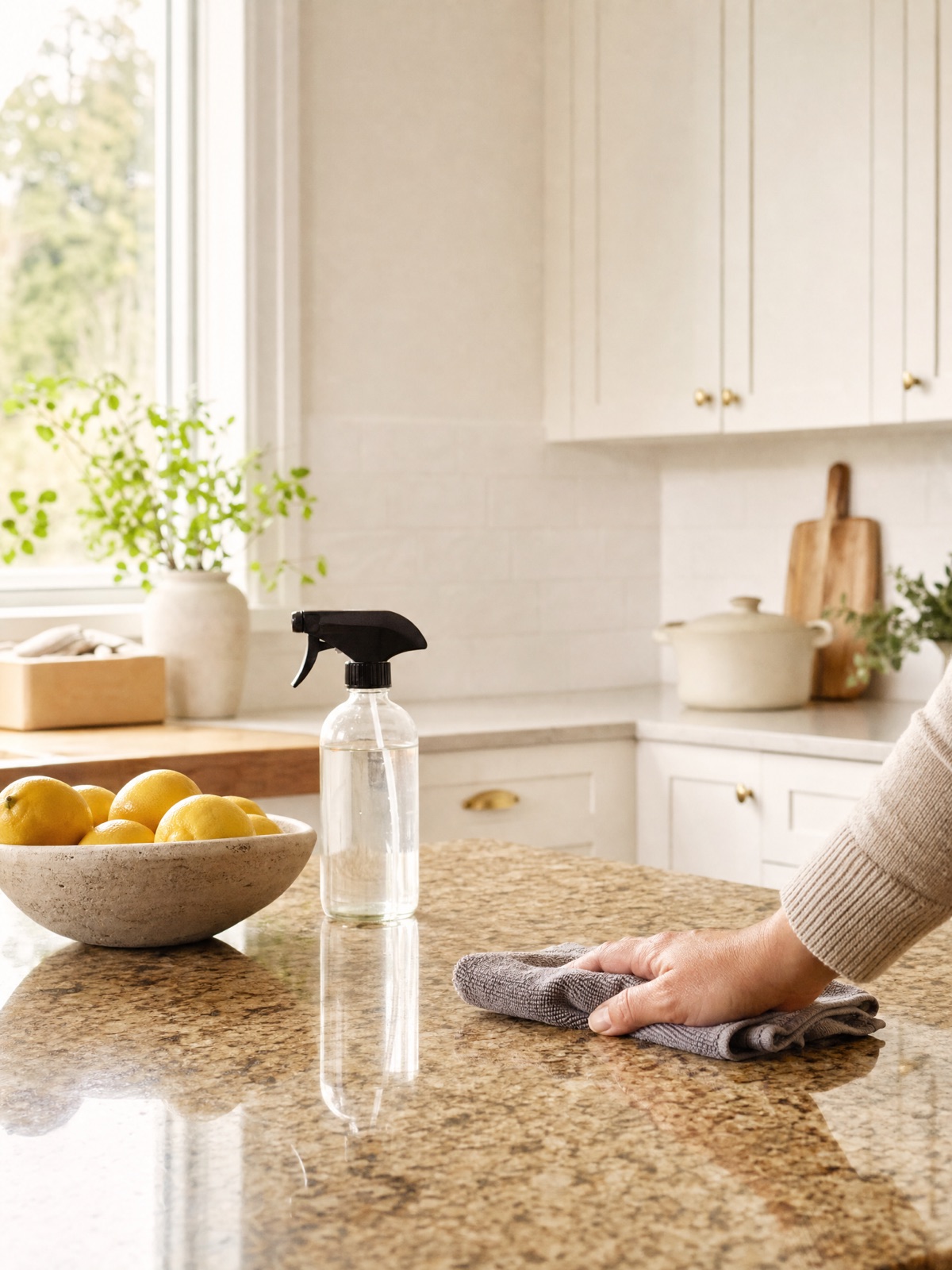
How to Clean Granite Countertops: A Vancouver Homeowner’s Guide
Cleaning granite is genuinely easy once you know two things: what to use, and what to never use. The good news is that the right method is gentle, quick, and uses products you can buy at any Canadian Tire or Home Depot in the Lower Mainland. The bad news is that a lot of common advice — vinegar sprays, all-purpose cleaners, baking-soda scrubs — slowly damages the sealer that keeps granite stain-resistant. This guide walks through a simple daily routine and a slightly deeper weekly one, names the stone-safe products sold here in Canada, and covers a local detail most guides get wrong: how Vancouver’s very soft tap water changes what you are actually wiping off your counter.
What you’ll need
- Warm water
- A mild dish soap (a few drops is plenty)
- A soft cloth or microfibre cloth, plus a second dry one for buffing
- Optional: a pH-neutral stone-safe cleaner — for example Granite Gold Daily Cleaner (Canadian Tire), Method Daily Granite Cleaner (Home Depot Canada), or Weiman granite cleaner (Canadian Tire, Walmart.ca)
- A soft sponge (the non-abrasive side only) for any stuck-on bits
That is the entire kit. Notice what is not on it: no vinegar, no lemon, no glass cleaner, no scouring powder, no abrasive pad. Those are the things that wear granite down over time.
Step-by-step: cleaning granite countertops
- Clear and dust the surface. Move small appliances and clear away crumbs and loose debris with a dry cloth or a quick sweep of the hand. Grit dragged around under a wet cloth is the main thing that puts fine scratches in a polished surface, so get it off first.
- Mix a mild cleaning solution. Add a few drops of mild dish soap to warm water. You want it barely soapy, not sudsy — too much soap leaves a film that dulls the stone. If you are using a bottled stone-safe cleaner instead, spray it lightly across the surface and skip to the wiping step.
- Wipe the surface. Dampen a soft or microfibre cloth in the solution, wring it out so it is damp rather than dripping, and wipe the whole counter. Work in sections so nothing dries before you get to it.
- Tackle stuck-on spots gently. For dried food or a sticky ring, lay the damp cloth over the spot for a minute to soften it, then wipe. If it still resists, use the non-abrasive side of a soft sponge. Never reach for a scouring pad or powder.
- Rinse off any soap. Wipe the surface again with a fresh cloth dampened in plain warm water. This step matters: leftover soap is the most common cause of a hazy, streaky-looking granite top, and in our soft-water region it is usually the real culprit behind what people call “water marks.”
- Dry and buff. Dry the counter with a clean, soft cloth. Buffing it dry prevents streaks and gives the polish its shine back. Your granite is clean.
A weekly and occasional routine
The six steps above are your daily wipe-down. Once a week, give the counter a slightly more thorough version of the same thing — the same mild soap and water, but take a little more time on the high-use zones around the sink, stove, and prep area, and check for any spills that dried unnoticed.
Two things to fold in occasionally rather than daily. First, disinfecting: granite is hard and, when sealed, does not readily harbour bacteria, but kitchens still need the odd sanitising pass. Use a stone-safe disinfecting cleaner, or a solution of isopropyl (rubbing) alcohol and water, which is safe on sealed granite. Avoid bleach and ammonia, which are hard on the sealer. Second, the water-bead test: every few months, drip a little water on the stone near the sink. If it beads, the seal is intact; if it soaks in and darkens, it is time to reseal. That simple test, not a fixed calendar, is how you know when granite needs resealing.
What to avoid
The list of things that damage granite is short and worth knowing cold:
- Acidic cleaners — vinegar, lemon juice, and many “natural” or citrus sprays. Granite is a siliceous stone and resists acid far better than marble, so a splash will not etch it, but routine acid exposure degrades the impregnating sealer and dulls the polish over time. The Natural Stone Institute does not recommend acidic cleaners even on acid-resistant stone.
- Abrasives — scouring powders, gritty cream cleansers, and scrubbing pads. They scratch the polished finish.
- Harsh alkalis and bleach — bleach, ammonia, and strong degreasers are too aggressive for a sealed natural stone and shorten the sealer’s life.
- Generic all-purpose sprays — unless a product is specifically labelled safe for natural stone, assume it is not, and use mild soap and water instead.
If you only remember one rule, make it this: warm water and a couple of drops of dish soap will clean almost anything off granite, and it will never harm the stone.
The Vancouver water angle
Here is the local detail that changes how you should read your own counter. Metro Vancouver’s tap water is very soft — it comes from the Capilano, Seymour, and Coquitlam mountain reservoirs and runs roughly 2.5 to 4.8 mg/L hardness as calcium carbonate (Metro Vancouver’s 2024 water quality report), among the softest municipal water in North America.
Soft water leaves very little mineral residue, so the chalky hard-water film that builds up on counters in much of the world is uncommon across Vancouver, Burnaby, Richmond, the North Shore, Coquitlam, and New Westminster. When you see a haze or a mark on granite here, it is much more likely to be soap or cleaner residue sitting on the surface — which is exactly why the rinse-and-dry steps above matter — or a temporary dark patch where water soaked into under-sealed stone and will fade as it dries. It is rarely true mineral scale.
The exception is the Fraser Valley. Parts of Abbotsford, Langley Township, and other areas on groundwater wells have noticeably harder water, where genuine mineral deposits are more plausible. If you are on a well rather than municipal supply, drying the counter after use helps keep deposits from forming. For the full picture of marks and how to fix each kind, see our guide on removing water marks and rings from granite.
When to call a professional
Cleaning granite is firmly DIY. Call a fabricator when cleaning is not the issue: a stain that will not lift with a poultice, a polished surface that has gone dull or scratched across an area, or a chip, crack, or failing seam. Resealing is also a quick professional job if your counter fails the water-bead test and you would rather not do it yourself. Alpine Countertops works in granite across Metro Vancouver every week and is happy to advise.
Frequently asked questions
What should I clean granite countertops with day to day?
Warm water with a few drops of mild dish soap on a soft or microfibre cloth, then dry it off. If you prefer a bottled product, use a pH-neutral stone-safe cleaner such as Granite Gold Daily Cleaner (Canadian Tire), Method Daily Granite Cleaner (Home Depot Canada), or Weiman granite cleaner (Canadian Tire, Walmart.ca). Avoid vinegar, lemon, abrasives, and bleach.
Can I use the same cleaner on granite and quartz?
For everyday cleaning, yes — mild dish soap and warm water is safe on both, and so are most pH-neutral stone-safe sprays. The bigger differences between the two materials are in sealing (granite needs it periodically; quartz never does) and heat tolerance. If you also have quartz, see our companion guide on how to clean quartz countertops.
How do I disinfect granite without damaging it?
Use a stone-safe disinfecting cleaner, or wipe the surface with a solution of isopropyl (rubbing) alcohol and water, which is safe on sealed granite. Let it sit briefly, then rinse with plain water and dry. Avoid bleach and ammonia, which degrade the sealer over time.
Why does my granite look hazy or streaky after I clean it?
The usual cause is leftover soap or cleaner residue, especially in Metro Vancouver where soft tap water deposits almost no minerals of its own. Re-clean with plain warm water to rinse the residue away, then buff dry with a soft cloth. Using less soap next time prevents it from recurring.
This guide is part of our Granite Countertop Care & Maintenance Guide →
Get help from Alpine
If your granite needs resealing, has a mark you cannot shift, or you are planning a new natural-stone kitchen, we can help. Alpine Countertops fabricates in our own Richmond facility and installs across Metro Vancouver and the Fraser Valley. Call 604-630-5700 or email info@alpinecountertops.com, or reach us through our contact page.