
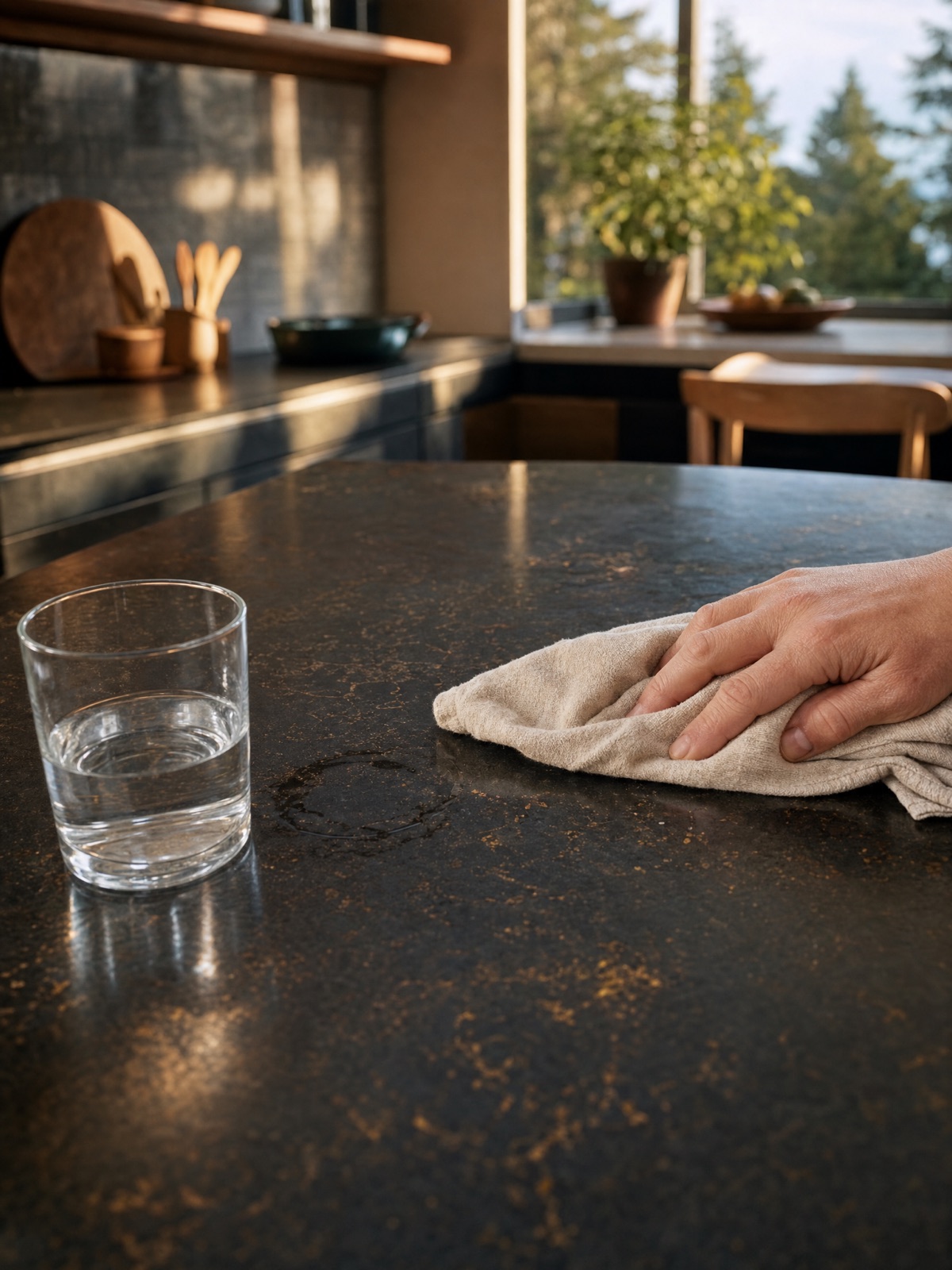
How to Remove Water Marks and Rings from Granite Countertops
A water mark on granite is frustrating because it looks like damage, but most of the time it is not — and the fix is easy once you work out which kind you have. There are really only two: a dark mark, where water has soaked into stone that is no longer well sealed, and a cloudy or filmy mark, which is leftover residue sitting on top of the surface. They look different, they are caused by different things, and they need different fixes. In Metro Vancouver there is an added twist: our tap water is so soft that the chalky hard-water rings common elsewhere are uncommon here, which actually narrows down what you are dealing with. This guide shows you how to tell the two apart and clear each one.
What you’ll need
- Warm water and a mild dish soap
- A soft cloth or microfibre cloth, plus a dry one for buffing
- A soft non-abrasive sponge
- For resealing if needed: a penetrating stone sealer such as Miracle Sealants 511 Impregnator (Home Depot Canada), Weiman granite & stone sealer, or Rock Doctor sealer (both Canadian Tire)
- Optional for stubborn surface film: a pH-neutral stone-safe cleaner
First, tell which mark you have
Before you treat anything, identify the mark. It takes ten seconds and decides everything that follows.
- A dark mark — the stone looks darker or wet in a patch or ring, often where a glass, vase, or wet pan sat. This is water that has been absorbed into under-sealed granite. The tell-tale sign is that it slowly fades on its own as the stone dries out.
- A light, cloudy, or filmy mark — a hazy ring or dull patch sitting on the surface. This is residue on top of the stone: soap film, cleaner residue, or (less often here) mineral deposits. The tell-tale sign is that it does not change as the stone dries, and you can sometimes feel a faint film.
The quick rule: darker and fades as it dries = absorbed water; lighter and stays put = surface residue. Get this right and the rest is straightforward.
Step-by-step: removing a dark (absorbed) water mark
A dark mark is the stone telling you the sealer has worn thin in that spot. The mark itself usually clears on its own; the real job is restoring the protection.
- Let it dry and confirm. Stop putting water on the spot and give it time — a dark absorption mark fades over minutes to a few hours as the moisture evaporates out of the stone. If it fades, you have confirmed it was absorbed water, not a stain.
- Gently warm the area, if you are impatient. You can speed drying with gentle warmth — a hairdryer on a low setting held well back, moved constantly. Do not use high heat, and never apply it to one fixed spot.
- Run the water-bead test. Once dry, drip a few drops of clean water on the spot and wait a few minutes. If the water soaks in and darkens again, the seal has failed there. If it beads, the sealer is fine and the mark was a one-off.
- Reseal if it absorbs. Clean and fully dry the surface, then apply a penetrating stone sealer per the product label — let it dwell for the stated time, then buff off all the excess so none dries on the surface. Reseal the whole counter, not just the patch, so the finish stays even. Always follow the specific product’s instructions.
If dark marks keep reappearing across the counter, that is the clearest possible signal the granite is due for a full reseal. Our countertop sealing guide walks through sealer types and technique in detail.
Step-by-step: removing a cloudy or filmy mark
A surface mark is not in the stone — it is on it — so you are cleaning, not resealing.
- Wash with warm soapy water. Add a few drops of mild dish soap to warm water, wipe the area with a damp cloth, and work the film loose. Most soap and cleaner residue lifts at this stage.
- Rinse thoroughly with plain water. This is the step people skip. Wipe again with a fresh cloth and clean warm water to carry the loosened residue away rather than smearing it around. Buff dry with a soft cloth.
- For a stubborn film, use a stone-safe cleaner. If a haze remains, a pH-neutral stone-safe cleaner will usually clear it. Reach for the non-abrasive side of a soft sponge if needed, but never a scouring pad or powder.
- If it is a genuine mineral deposit (more likely on well water). On a Fraser Valley well, you may occasionally get a real mineral ring. Do not attack it with vinegar — acid degrades granite’s sealer. Instead, soften it with a stone-safe cleaner and gentle non-abrasive rubbing, repeating as needed, and reseal afterward if the sealer has been worn.
What to avoid
- Vinegar and lemon. The internet’s favourite “water spot” fix is acid, and on granite that is exactly wrong — it breaks down the sealer and, repeated, dulls the polish. Granite resists acid better than marble, but routine acid still does harm.
- Abrasive pads and powders. They can scratch the polish and turn a cosmetic mark into real damage.
- Sealing over a damp or dirty surface. Sealer must go onto clean, dry stone. Sealing in moisture can trap the very darkening you are trying to fix.
- Assuming it is hard water. In Metro Vancouver it almost never is — chasing a “hard water” fix wastes effort on a mark that is really absorbed water or soap film.
The Vancouver water angle
This is why telling the marks apart is easier here than almost anywhere. Metro Vancouver’s tap water is very soft — about 2.5 to 4.8 mg/L hardness as calcium carbonate, drawn from the Capilano, Seymour, and Coquitlam mountain reservoirs (Metro Vancouver’s 2024 water quality report). Soft water deposits very little mineral content, so true hard-water rings are genuinely uncommon across Vancouver, Burnaby, Richmond, the North Shore, Coquitlam, and New Westminster.
Practically, that means a mark on your granite is almost always either absorbed water (the dark, fading kind — reseal) or soap and cleaner residue (the cloudy, surface kind — rinse and dry). Genuine mineral deposits are mostly a Fraser Valley well-water issue, in parts of Abbotsford, Langley Township, and similar areas on groundwater. Knowing your water tells you which fix to try first.
When to call a professional
If a dark mark does not fade after the stone has fully dried, it may be a true stain (something absorbed and trapped) rather than water, and that calls for a poultice or professional help rather than resealing. Likewise, if the polish itself looks etched or worn where the mark is, restoring a polished finish is a specialist job. Alpine Countertops can assess a mark, reseal a counter properly, or advise whether what you are seeing is cosmetic or needs hands-on work.
Frequently asked questions
Why does my granite turn dark where water sits, then go back to normal?
That is absorbed water, not a stain. The stone is soaking up moisture because the sealer has worn thin there, and the dark patch fades as the water evaporates back out. Run the water-bead test, and if water keeps soaking in, reseal the counter.
Are the white rings on my granite hard-water deposits?
In Metro Vancouver, usually not — our tap water is very soft and leaves little mineral residue. A white or cloudy ring here is far more often soap or cleaner film sitting on the surface, which washes off with warm soapy water and a thorough rinse. True mineral deposits are more likely on Fraser Valley well water.
Can I use vinegar to remove water marks from granite?
No. Vinegar is acidic and degrades the sealer that keeps granite stain-resistant, dulling the polish over time. Use warm soapy water and a rinse for surface film, and resealing for absorbed-water darkening. Save the acid for nothing on granite.
How do I know if my granite needs resealing?
Use the water-bead test: drip a few drops of water on the stone and wait a few minutes. If it beads, the seal is intact. If it soaks in and the stone darkens, it is time to reseal. Repeated dark water marks are a sign the whole counter is due.
This guide is part of our Granite Countertop Care & Maintenance Guide →
Get help from Alpine
If a mark will not clear, or your granite is due for resealing and you would rather have it done properly, we can help. Alpine Countertops fabricates in our own Richmond facility and serves Metro Vancouver and the Fraser Valley. Call 604-630-5700 or email info@alpinecountertops.com, or use our contact page.