
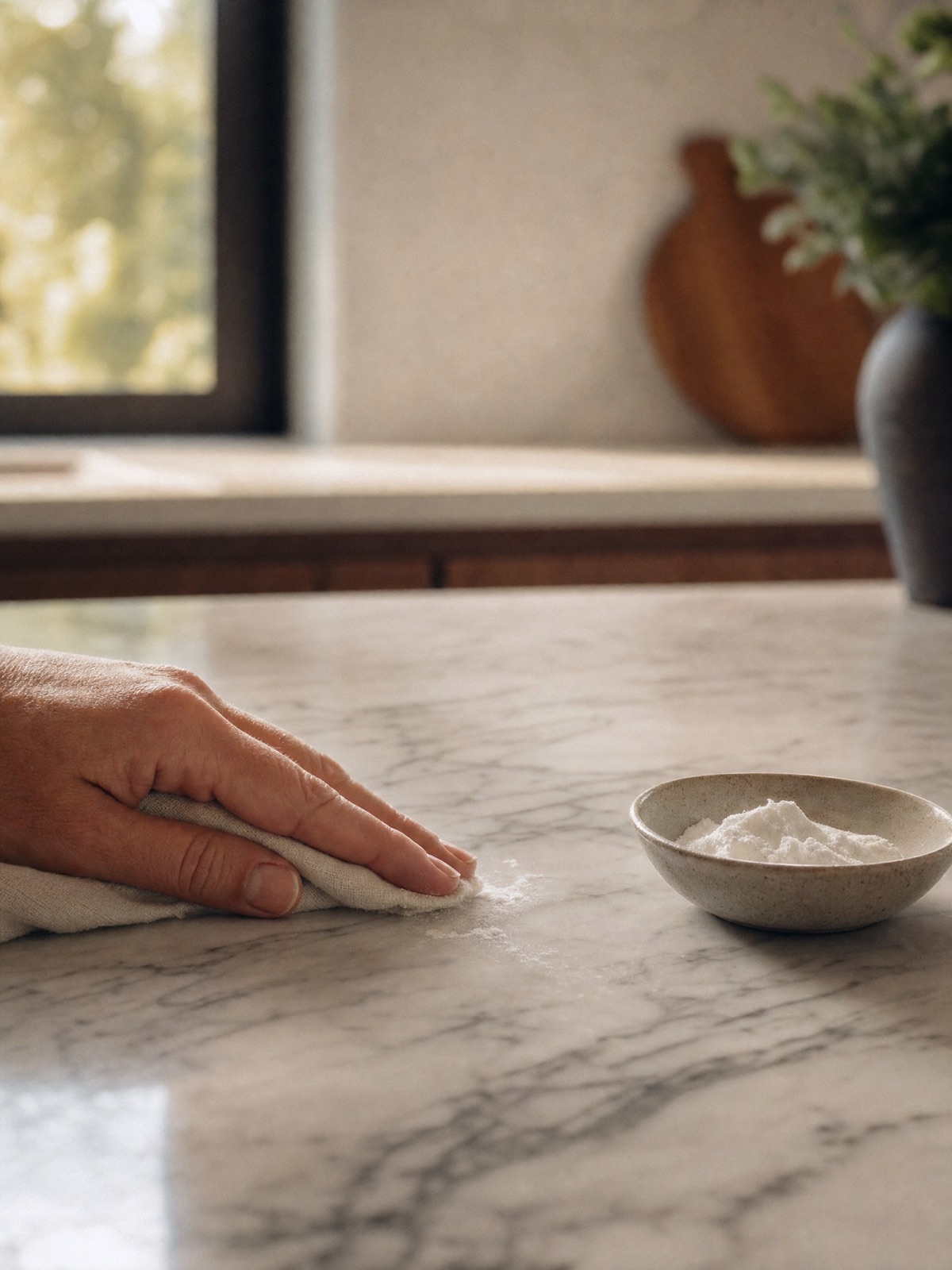
How to Remove Etching from Marble Countertops
If your polished marble has a dull, cloudy patch where a glass of wine, a lemon, or a splash of cleaner sat, you almost certainly have an etch, not a stain — and the good news is that a light etch is often fixable at home. Etching is the most common marble complaint we hear from Metro Vancouver homeowners, and most of the time it is a cosmetic surface issue rather than damage to the stone’s structure. This guide shows you how to confirm you are dealing with an etch, restore a light one yourself with a marble polishing powder, and recognise when an etch is deep enough that it needs professional refinishing.
First, confirm it is an etch and not a stain
This matters because the fixes are opposite, and using the wrong one wastes effort. Marble has two separate problems:
- An etch is chemical damage to the surface. Acid — wine, citrus, vinegar, tomato, many cleaners — has reacted with the calcium carbonate in the marble and dulled the polished finish. An etch is typically lighter than the surrounding stone, looks dull or cloudy, and you can often feel a slight change in texture when you run a finger over it.
- A stain is absorbed liquid sitting in the pores beneath the surface. A stain is typically darker than the surrounding stone, and the surface feels smooth and even over it.
The shorthand: lighter and you can feel it equals an etch; darker and you cannot feel it equals a stain. Polishing powder fixes an etch by restoring the lost sheen. A stain needs a poultice instead, which we cover in our guide on removing wine, coffee, and acid stains. If a single spill left both a dull spot and a dark mark, treat the stain first, then re-polish the etch.
What you’ll need
- A marble polishing powder / etch remover formulated for calcite-based stone. One option sometimes named is MB-11, though availability varies in Canada — a local stone-care supplier can point you to an equivalent if a big-box store does not stock it.
- A few soft, clean cloths (microfibre or cotton)
- Clean water in a small container or spray bottle
- A pH-neutral stone cleaner or mild dish soap, to clean the area first
- Optional: a soft, damp buffing pad if the product directions call for one
That is all a light etch repair takes. You do not need acid, you do not need a power tool, and you should not improvise with household abrasives — scouring powder will scratch the marble and make things worse.
Step-by-step: removing a light etch from marble
- Clean the etched area. Wipe the spot and the surrounding stone with a pH-neutral stone cleaner or a few drops of mild dish soap in warm water, then dry it with a clean cloth. You want the surface free of grease, food residue, and cleaner film so the polishing powder works on the marble, not on the grime.
- Confirm the etch is shallow. Look at the mark in raking light (light coming across the surface at an angle). A light etch is a loss of gloss with little or no pitting you can catch a fingernail in. If the spot is deeply pitted, rough, or large, stop here — that is a job for a professional, covered below.
- Read the polishing powder’s directions. Products vary, so follow the label for how much to use and whether to apply it to a dry or damp surface. The general method that follows is typical, but the label wins if it differs.
- Apply a small amount of polishing powder. Sprinkle a modest amount of powder directly onto the etched spot, or onto a damp cloth, as the directions specify. A little goes a long way; you can always add more.
- Buff the powder into the etch. Using a damp soft cloth (or the recommended buffing pad), work the powder into the dulled area with firm, small, circular motions. Keep the cloth slightly damp. As you buff, the powder gently re-hones and re-polishes the surface, bringing the sheen back toward the surrounding stone. This usually takes a few minutes of steady buffing.
- Wipe and inspect. Wipe away the powder residue with a clean damp cloth and dry the area. Check it again in raking light. The dull patch should be noticeably closer to the surrounding gloss.
- Repeat if needed. A faint remaining haze often clears with a second pass. Re-apply a small amount of powder and buff again. Light etches frequently take two or three rounds to blend in fully.
- Clean up and consider resealing. Once the etch has blended, give the area a final wipe with stone cleaner and dry it. Polishing does not remove your sealer in any meaningful way, but if the spot was etched it may also be a good moment to check the seal nearby with the water-bead test (see our countertop sealing guide) and reseal if water no longer beads.
Work on a small area at a time, and resist the urge to over-buff a large surrounding zone “to match” — you want to lift the etch, not re-polish half the counter.
What to avoid
- Do not use vinegar, lemon, or any acid to “clean” the etch first. Acid is what caused the etch; more acid deepens it. Marble is calcareous and reacts with acid.
- Do not reach for scouring powder, Comet-type cleansers, or rough scrub pads. They scratch polished marble and create a wider dull zone.
- Do not use polishing powder on a stain. If the mark is darker and smooth, it is absorbed liquid — buffing the surface will not lift colour out of the pores. Use a poultice instead.
- Do not attempt to DIY a deep or large etch. Aggressive home buffing of a deep etch can leave an uneven, visibly re-worked patch that is harder for a pro to correct.
- Do not over-wet the marble for long periods. Keep the cloth damp, not soaking; wipe up excess water as you go.
When a light fix is not enough: deep and widespread etching
Polishing powder is designed for small, shallow etches. Some etching is beyond it, and trying to force a home fix can make a professional’s job harder. Call a stone restoration professional when:
- The etch is deep or pitted — you can feel a real divot, not just a loss of gloss.
- Etching is large or covers much of the surface — for example, a whole zone around a sink or prep area that has dulled over years. Restoring an even finish across a large area requires professional honing and polishing equipment that blends the whole surface, not just one spot.
- You have tried polishing powder two or three times and the dull mark will not blend in.
- The marble also has chips, cracks, or an uneven seam (lippage) alongside the etching — those are structural repairs, not a polishing job.
- You want the finish changed to honed so it stops showing etches in future — a sensible move for a heavily used kitchen, and one only a pro can do evenly.
Professional refinishing mechanically re-hones and repolishes the marble, removing a thin, even layer across the surface to bring back a uniform finish. It is the right answer for damage a polishing powder cannot reach, and it can make a tired marble surface look effectively new.
Etching and marble in Metro Vancouver
A quick local note: do not let anyone blame your etching on Vancouver’s water. Metro Vancouver’s tap water is very soft, drawn from mountain reservoirs, and soft water neither causes nor cures marble etching. Etching is acid chemistry — the lemon, wine, vinegar, or cleaner that touched the stone — and abrasion. So the prevention that actually works is behavioural, not a water filter: clean only with pH-neutral products, blot acidic spills promptly, and use boards and trivets. If your marble is in a busy kitchen and etches faster than you would like, a honed finish hides it far better than a polished one. We talk this through with marble clients, because the right finish prevents most etching frustration before it starts.
When to call a professional
To summarise: a small, shallow etch on polished marble is a reasonable DIY repair with a marble polishing powder and a few minutes of patient buffing. Bring in a professional for deep or widespread etching, etches that will not blend after a couple of attempts, any accompanying chips or cracks, or a finish change. As a fabricator, Alpine can advise whether your situation calls for refinishing, repair, or — in the worst cases — replacement, and we would rather give you that honest assessment than watch a fixable surface get over-worked.
Frequently asked questions
How do I know if it is an etch or a stain?
Look at the colour and feel the surface. An etch is usually lighter than the surrounding marble, looks dull or cloudy, and you can often feel a slight change in texture. A stain is usually darker, and the surface feels smooth and even over it. Lighter and you can feel it means an etch (fix it with polishing powder); darker and smooth means a stain (fix it with a poultice). One spill can cause both, in which case you remove the stain first and then re-polish the etch.
Will marble polishing powder remove a deep etch?
Not reliably. Polishing powder is made for light, shallow etches — a loss of gloss without significant pitting. A deep etch you can feel as a divot, or etching spread across a large area, needs professional honing and repolishing to restore an even finish. Forcing a home fix on a deep etch often leaves an uneven, visibly re-worked patch, so it is better to call a stone restoration pro for those.
Can I use a regular metal polish or car polish instead?
No. Use a polishing powder formulated for marble or other calcite-based stone. Generic metal and automotive polishes are not designed for the chemistry of calcareous stone and may contain abrasives or compounds that dull or damage the surface further. If you cannot find a marble-specific product locally, a stone-care supplier can recommend the right one rather than a household substitute.
Does removing an etch wear away the marble?
Polishing powder removes only an extremely thin, microscopic layer as it re-hones the dulled spot back to a shine, so for the occasional light etch the effect on the slab is negligible over a lifetime. Professional refinishing removes a slightly more substantial even layer across the surface, but marble countertops are thick and can be refinished multiple times over their life. Neither process meaningfully shortens the life of the stone for normal household use.
This guide is part of our Marble Countertop Care Guide →, which explains the full etch-versus-stain picture, daily cleaning, sealing, and where marble works best in a Metro Vancouver home.
Get help from Alpine
If your marble etching is more than a quick buff can handle, or you would rather have it assessed before you start, call 604-630-5700 or email info@alpinecountertops.com. We will give you a straight answer on whether it is a refinish, a repair, or a replacement, and help you protect the surface going forward. You can also reach us through our contact page.