
The Water Bead Test: Does Your Countertop Need Resealing?
If you own natural stone, you have probably wondered whether it is time to reseal — and run into wildly different advice online, from every six months to every five years. The good news is you do not have to guess or trust a calendar. There is a free, two-minute test that tells you exactly what your stone needs right now: the water bead test. Drip a little water on the counter and watch what it does. This guide shows you how to run the test properly, how to read the result, which countertops to test (and which to skip entirely), and what to do next.
What you’ll need
- A few tablespoons of plain tap water (or a small glass of water).
- A clean, dry cloth to wipe the test area first.
- A clock or your phone to time a few minutes.
- Good light, so you can clearly see whether the stone darkens.
That is genuinely all. No special products, no chemicals.
Step-by-step: the water bead test
- Pick a high-use spot. Test where the sealer wears first — usually the area right around the sink or your main food-prep zone. These spots get the most wiping, scrubbing, and spills, so they lose their seal before the quieter corners of the counter do.
- Clean and dry the area. Wipe the test spot with a dry cloth so the surface is clean and dry to start. You want to watch water behave on the stone itself, not on residue.
- Drip a few small drops of water. Place several separate drops, or a small splash about the size of a coin, onto the stone. Keep it modest — you only need enough to watch.
- Wait three to five minutes. Leave the water undisturbed and let it sit. This waiting period is the whole test — absorption takes a few minutes to show.
- Read the result. Look closely at the water and the stone underneath it (see the next section).
- Test a second spot to confirm. Repeat in another well-used area. Seal can wear unevenly, so checking two or three spots gives you a truer picture than a single test.
How to read the result
There are two clear outcomes, and they point in opposite directions.
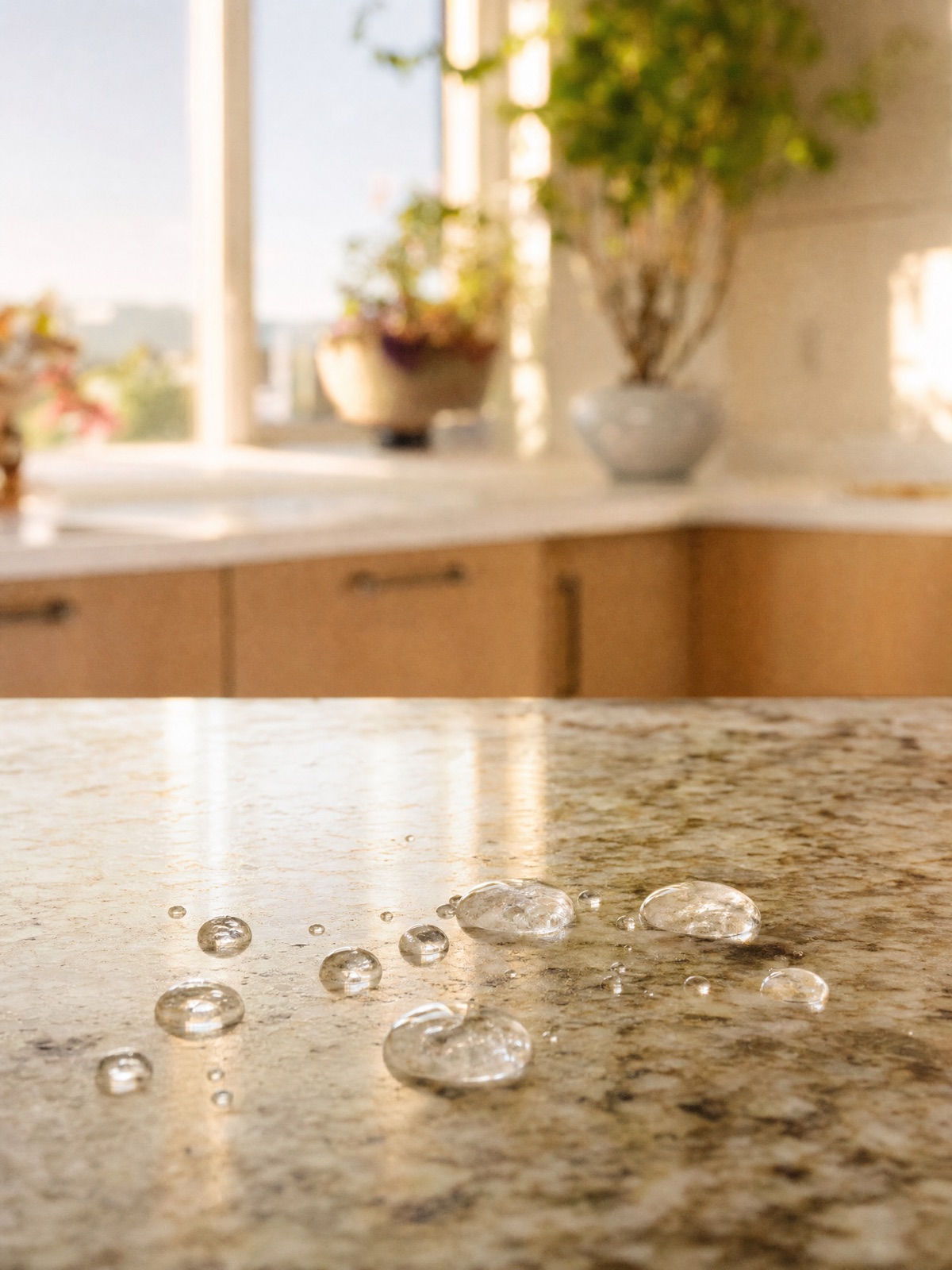
- The water beads up or sits on top, and the stone stays the same colour. Your seal is intact and doing its job. The pores are still lined, so liquid cannot soak in. You do not need to reseal yet — just retest in a few months.
- The water soaks in and the stone darkens where the drops sat. The stone is absorbing, which means the seal has worn thin or failed in that area. It is time to reseal. The dark patch is harmless and almost always fades back to normal as the water evaporates — it is simply the visible sign of absorption.
A quick way to remember it: beads = sealed; darkens = reseal. If you get a mixed result — water beads in one spot but absorbs near the sink — treat the stone as needing attention in the worn area; you can reseal the whole surface for consistency.
Which countertops to test (and which to skip)
The water bead test is only meaningful on porous natural stone. Knowing which materials to test saves you from worrying about surfaces that never need sealing.
- Test these: granite, marble, quartzite, and natural stone generally (limestone, travertine, slate, soapstone). These are porous and rely on a sealer to slow absorption.
- Skip these — they never need sealing: engineered quartz (Caesarstone, Cambria, Silestone, HanStone and similar) and porcelain or sintered slabs such as Dekton. These are non-porous. Cambria states outright that its quartz never requires sealing. On a quartz counter the water will simply bead because the surface is naturally non-porous — not because of any sealer — so the test tells you nothing actionable. Do not seal these materials.
One important note for marble owners: the water bead test checks for staining risk (absorbed liquid), not etching. Etching is acid dulling the polished surface — a separate, chemical problem that sealing does not prevent. A marble counter can pass the water bead test perfectly and still etch from a slice of lemon. So use this test to decide on resealing, but understand it does not measure acid resistance.
What to do next
If your stone passed (water beads), you are done — note the date and plan to retest in a few months. If your stone failed (water absorbs), reseal it with a penetrating impregnating sealer. The full procedure — clean, dry, apply, dwell, wipe, buff, cure — is in our step-by-step guide on how to seal granite countertops, which works for quartzite and marble too. For products you can actually buy here and where to find them, see the best stone cleaners and sealers in Canada.
A note for Vancouver and the Fraser Valley
How often should you run this test? Every few months is plenty for a busy kitchen. We will be honest about the local angle: Metro Vancouver’s damp, mild climate does not dramatically speed up how fast a sealer wears — daily use and acidic spills do that, not humidity. So base your resealing on what the test shows, not on the season or the weather. Many homeowners simply test at a memorable time of year, such as spring cleaning, as a reminder. Metro Vancouver tap water is also very soft (about 2.5 to 4.8 mg/L as calcium carbonate from the Capilano, Seymour, and Coquitlam reservoirs), so it leaves little mineral residue and does not interfere with the test.
When to call a professional
If your test fails and resealing is not something you want to tackle, or if you are unsure whether you are looking at a worn seal, a stain, or an etch, Alpine can help. We seal natural stone as part of every installation, and we can reseal counters we have access to. We can also tell you in person whether your real issue is absorption (reseal), a trapped stain (poultice), or acid etching on marble (honing or polishing) — three different problems with three different fixes. Alpine works across Metro Vancouver and the Fraser Valley.
Frequently asked questions
How often should I do the water bead test?
Every few months is sensible for a kitchen in regular use, focusing on the area around the sink where sealer wears first. There is no need to test daily or weekly. Running it at a memorable time, such as spring cleaning, makes it easy to remember.
The water darkened the stone — did I damage it?
No. The dark patch is simply absorbed water and is harmless; it almost always fades back to the stone’s normal colour as the water evaporates. What it tells you is that the seal has worn thin in that spot and the stone is ready to be resealed.
Should I do the water bead test on my quartz counter?
There is no point. Engineered quartz is non-porous and never needs sealing, so water will bead on it regardless of any sealer. The test only gives you actionable information on porous natural stone like granite, marble, and quartzite. The same applies to porcelain slabs — do not test or seal them.
My marble passed the test but still gets dull marks — why?
Those dull marks are almost certainly etching, not staining. Etching is a chemical reaction between acids (lemon, vinegar, wine, some cleaners) and the calcium carbonate in marble that dulls the polished surface. The water bead test measures absorption (staining risk), not acid resistance, and sealing does not prevent etching. Etch marks are corrected by honing or polishing, not by resealing.
This guide is part of our Countertop Sealing Guide. Next, see how to seal granite countertops step by step, or our marble countertop care guide for the etching question in depth.
Get help from Alpine
Not sure what your test result means, or want a professional to handle resealing? Alpine Countertops has fabricated and installed stone across Metro Vancouver since 2015 and is BBB A+ accredited. Call 604-630-5700 or email info@alpinecountertops.com, or reach us through our contact page.