
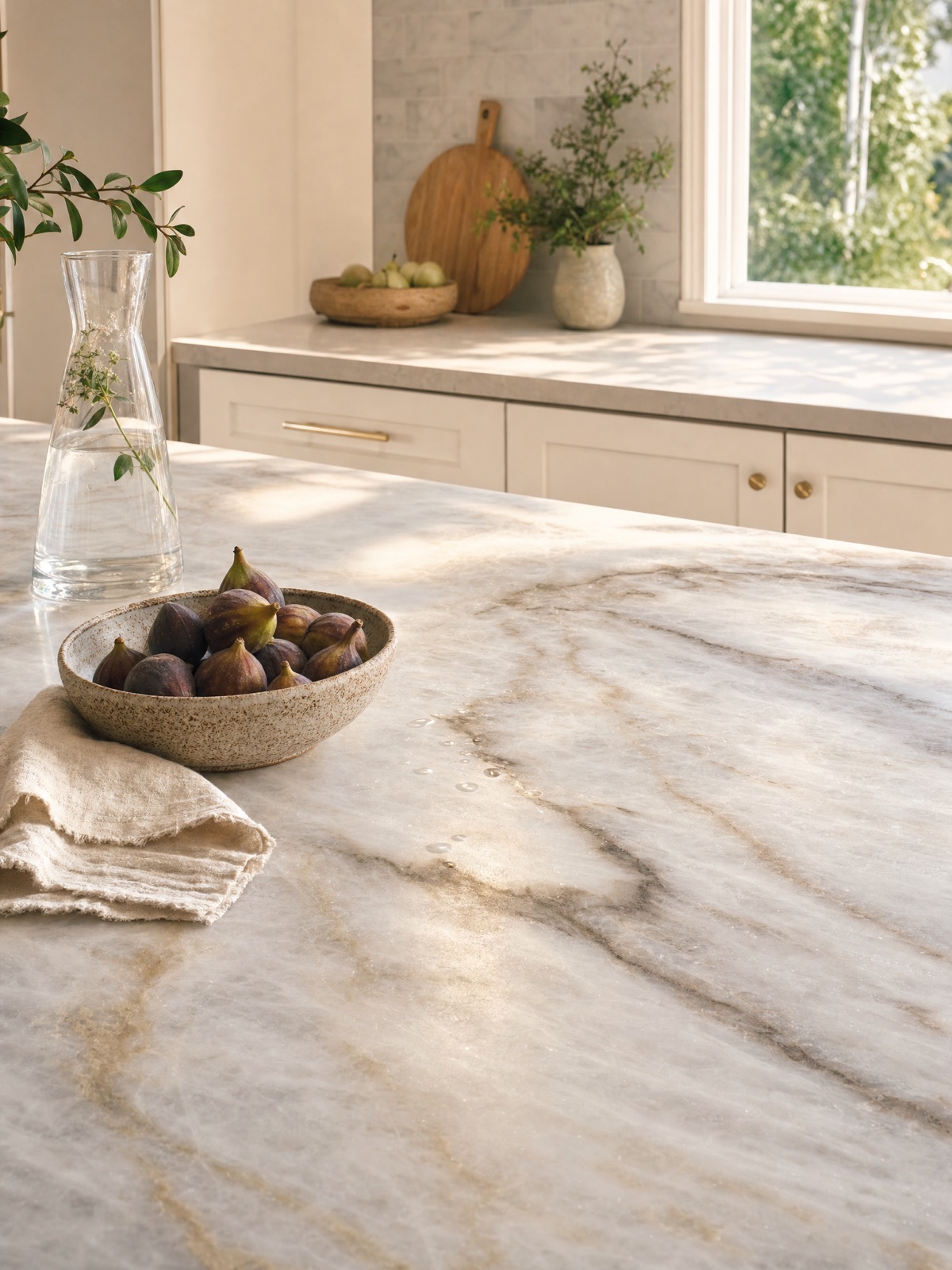
Quartzite vs Quartz Countertops: Natural Stone vs Engineered (the Difference Most People Miss)
Quick answer: Despite the near-identical names, quartzite and quartz are completely different products. Quartzite is 100% natural stone quarried from the earth; quartz is engineered — ground stone bound with resin and pigments in a factory. Quartzite is harder and far more heat-tolerant; quartz is non-porous, never needs sealing, and offers totally consistent colour. Choose quartzite for natural beauty, heat resistance and a one-of-a-kind marble look; choose quartz for low-maintenance, uniform, worry-free surfaces. One isn’t “better” — they suit different priorities.
This is the single most common mix-up we hear at Alpine Countertops. Customers walk into our Richmond shop asking for “quartz” when they mean the natural marble-look stone, or assume the two are the same because the words sound alike. They aren’t. Getting this straight before you shop saves real money and disappointment, so let’s clear it up.
Last updated: June 2026
Quartzite vs quartz: natural vs engineered, explained first
Here’s the core distinction in plain terms:
- Quartzite is a natural metamorphic rock. Sandstone gets buried, heated and compressed over geological time until its quartz grains recrystallize into a dense, solid stone. It’s cut straight from a quarry into slabs — nothing is added.
- Quartz (the countertop) is an engineered/manmade material. Manufacturers engineer it from ground/crushed stone (predominantly quartz) bound with polymer resin and pigments, pressing it into uniform slabs. The familiar brand names — Caesarstone, Cambria, Silestone, Vicostone, HanStone, all of which we fabricate — are engineered quartz.
So “quartz” the countertop is a product; “quartzite” is a rock. They share the word because engineered quartz is made predominantly of quartz mineral — but the resin binder changes how it behaves. Everything below follows from that one fact.
Quartzite vs quartz at a glance
Cost figures below are typical Metro Vancouver installed ranges; exotic/premium slabs and complex fabrication run higher — request a quote.
| Dimension | Quartzite (natural stone) | Quartz (engineered) |
|---|---|---|
| Origin | Quarried natural metamorphic rock | Factory-made: ground stone + resin + pigment |
| Look | Unique, natural veining; marble-like; every slab differs | Highly consistent; can mimic marble or solid colours |
| Hardness | Very hard (Mohs ~7–8); resin-free | Hard (Mohs ~7), but resin makes the finished surface behave slightly softer than solid quartzite |
| Heat resistance | Highly heat-resistant — tolerates hot cookware set briefly on the surface | Heat-sensitive — the polymer-resin binder can scorch, discolour or crack from hot pans; damage is usually permanent |
| Porosity | Natural stone; dense; benefits from periodic sealing | Non-porous; never needs sealing |
| Stain resistance | Good when sealed | Excellent — non-porous surface resists staining |
| UV / outdoor use | UV-stable; suitable outdoors (sealed/maintained) | Resin yellows/fades under sustained direct UV; manufacturers void the warranty for outdoor installation |
| Maintenance | Seal periodically (~every 1–2 years); mild soap & water | No sealing; mild soap & water; avoid abrasives |
| Cost (installed, Metro Van) | ~$110–$180/sq ft (rare exotics higher) | ~$70–$120/sq ft |
| Best for | Heat tolerance, natural beauty, marble look, cooks | Low maintenance, consistent colour, no sealing |
Which is more heat resistant, quartzite or quartz?
Quartzite, clearly. Because quartzite is solid natural stone with no resin, it’s highly heat-resistant and tolerates hot cookware set briefly on the surface. Engineered quartz is the exception among hard countertop surfaces: its polymer-resin binder is heat-sensitive, so a pan straight off the burner can scorch, discolour or crack it — damage that is usually permanent. Caesarstone (the manufacturer) states quartz is “heat resistant, not heat proof,” that the resin withstands only around 150°F (≈65°C), and advises using hot pads or trivets.
This is one of the biggest practical reasons serious home cooks choose quartzite. That said, we recommend trivets on every countertop, including quartzite — protecting the sealer and avoiding repeated thermal shock is just good practice.
Which needs less maintenance?
Quartz wins on pure convenience. Because it’s non-porous, engineered quartz never needs sealing and resists staining out of the box — wipe it with mild soap and water and you’re done. (For day-to-day tips see how to clean quartz countertops.)
Quartzite is natural stone, so it benefits from periodic sealing to keep liquids from soaking in — it’s very dense, so roughly every 1–2 years is typical depending on the slab and sealer. It’s not difficult, but it’s a real difference if you want a truly hands-off surface. Our sealing guide walks through it.
How do they compare on looks?
Both can give you a marble-inspired look, but the character differs. Quartzite is natural, so every slab is unique, with organic veining and depth you can’t fully replicate. Quartz is engineered for consistency — if you want a predictable, uniform pattern across a big island with no surprises, that’s a genuine advantage. Quartz patterns have come a long way, but a discerning eye can still tell printed-resin veining from the real thing.
There’s also a practical seam consideration. Because quartz slabs are manufactured to a consistent pattern, seams can sometimes be matched very cleanly. With quartzite, we book-match or vein-match natural slabs — done well, the result is stunning, but it takes a fabricator who plans the layout around the stone’s movement. This is one reason slab selection in person matters so much with quartzite: you’re choosing the actual veining that will run across your island.
Which is more scratch resistant?
Quartzite has the edge. Its quartz-rich, resin-free structure rates around 7–8 on the Mohs scale, slightly harder than engineered quartz (around 7), whose resin content makes the finished surface behave a touch softer. In everyday terms both resist scratching well from normal kitchen use, and you shouldn’t cut directly on either surface — it dulls knives and isn’t hygienic. One nuance with quartz: abrasive pads and scouring cleaners can dull or scratch its finish over time, so stick to non-abrasive cleaning on both.
Quartzite vs quartz on cost
Quartz spans a wide range depending on brand and series, and is often the more predictable spend. Quartzite usually carries a premium, especially for sought-after whites and rare blues. The bigger long-term difference is maintenance: quartz has effectively zero sealing cost; quartzite has a small periodic one. These are planning ranges — typical Metro Vancouver installed costs, with exotic/premium slabs and complex fabrication running higher — so request a quote for your project. For full local pricing, see our quartzite cost guide, the existing quartz cost guide, and our all-material cost comparison.
Which should you choose?
- Choose quartzite if you cook a lot and value heat resistance, you want genuine natural-stone beauty and a unique slab, or you’re after that authentic marble look in a tough surface.
- Choose quartz if you want the lowest-maintenance option (no sealing, ever), highly consistent colour across large runs, or maximum stain resistance for a busy family kitchen.
- Skip quartz for outdoor kitchens — its resin yellows/fades under sustained direct UV, and manufacturers void the warranty for outdoor installation. Quartzite (or another natural stone) is the better outdoor pick.
A quick word on Metro Vancouver kitchens specifically: many of the homes we work in — from Richmond condos to North Shore family kitchens — pair a bright, open layout with serious cooking. That combination is where the choice gets interesting. If your kitchen is a showpiece you cook in constantly, quartzite’s heat tolerance and natural depth shine. If it’s a busy rental, a young family’s first home, or simply a space where you’d rather never think about maintenance, quartz’s non-porous, no-seal convenience is hard to beat. Neither choice is wrong; they reward different priorities.
Comparing quartz against other stones too? Our existing quartz vs granite guide covers that head-to-head, and the complete materials guide lines up every option.
Frequently asked questions
Is quartzite the same as quartz?
No. Quartzite is 100% natural stone quarried from the earth. Quartz countertops are engineered in a factory from ground stone bound with resin. The names are similar, but they are different products that look and behave differently.
Is quartzite or quartz more durable?
Quartzite is harder (Mohs ~7–8) and far more heat-resistant. Quartz is non-porous and very stain-resistant. Both are durable; quartzite wins on heat and hardness, quartz wins on stain resistance and zero maintenance.
Does quartz need to be sealed?
No. Engineered quartz is non-porous and never needs sealing. Quartzite, being natural stone, benefits from periodic sealing roughly every 1–2 years.
Can you put hot pans on quartz countertops?
It’s risky. The polymer resin in engineered quartz is heat-sensitive and can scorch, discolour or crack from direct heat, and the damage is usually permanent. Caesarstone advises using a hot pad or trivet. Quartzite tolerates heat much better, but trivets are still wise on any surface.
Why is quartzite often more expensive than quartz?
Quartzite is a hard natural stone that is more difficult to quarry and fabricate, and the most in-demand whites and blues are scarce. Engineered quartz is produced in controlled factory runs, so pricing is often more predictable.
Not sure which is right? Ask Alpine
Alpine Countertops fabricates both natural quartzite and engineered quartz from our Richmond facility, serving Metro Vancouver and the Fraser Valley since 2015 (BBB A+). We’ll show you real slabs of each so you can feel the difference before deciding. Call 604-630-5700, email info@alpinecountertops.com, or contact us to book a visit. See more on our quartz countertops and Vancouver countertops pages.
Last updated: June 2026