
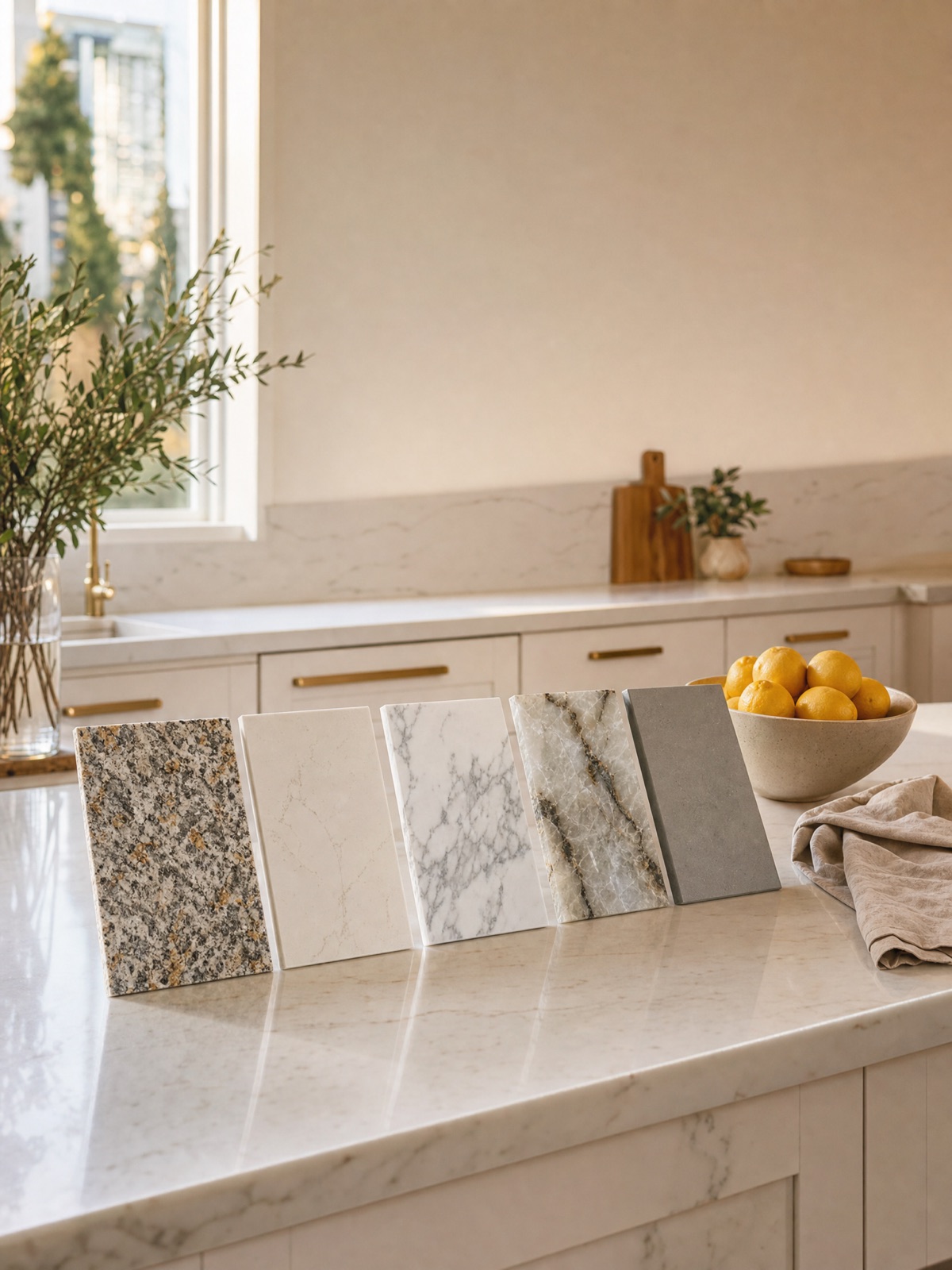
Countertop Materials Compared: The Complete Guide (2026)
Quick answer: The five countertop materials worth comparing are granite, engineered quartz, marble, quartzite, and porcelain (sintered stone). In short: quartz is the low-maintenance all-rounder, granite the durable budget-friendly natural stone, marble the luxury statement that etches, quartzite the toughest natural stone with a marble-like look, and porcelain the heat- and UV-proof choice for outdoor and sunny kitchens. The master table below compares all five across look, durability, maintenance, heat, cost, lifespan, and best use — and links to a head-to-head deep dive for every pairing.
Last updated: June 2026.
We have fabricated and installed all five of these surfaces from our Richmond shop since 2015, for kitchens and baths across Metro Vancouver and the Fraser Valley. This is our complete, no-spin comparison — the same framework we use to guide clients through a decision that, done right, lasts decades. We do not crown a single winner, because the best material genuinely depends on your priorities, your cooking habits, your light, and your budget. What we can do is lay out exactly how each material behaves so you can match it to your kitchen with confidence.
Countertop materials master comparison table
This is the side-by-side overview. Ratings are relative and reflect typical slab behaviour, not any single product. Cost tiers reflect installed pricing in the Metro Vancouver market as of 2026 and vary with slab grade, edge profile, square footage, and complexity — see our Vancouver countertop cost comparison for full ranges.
| Material | Look | Durability | Maintenance | Heat resistance | Cost tier (installed) | Lifespan | Best for |
|---|---|---|---|---|---|---|---|
| Quartz (engineered) | Consistent, wide colour range; can mimic marble | Very good; scratch- & stain-resistant | Low — non-porous, never seal | Fair (resin scorches) | $$–$$$ | 15–25 yrs | Low-maintenance family kitchens |
| Granite | Natural, varied; flecked to bold movement | Very good; hard & heat-tolerant | Moderate — seal periodically | Excellent | $$–$$$ | 30–100 yrs | Durable natural stone on a budget |
| Marble | Bright, soft, luxurious veining | Fair; soft, stains & etches | High — seal often, accept patina | Very good | $$$–$$$$ | 20–50+ yrs | Luxury look, lower-traffic surfaces |
| Quartzite | Marble-like brightness & veining, natural | Excellent; hardest stone, no etching | Moderate — seal every 1–2 yrs | Excellent | $$$–$$$$ | 30–100+ yrs | Heavy cooks who want the marble look |
| Porcelain (sintered) | Ultra-consistent; stone, concrete & matte looks | Very good; UV & heat proof, thin edges chip | Low — non-porous, never seal | Excellent | $$$–$$$$ | Decades | Outdoor & sunny kitchens |
Cost tiers above are relative ($$–$$$$), not dollar figures — precise Metro Vancouver $/sq-ft ranges, with sources and assumptions, live in our cost comparison pillar, because real pricing is always project-specific.
How do the materials differ on look?
Natural stones — granite, marble, and quartzite — give you one-of-a-kind slabs with real geological movement; no two are identical, which is the appeal for many homeowners. Marble and white quartzite share that bright, soft, veined elegance that reads “luxury.” Granite ranges from subtle flecked patterns to bold, dramatic movement.
Engineered surfaces — quartz and porcelain — offer consistency and predictability. Quartz comes in a vast, controlled colour palette and can convincingly imitate marble veining while staying uniform slab to slab. Porcelain (sintered stone) extends that into stone, concrete, and ultra-matte looks, often with the pattern printed and fired into the surface. If you want exactly what you saw in the showroom with no surprises, engineered wins; if you want a natural, unrepeatable slab, stone wins.
Natural stone vs engineered surfaces: the first real decision
Before you compare individual materials, it helps to split them into two camps, because they behave differently as a category. Natural stones — granite, marble, and quartzite — are quarried slabs cut straight from the earth. Each is unique, they are generally heat- and UV-stable, and they are porous to varying degrees, so they need sealing. Engineered surfaces — quartz and porcelain — are manufactured: quartz binds ground stone with polymer resin, while porcelain is mineral clay and stone fired at extreme temperature. Engineered surfaces are non-porous and consistent, but quartz pays for that with weaker heat and UV tolerance because of its resin.
For many Metro Vancouver homeowners the decision starts here. If you want a one-of-a-kind slab and don’t mind periodic sealing, natural stone is your lane. If you want predictability, no sealing, and a precise colour match to your cabinets, engineered is your lane. From there, the specific material follows from your priorities on durability, looks, and budget.
How do they compare on durability?
Durability is really five properties — heat, scratch, stain, chip, and UV resistance — and the materials rank differently on each. We break this down fully in our most durable countertop material guide, but the headlines:
- Hardest / most scratch-resistant: quartzite (Mohs ~7–8), then quartz, porcelain, and granite (~6–7). Marble is soft (~3–5) and scratches easily.
- Most heat-resistant: porcelain, quartzite, and granite all take a hot pan. Quartz is the weak link — its resin can scorch. Marble is solid stone but can suffer thermal shock.
- Most stain-resistant: non-porous quartz and porcelain top the list; sealed granite and quartzite do well; marble is the most stain-prone.
- Acid etching: only marble etches readily from kitchen acids. True quartzite is chemically inert and does not etch — the key reason heavy cooks pick it over marble.
- UV stability: the natural stones and porcelain are sun-stable; quartz is not, and should not be used outdoors or in sustained direct sun.
How much maintenance does each need?
Lowest maintenance: engineered quartz and porcelain are non-porous and never need sealing — mild soap and water is the whole routine. Moderate: granite and quartzite are natural stones that should be sealed periodically (roughly every 1–2 years for both, depending on the slab’s porosity) to resist staining; we seal them before install. Highest: marble needs frequent sealing against staining, and you must also accept that it will etch and develop patina over time regardless of sealing.
For step-by-step care, see our dedicated guides: quartz care, granite care, marble care, and our countertop sealing guide.
What about cost?
Installed cost in Metro Vancouver depends far more on slab grade, edge profile, square footage, cutouts, and job complexity than on the material name alone — a premium “exotic” granite can cost more than an entry quartz, and vice versa. As a rough ordering, standard-colour granite and entry quartz tend to be the most budget-friendly, mid-range quartz sits in the middle, and quartzite, marble, and porcelain run toward the premium end. We publish current BC ranges by material in our Vancouver countertop cost comparison pillar rather than quoting single numbers here, because real pricing is always project-specific.
How long does each material last?
All five can last decades when fabricated and cared for well. Natural quartzite and granite are the longest-lived — commonly 30 to 100 years — because they are extremely hard geological stone. Porcelain is a very stable, long-lasting surface. Engineered quartz typically lasts 15 to 25 years. Marble lasts 20 to 50+ years but shows its age (patina, etching) more visibly along the way, which for some homeowners is the charm and for others is the dealbreaker.
Edges, finishes, and seams: where fabrication matters
The material is only half the result — how it is fabricated determines how the finished kitchen looks and lasts. A few things we talk through with every client:
- Edge profiles: all five materials can take a clean eased or square edge; thicker mitred edges (for a chunky “waterfall” island look) are popular in Vancouver and add labour. Marble and porcelain need extra care at delicate edges — marble because it is soft, porcelain because thin slabs are chip-prone.
- Finishes: polished is standard, but honed (matte) and leathered finishes are increasingly requested. Honed marble hides etching better than polished marble; leathered granite and quartzite hide fingerprints and water spots.
- Seams: larger kitchens and islands often need a seam. Engineered quartz and porcelain seam very discreetly thanks to colour consistency; natural stone seams require matching the slab’s movement, which is a fabricator’s craft. Condo access and elevator constraints in Vancouver can also force a seam where a single slab won’t fit.
This is exactly where a local fabricator earns its place over a big-box order — slab selection, seam placement, and edge detailing are decided in person, on your actual material.
Which material fits a Vancouver home?
A few Lower Mainland realities shift the recommendation:
- Bright, south-facing rooms and skylit islands are common in newer Vancouver builds. Ordinary sunny windows are fine for quartz, but where a surface gets sustained, direct sun — an unshaded skylit island or all-day exposure — favour a UV-stable stone or porcelain instead.
- Outdoor kitchens on Lower Mainland patios are a growing trend — porcelain is the only one of these five we recommend fully outdoors.
- Condos and character homes bring tight kitchens, elevator limits, and existing cabinetry that affect slab size and seam strategy.
- Coastal humidity is no threat to any sealed or non-porous surface here, but it is one more reason to keep natural stone properly sealed.
We cover the priority-by-priority choice in depth in our best countertop material for a Vancouver kitchen guide.
Compare any two materials head-to-head
Most decisions come down to a specific pairing. We have a dedicated, in-depth comparison for each common match-up — pick the two you are weighing:
- Quartzite vs Granite — two tough natural stones, which is harder and which is better value.
- Quartzite vs Quartz — natural vs engineered; clears up the most common naming confusion.
- Quartzite vs Marble — look-alikes that behave completely differently (etching is the key difference).
- Quartzite Pros & Cons — is quartzite worth it for your kitchen?
- Granite vs Marble — the classic natural-stone decision.
- Porcelain vs Quartz — engineered surfaces compared, with the outdoor/use-case angle.
- Dekton vs Quartz vs Granite — a three-way for Vancouver kitchens.
- Quartz vs Granite (Vancouver) — the two most-installed surfaces, local angle.
- Marble vs Quartz for a Bathroom Vanity — where marble makes more sense.
Still narrowing the field? Our most durable countertop material guide ranks all five on heat, scratch, stain, chip, and UV, and our best countertop material for a Vancouver kitchen guide walks you through the choice by priority (budget, maintenance, luxury, durability, resale).
Which countertop material should you choose?
Match your top priority to the material:
- You want the least upkeep: engineered quartz — non-porous, no sealing, forgiving of spills.
- You want durable natural stone without overspending: granite, especially in standard colours.
- You cook constantly and want a bright, natural look: quartzite — marble’s look, real toughness, no etching.
- You want a true luxury statement and will maintain it: marble — best on islands, baking stations, and lower-traffic surfaces.
- You are building an outdoor or very sunny kitchen: porcelain — UV- and heat-proof.
- You want broad resale appeal: quartz or granite in neutral tones.
Frequently asked questions
What is the best overall countertop material?
There is no single best — it depends on your priority. Engineered quartz is the best all-round low-maintenance choice for most kitchens; quartzite is the most durable natural stone; granite is the best-value natural stone; marble is the luxury look; and porcelain is best for outdoor or sunny spaces. Match the material to how you use your kitchen.
What is the difference between quartz and quartzite?
Quartz is an engineered product — ground/crushed stone (predominantly quartz) bound with polymer resin and pigments — that is non-porous and never needs sealing but is sensitive to heat and UV. Quartzite is a 100% natural stone that is harder, heat-resistant, and UV-stable, but is porous enough to need periodic sealing. They are completely different materials despite the similar name.
Which countertop is the most heat resistant?
Porcelain, quartzite, and granite are the most heat-resistant, since they contain no resin to scorch. Engineered quartz is the least heat-tolerant of the five because its polymer binder can discolour or crack under high heat, so always use a trivet on quartz.
Which countertop does not need sealing?
Engineered quartz and porcelain are non-porous and never need sealing. Granite, quartzite, and marble are natural stones that should be sealed periodically to resist staining.
Which countertop material lasts the longest?
Quartzite and granite last the longest, commonly 30 to 100 years, because they are extremely hard natural stone. Porcelain is also very long-lasting. Quartz typically lasts 15 to 25 years, and marble 20 to 50+ years while showing more patina over time.
Do you fabricate all of these materials in Metro Vancouver?
Yes. We fabricate and install granite, quartz, marble, quartzite, and porcelain from our Richmond facility for homeowners across Vancouver, Burnaby, Richmond, Surrey, the North Shore, and the Fraser Valley.
Get expert help choosing your countertop
Comparing materials on a screen only gets you so far — the right call comes from seeing real slabs in your own kitchen light and talking through seams, edges, and trade-offs with a fabricator. We serve Vancouver, Burnaby, Richmond, Surrey, and North Vancouver, with material-specific pages for quartz, granite, marble, and porcelain. Browse finished projects in our design gallery, check pricing in our cost comparison, or learn upkeep in our product care library.
Ready to start? Contact Alpine Countertops, call 604-630-5700, or email info@alpinecountertops.com for a quote tailored to your project.
Last updated: June 2026.