
How to Clean Marble Countertops Without Etching Them
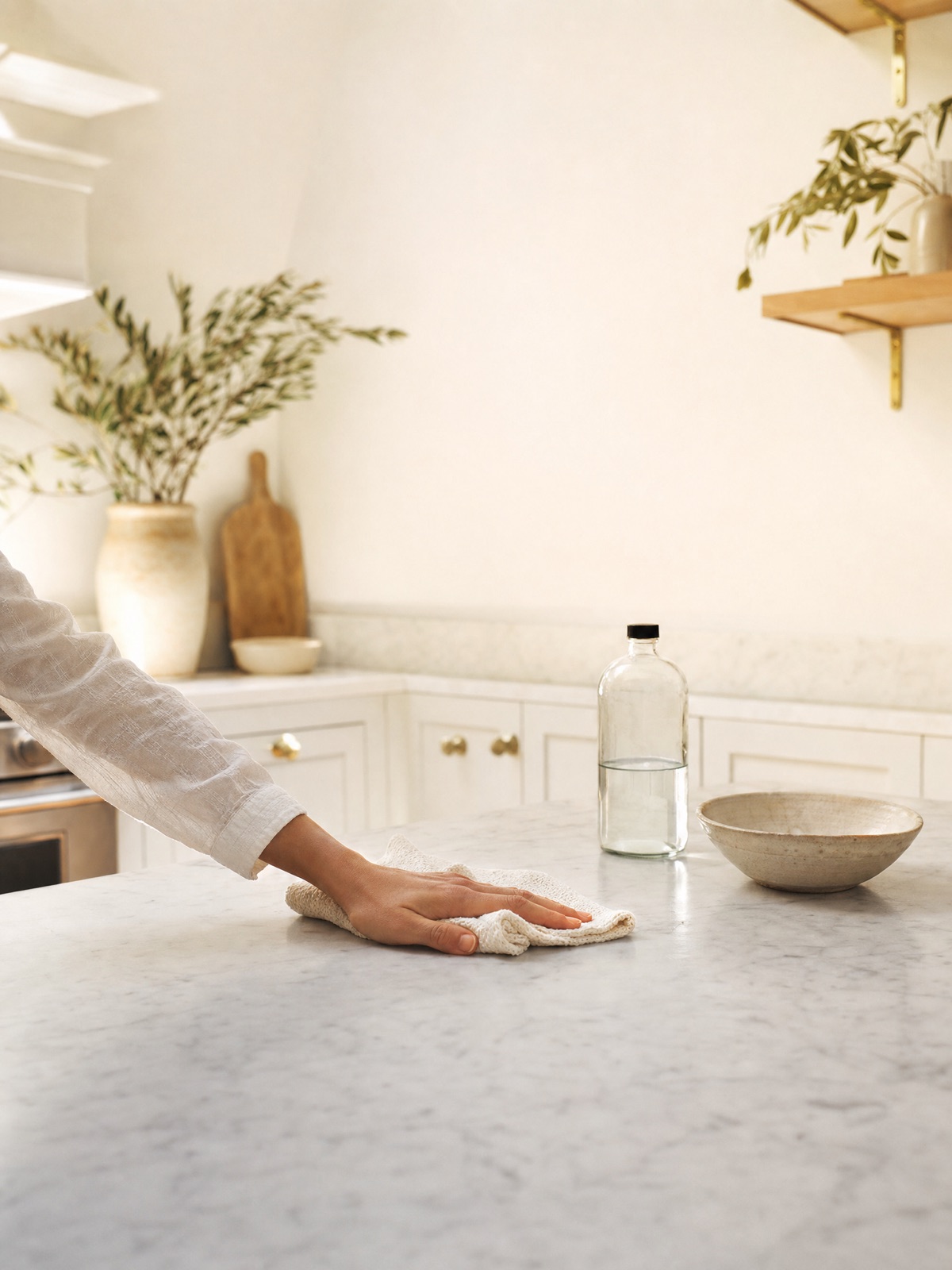
The secret to cleaning marble is that the right routine is almost boringly simple — and most marble damage comes from people making it more complicated than it needs to be. Reach for a “natural” citrus spray, a vinegar rinse, or a bright all-purpose cleaner, and you can dull a polished marble surface in seconds. This guide gives you the safe daily routine for cleaning marble countertops, the short list of products that genuinely harm it, and the habit that prevents most spills from ever becoming a problem. Get these right and your marble stays crisp for years.
Why marble needs special handling
Marble is a calcareous stone — mostly calcium carbonate — which means acid reacts with it. When an acidic liquid or cleaner touches polished marble, it dissolves a microscopically thin layer and leaves a dull, slightly rough spot called an etch. That is different from a stain (absorbed liquid in the pores). Cleaning is where etching is most avoidable, because unlike a surprise wine spill, your cleaning products are entirely within your control. Choose pH-neutral, and etching from cleaning simply does not happen.
What you’ll need
- A pH-neutral stone cleaner, or simply mild dish soap (a few drops is plenty)
- Warm water
- Two soft or microfibre cloths — one to clean, one to dry
- Optional: a soft sponge for stuck-on residue (non-abrasive side only)
In Canada, suitable pH-neutral stone cleaners include Method Daily Granite Cleaner (Home Depot Canada, Amazon.ca) and Weiman Granite & Stone Cleaner (Canadian Tire, Walmart.ca, Amazon.ca). Despite the “granite” branding, these are pH-neutral cleaners formulated for natural stone generally. If you would rather not buy a dedicated product, a few drops of mild dish soap in warm water is exactly what every option below comes down to, and it works.
Step-by-step: cleaning marble safely
- Clear the surface. Move small appliances, boards, and clutter off the counter so you can reach the whole surface, including the area behind the sink and tap where residue collects.
- Mix a mild solution (if using dish soap). Add a few drops of mild dish soap to a bowl of warm water and stir. You want it barely soapy, not sudsy. If you are using a ready-made pH-neutral stone cleaner, follow its label instead.
- Wipe the surface gently. Dampen a soft cloth in the solution (wring it out so it is damp, not dripping) and wipe the marble in even strokes. Let the mild soap do the work; you do not need to scrub.
- Lift any stuck-on residue carefully. For dried food or residue, lay the damp cloth over it for a minute to soften it, then wipe. If you need a little more, use the soft, non-abrasive side of a sponge. Never use a scouring pad or powder.
- Rinse with clean water. Wipe the surface again with a fresh cloth dampened in plain warm water to remove any soap film. Soap film left to dry can leave a hazy cast on polished marble.
- Dry the surface. Buff the marble dry with a second clean, soft cloth. Drying prevents water spotting and leaves the polish looking its best. This step takes seconds and makes a visible difference on a polished finish.
- Spot-check around the sink and tap. These zones see the most water, soap, and toothpaste or food acids, so give them a final look and wipe if needed.
That is the whole routine. Done daily or every couple of days, it keeps marble clean without ever putting it at risk.
The acid blacklist: what never touches marble
These are the products and substances that etch or scratch marble. On marble these are genuinely harmful, not just inferior choices:
- Vinegar — acidic, etches marble. (A couple of quartz brands permit a vinegar-water rinse on their non-porous engineered surfaces; that advice does not transfer to marble. Marble is calcareous and reacts with acid.)
- Lemon, lime, and citrus cleaners — acidic, etches.
- Most all-purpose and citrus-scented sprays — many are mildly acidic or alkaline. Unless the label specifically says pH-neutral and safe for natural stone, keep it off marble.
- Bathroom and tub-and-tile cleaners, descalers, and grout cleaners — frequently acidic; designed for ceramic and porcelain, not calcareous stone.
- Bleach and ammonia-based glass cleaners — too harsh for regular use on marble.
- Scouring powders and creams (Comet-type) and abrasive pads — these scratch and dull the polished finish.
- Magic-eraser-style melamine pads — mildly abrasive; they can dull a polished marble surface, so avoid them here.
The simple test: if a product is meant to cut through limescale, descale a kettle, or whiten grout, it is almost certainly too acidic or too abrasive for marble. When in doubt, pH-neutral stone cleaner or mild dish soap is always safe.
Blot, do not wipe: the spill habit that saves your marble
Even with perfect cleaning, life happens — a glass of wine tips, a lemon gets cut, salad dressing drips. How you respond decides whether you get a mark.
- Blot, do not wipe. Press a clean cloth or paper towel straight down onto the spill to lift it. Wiping drags an acidic or pigmented liquid across more of the surface, turning a small spot into a wide one.
- Act promptly. The longer an acidic or staining liquid sits on marble, the more likely it is to etch or absorb. We will not pin a specific number of minutes on it — that varies with the spill, the stone, and the seal — but the honest rule is to deal with spills as they happen.
- Rinse and dry after blotting. Once you have lifted the spill, wipe the area with plain water and dry it, so nothing acidic is left behind.
- Know that a sealer buys time, not immunity. A good impregnating sealer slows absorption so you have longer to blot — but it does not stop etching, because etching is surface chemistry. Blotting promptly still matters on sealed marble.
What to avoid
- Do not use any acidic or citrus cleaner, however “natural” it sounds. Natural does not mean safe for marble; lemon juice is natural and it etches.
- Do not use abrasive powders or pads. They permanently dull a polished surface.
- Do not let cleaning solution pool on the marble for long periods; work in sections and dry as you go.
- Do not skip the rinse and dry steps when using dish soap — soap film leaves a haze on polished marble.
- Do not assume quartz or granite cleaning advice applies. Marble is calcareous and needs its own, stricter routine. For quartz, see our guide to cleaning quartz countertops.
Cleaning marble in Metro Vancouver
A local point worth clearing up: Metro Vancouver’s tap water is very soft, drawn from the region’s mountain reservoirs. That means the hazy film you sometimes see on marble here is almost never hard-water mineral scale — it is much more likely soap film or cleaner residue, which is exactly why the rinse-and-dry step above matters. Soft water also means you do not need any descaling product (which would be acidic and harmful anyway). The real risks to marble in a Vancouver kitchen are acid and abrasion, not water hardness, so the safe-cleaning routine here is the same as anywhere: pH-neutral only, blot spills, dry the surface. Households in parts of the Fraser Valley on groundwater wells can have harder water, but even there the marble rule does not change — never reach for an acidic descaler to deal with it.
When to call a professional
Routine cleaning is entirely DIY. Call a professional if, despite correct cleaning, you find a dull etched patch that will not come back with a marble polishing powder, a stain that will not lift with a poultice, or a persistent haze across a large area that you cannot resolve. As a fabricator, Alpine can also assess whether a tired-looking marble surface would benefit from professional refinishing, and advise on switching a heavily used kitchen marble to a honed finish that shrugs off etching far better than a polished one.
Frequently asked questions
What is the safest everyday cleaner for marble?
A dedicated pH-neutral stone cleaner, or a few drops of mild dish soap in warm water, applied with a soft cloth and followed by a rinse and a dry. That is genuinely all marble needs day to day. The key word is pH-neutral: nothing acidic (vinegar, citrus, descalers) and nothing abrasive (scouring powders, rough pads).
Can I use dish soap on marble every day?
Yes. Mild dish soap in warm water is safe for daily marble cleaning. The one thing to remember is to rinse with plain water and dry afterward, because soap film left to dry can leave a faint haze on a polished surface. Used this way, dish soap is exactly as safe as a branded stone cleaner.
Why does my marble look hazy after I clean it?
In Metro Vancouver, where the tap water is very soft, a haze is far more likely to be soap film or cleaner residue than hard-water mineral scale. The fix is to rinse the surface with plain warm water after cleaning and buff it dry with a clean cloth. If the haze is actually a dull patch you can feel, that is an etch rather than residue, and it needs a marble polishing powder instead of more cleaning.
Are stone-cleaning wipes safe for marble?
Only if they are specifically labelled pH-neutral and safe for natural stone or marble. Many general-purpose and disinfecting wipes are mildly acidic or contain citrus, which can etch marble with repeated use. Check the label, and when in doubt fall back on the reliably safe option: mild dish soap and warm water, rinsed and dried.
This guide is part of our Marble Countertop Care Guide →, which covers the full etch-versus-stain picture, sealing, removing marks, and where marble works best in a Metro Vancouver home.
Get help from Alpine
Questions about caring for marble, or thinking about a new marble surface? Call 604-630-5700 or email info@alpinecountertops.com. We are happy to give honest, practical advice on cleaning, finishes, and whether marble is the right fit for your space. You can also reach us through our contact page.