
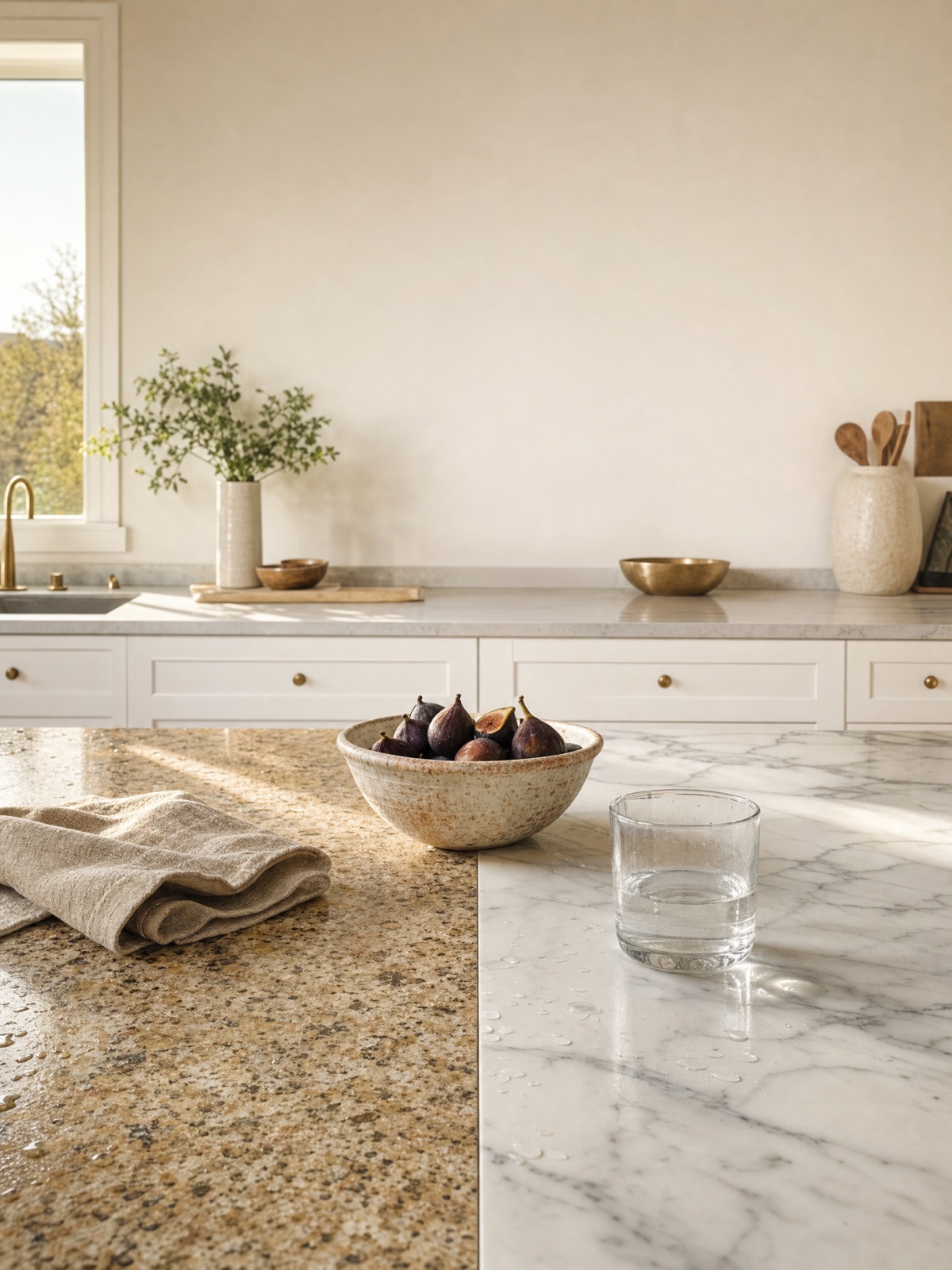
Granite vs Marble Countertops: Which Is Right for Your Vancouver Kitchen?
Quick answer: Granite is the more durable, lower-maintenance natural stone — it resists scratches, heat, and etching far better than marble, which makes it the safer pick for a hard-working family kitchen. Marble wins on pure visual elegance (the soft, veined look that nothing else quite matches), but it etches from everyday acids like lemon and wine and needs more careful upkeep. Choose granite for a busy kitchen, marble for a low-traffic island, baking station, or bathroom where you’ll baby the surface.
Last updated: June 2026
At our Richmond fabrication shop we cut both materials every week for Metro Vancouver homes, and the granite-vs-marble question comes up in almost every kitchen consultation. They’re both genuine natural stone quarried from the earth, both gorgeous, and both will outlast a laminate or solid-surface counter many times over. But they behave very differently once they’re living in your kitchen — and the difference comes down to chemistry, not just looks. This guide lays out how each stone performs on the things that actually matter day to day, with a fabricator’s perspective on what holds up in real Vancouver kitchens.
Granite vs marble at a glance
| Dimension | Granite | Marble |
|---|---|---|
| Stone type | Igneous, siliceous (quartz + feldspar) | Metamorphic, calcareous (calcium carbonate) |
| Hardness (Mohs) | ~6–7 — harder, resists scratches | ~3–5 (calcite ~3; dolomitic marble higher) — softer, scratches more easily |
| Acid etching | Highly resistant | Etches from acids (lemon, wine, vinegar, tomato) |
| Heat | Excellent — handles hot cookware well | Moderate — vulnerable to thermal shock |
| Staining | Low risk when sealed | Higher risk; more porous |
| Sealing | Typically once a year | Often every 6–12 months |
| Look | Speckled, grainy, dramatic movement; huge colour range | Soft white/grey grounds with elegant veining |
| Relative cost | Wide range; many affordable options | Often higher, especially Calacatta-look slabs |
| Best for | Busy kitchens, heavy-use counters, outdoor-adjacent | Low-traffic islands, baking stations, vanities, statement pieces |
If you want the same side-by-side treatment for engineered stone, see our quartz vs granite comparison and our marble vs quartz for bathroom vanities guide. For the full lineup of every material side by side, see our complete countertop materials comparison.
Which is more durable, granite or marble?
Granite is the more durable of the two by a clear margin. The reason is mineral hardness. Granite is a siliceous stone built largely from quartz and feldspar, and it sits around 6–7 on the Mohs hardness scale. Marble is a calcareous stone — essentially recrystallized limestone, made of calcium carbonate — and it lands around 3–5 on that same scale (calcite-rich marble sits near 3; dolomitic marble runs a bit higher). That gap shows up in everyday life: granite shrugs off the small knife slips, dragged pots, and grit that would leave fine scratches on marble.
Durability isn’t just about scratches, though. Marble’s calcium-carbonate makeup is what makes it react to acids (more on that below), while granite’s quartz content keeps it chemically stable against the lemon juice, coffee, and wine that pass over a kitchen counter all the time. For a counter that’s going to take a beating — a main prep run, a family island, a kitchen with kids — granite is the more forgiving choice.
Why does marble etch and granite doesn’t?
Etching is the single most misunderstood thing about marble, so it’s worth being precise. An etch is a dull, slightly rough mark left when an acid reacts with the calcium carbonate in the stone — it’s a chemical change to the surface, not a stain sitting on top. A splash of lemon, a ring from a wine glass, a drip of vinaigrette, or even some acidic cleaners can leave a faint matte spot on a polished marble counter.
Here’s the part homeowners are often surprised by: sealing does not stop etching. A sealer reduces staining by slowing how fast liquids soak in, but etching is a reaction with the stone itself, so an acid can still etch a sealed marble surface. Granite, because it’s siliceous rather than calcareous, is highly resistant to acid etching — which is the biggest practical reason granite is easier to live with in a kitchen. If you love marble but hate the idea of etch marks, a honed (matte) finish hides them better than a high polish, since there’s no glossy sheen for the dull spot to interrupt.
How do they compare on heat?
Granite handles heat very well. It’s formed under intense geological heat to begin with, so a hot pot or a baking sheet set down briefly generally won’t harm it. We still recommend trivets as good practice — sudden, repeated thermal shock is hard on any stone, and dark slabs can hold heat — but granite is genuinely heat-tolerant.
Marble has only moderate heat resistance. The bigger concern with marble is thermal shock: setting a very hot pan onto a cool marble surface can stress the stone and, in some cases, cause cracking. If you’re choosing marble for a baking station because it stays cool and is lovely to roll dough on (a real and classic reason to pick it), just commit to always using trivets and never parking hot cookware straight off the burner.
What about maintenance and sealing?
Both stones are natural and both benefit from sealing, but the rhythm differs:
- Granite is relatively low-maintenance. A reseal roughly once a year keeps it stain-resistant, and day-to-day care is just pH-neutral cleaner and a soft cloth. Our granite countertop care guide walks through the full routine.
- Marble asks for more attention. Plan to reseal more often — frequently every 6 to 12 months depending on use — and be quick to wipe acidic spills before they have time to etch or stain. Use only soft cloths and mild, pH-neutral soap; skip vinegar, citrus cleaners, and abrasive pads entirely. Our marble countertop care guide covers what to use and what to avoid.
For sealing technique and timing on any natural stone, our countertop sealing guide has the step-by-step.
Granite vs marble: which looks better?
This one is genuinely personal — neither stone “wins” on looks. Granite tends to read as speckled and grainy, often with dramatic flecks and bold movement, and it comes in an enormous colour range from near-black to warm gold to deep blue. It feels substantial and energetic. Marble reads softer and more architectural: typically a white or pale-grey ground crossed by elegant veining, the look people associate with classic kitchens and luxury baths. If you picture a serene, timeless island with delicate veins, that’s marble. If you want depth, pattern, and a wide palette to match cabinetry, granite gives you more to choose from. We encourage clients to view full slabs in person at our shop — both stones vary enormously piece to piece, and a sample chip never tells the whole story.
How much do granite and marble cost in Vancouver?
Both are priced per square foot installed, and the range within each material is wide — driven by the specific slab, its rarity, thickness, edge profile, sink cutouts, and install complexity. As a general pattern in Metro Vancouver, granite is the more affordable natural stone with plenty of accessible options, while marble (especially sought-after Calacatta-style white-and-grey slabs) often sits at the higher end. Rather than quote a single number here, see our countertop cost comparison for Vancouver, which breaks down every material side by side with current ranges and the factors that move the price. For a number specific to your slab and layout, the most accurate path is a quote.
Which should you choose for your kitchen?
Use the surface and how you live with it as your guide:
- Choose granite if it’s a main kitchen counter, you cook often, you have kids, you want minimal worry about acids and heat, or you want a wide colour palette. It’s the practical workhorse.
- Choose marble if the look is the priority and the surface sees lighter use — a furniture-piece island, a dedicated baking zone, a butler’s pantry, a fireplace surround, or a bathroom vanity. Marble rewards owners who’ll wipe spills promptly and don’t mind a little patina over time. (Some homeowners genuinely love how marble ages.)
- Mix and match. A common Vancouver approach: durable granite (or quartz) on the hard-working perimeter and a marble or marble-look statement island. You get the practicality where it counts and the showpiece where you’ll see it.
If you want maximum durability without etching worries, it’s also worth comparing both against engineered quartz and quartzite — start with our quartz vs granite guide.
Frequently asked questions
Is granite or marble better for a kitchen?
For most kitchens, granite is the more practical choice because it resists scratches, heat, and acid etching, and needs less frequent sealing. Marble is better suited to lower-traffic surfaces or homeowners who want the classic veined look and are happy to maintain it carefully.
Does sealing prevent marble from etching?
No. Sealing helps reduce staining by slowing absorption, but etching is a chemical reaction between acid and the calcium carbonate in marble, so a sealed marble surface can still etch. Wiping acidic spills quickly and choosing a honed finish both help minimize visible etching.
Can you put hot pots on granite or marble?
Granite handles brief contact with hot cookware well, though we still recommend trivets as good practice. Marble is more vulnerable to thermal shock and can crack if a very hot pan meets a cool surface, so always use trivets on marble.
Which lasts longer, granite or marble?
Both can last for decades with proper care, but granite generally holds up better under heavy daily use thanks to its greater hardness and acid resistance. Marble can last just as long when it’s used gently and maintained attentively.
Is marble too high-maintenance for a busy family kitchen?
For a hard-working main kitchen counter, many families find marble more upkeep than they want because of etching and more frequent sealing. A good compromise is using marble on a low-traffic island or baking area and a tougher stone on the prep zones.
Talk to Alpine about your slab
Alpine Countertops has fabricated granite and marble for Metro Vancouver and Fraser Valley homes since 2015, and we’re BBB A+ accredited. We’ll help you see full slabs in person, talk through how each stone fits the way you actually use your kitchen, and give you a quote specific to your layout. Call us at 604-630-5700, email info@alpinecountertops.com, or get in touch here. Serving Vancouver, Burnaby, Richmond, Surrey, North Vancouver and the surrounding region from our Richmond fabrication shop.