
Marble vs Quartz for Your Vancouver Bathroom Vanity: What Lasts
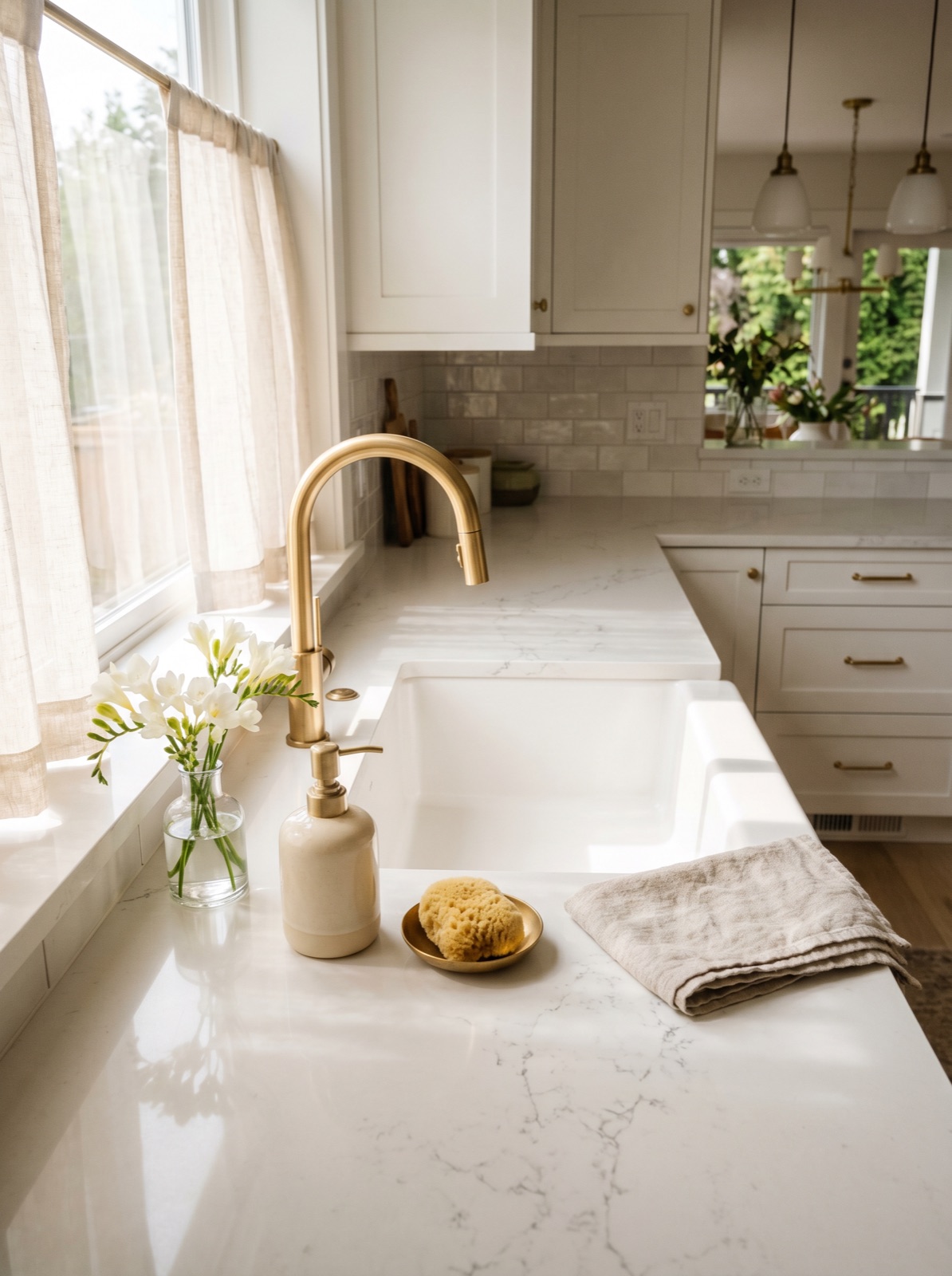
The mascara tube rolled off last night with its lid half-off. The perfume bottle leaves a faint ring where it always sits. A toothpaste splatter by the faucet you didn’t notice until the morning light hit it. Bathroom counters take a different beating than kitchen counters — less heat, less coffee, but a daily parade of cosmetics, cleansers, and acids disguised as beauty products. That’s the real test when choosing a marble vs quartz bathroom vanity for your Vancouver home.
Both materials can look stunning. Both can outlast the renovation that installed them. But they respond to bathroom life differently, and the right answer for your space depends on how the vanity is actually used. Here’s how we think about it at Alpine.
What’s the real difference between marble and quartz for a vanity?
Marble is a natural metamorphic rock. Geology.com describes it plainly: “Marble is a metamorphic rock that forms when limestone is subjected to the heat and pressure of metamorphism. It is composed primarily of the mineral calcite (CaCO3)” (Geology.com — Marble). Every slab is different — veining, background tone, crystal structure. What you see in the slab yard is what you get in your bathroom.
Quartz (engineered quartz) is manufactured. Most major brands are around 90–93% ground natural quartz bound with polyester resin and pigment. Caesarstone describes its surfaces as “hard, nonporous, and stain-resistant” that do not require regular sealing (Caesarstone care guide). Cambria’s FAQ confirms the same: “Cambria is nonabsorbent and nonporous and will not absorb food and liquids” (Cambria FAQ).
That single difference — porous natural stone vs non-porous engineered surface — drives almost every decision below.
Stain and etch resistance: where marble struggles
Here’s the part most marble lovers discover late.
Marble is calcium carbonate. Geology.com notes: “Being composed of calcium carbonate, marble will react in contact with many acids, neutralizing the acid” (Geology.com — Marble). That neutralization reaction is what creates an “etch” — a dull, lighter patch where the polished surface has been chemically dissolved. Etching is not a stain. Stains sit on top; etching changes the stone itself.
The bathroom is full of acids. The Natural Stone Institute’s guidance on using marble in bathrooms is direct: “Various hygiene products, such as perfumes, hair products, dental products… may contain acids or bases that could damage the stone” (Use Natural Stone — 5 Questions To Ask Before Using Marble In Your Bathroom). Whitening toothpaste, citrus-scented cleaners, vitamin C serums, perfume ethanol — all can mark a polished marble surface.
Add to this the fact that marble itself is soft. Calcite, the mineral marble is made from, registers a 3 on the Mohs hardness scale (Geology.com — Mohs Hardness Scale). By comparison, quartz is a 7. That softness doesn’t mean marble will scratch under a hairbrush — but it means the polished surface is more vulnerable than the engineered alternative.
This isn’t a reason to avoid marble. It’s a reason to go in with eyes open: marble in a bathroom develops patina. Some homeowners love that character; others find it maddening.
Quartz in the bathroom: what quartz handles well (and doesn’t)
Quartz takes the easy win on most bathroom challenges. Because it’s non-porous, it doesn’t absorb perfume spills, makeup, toothpaste, or the hair products that dominate a typical morning routine. Soap and water is usually enough for daily cleaning, and Caesarstone states directly that its surfaces are “nonporous” and resist staining (Caesarstone).
But quartz has real limits, and the bathroom is where they show up:
- Harsh chemicals. Caesarstone’s maintenance guide specifies: “Avoid harsh cleaning products such as: oven/grill cleaners, dishwasher detergent, floor strippers, oil soaps, paint removers/strippers… or any products containing trichloroethane or methylene chloride” (Caesarstone — Care & Maintenance). Most bathroom cleaners are fine, but a stripper or strong solvent is not.
- Heat. Caesarstone’s stated limit is 300°F (~150°C); the resin binder can cloud before the stone itself would fail (Caesarstone care guide). A hot curling iron or flat iron left face-down on the vanity is a genuine risk — not because the quartz aggregate can’t handle it, but because the resin around it can discolor.
- Strong dyes and solvents. Hair dye and permanent markers sit on the non-porous surface, but they can still leave a shadow if left to dry. The answer is speed: blot and clean promptly.
Quartz doesn’t patina. It stays as it was installed. That’s the appeal for most Vancouver homeowners — and, for a few, the drawback.
Maintenance reality for Vancouver humidity
Metro Vancouver bathrooms operate in a wetter envelope than most North American homes. Winter rain, long showers, and tightly sealed new-build envelopes mean bathrooms see extended humidity, and that matters for porous natural stone.
For marble specifically, the Natural Stone Institute recommends sealing when used in wet areas: “The stone will need to be sealed properly, so there is a little added maintenance in a wet space” (NSI — Using Marble in Your Bathroom). NSI’s general sealing position is that “a quality sealer… should have a life expectancy of ten to fifteen years” (Natural Stone Institute — Sealing), but individual bathroom slabs can benefit from a more frequent resealing schedule depending on use intensity. A simple test: drop water on the counter, wait 10 minutes, and see whether the stone darkens. If it does, it’s time to reseal.
Quartz sidesteps this conversation. Caesarstone and Cambria both state their surfaces never require sealing.
For many Vancouver homeowners, the sealing question tips the balance. In a daily-use ensuite, quartz is the easier long-term answer. In a powder room used twice a month by guests, marble’s maintenance is trivial.
Cost ranges for vanity tops
We don’t publish blanket per-square-foot numbers for a reason — vanity pricing in Metro Vancouver depends heavily on the slab yard, the specific marble or quartz color, and whether you want a full-height backsplash or an integrated sink.
A few honest notes from our Richmond fabrication bench:
- Mid-tier quartz in a small vanity format often comes in below entry-level marble, because marble’s cost is tied to quarry sourcing rather than production lines.
- Designer marble (Calacatta Gold, exotic movement patterns) prices well above everyday quartz.
- Marble-look quartz (Caesarstone Calacatta Nuvo, Cambria Brittanicca, Silestone Eternal Calacatta Gold) offers much of the aesthetic with non-porous behavior — pricing sits in the designer-quartz range.
If you want firm numbers for your bathroom, we’d rather measure and quote than invent averages.
When marble is the right call
Marble belongs in bathrooms where its trade-offs align with how the space will be used:
- Powder rooms. Used briefly by guests; minimal cosmetics exposure; maximum visual impact per square foot.
- Guest ensuites. Same logic as above, with the addition that guests tend to be gentler on surfaces than the owners who actually live there.
- Primary bathrooms for patina-lovers. If you genuinely enjoy the idea of a counter that records its life — faint etches, mellowed polish over years — marble is honest about what it becomes.
- Statement vanity walls. As full-height backsplashes, book-matched slab mirrors, or floor extensions where the vanity top itself is ceramic or quartz.
Softer marbles like Carrara are generous in price; harder dolomitic marbles like Super White hold up better to daily use than classic Italian marbles. Our team can walk you through the tradeoffs at the slab yard.
When quartz is the right call
Quartz is the safer call for bathrooms with heavy daily use:
- Primary ensuites. Two adults, daily routines, cosmetics, hot styling tools.
- Family bathrooms. Shared by children and teenagers; unattended nail polish; mystery substances that appear overnight.
- Kids’ bathrooms. Non-porous means stains don’t set while you’re trying to figure out what happened.
- Rental properties and Airbnb units. Consistent appearance, no sealing schedule, clean-up tolerance is higher.
For a deeper comparison between engineered quartz and other stones, our guide to quartz vs granite for Vancouver kitchens walks through the same kind of spec-by-spec decision. And if you want to understand how to pull a perfume etch or toothpaste splash out of a bathroom counter once it’s happened, our guide to removing stains from countertops covers the common bathroom culprits.
Hybrid approach
The most satisfying Vancouver bathroom renovations we’ve done in the last few years don’t pick one or the other — they combine them.
- Marble as a half-height vanity wall or full backsplash, where it catches light and carries the room visually, but isn’t the surface where the perfume bottle sits.
- Quartz as the vanity top, sized generously with an under-mount basin, handling the daily cosmetics without developing etch marks.
- Porcelain slab for shower surrounds and floor extensions — see our guide to porcelain countertops in Vancouver for where porcelain fits.
The hybrid is often cheaper than an all-marble bathroom, looks more considered than an all-quartz one, and ages better than either extreme. Browse our marble countertop collection and project gallery, or reach out and we’ll bring samples to your Vancouver home.
Planning a Kitchen or Bath Countertop Project in Metro Vancouver?
Still weighing materials? We can bring physical samples to your home — seeing marble and quartz side-by-side in your own bathroom light beats any showroom comparison.
Alpine Countertops has been crafting premium quartz, granite, marble, and porcelain surfaces in our Richmond facility since 2015. We serve homeowners across Vancouver, Burnaby, Richmond, Surrey, West Vancouver, North Vancouver, Coquitlam, New Westminster, and Langley.
Book a free design consultation:
– 📞 604-630-5700
– 📍 Fabrication facility: Richmond, BC
– 🌐 Browse our gallery · View countertop materials · Get in touch
Alpine Countertops — Professionals Bringing Style to Life.