
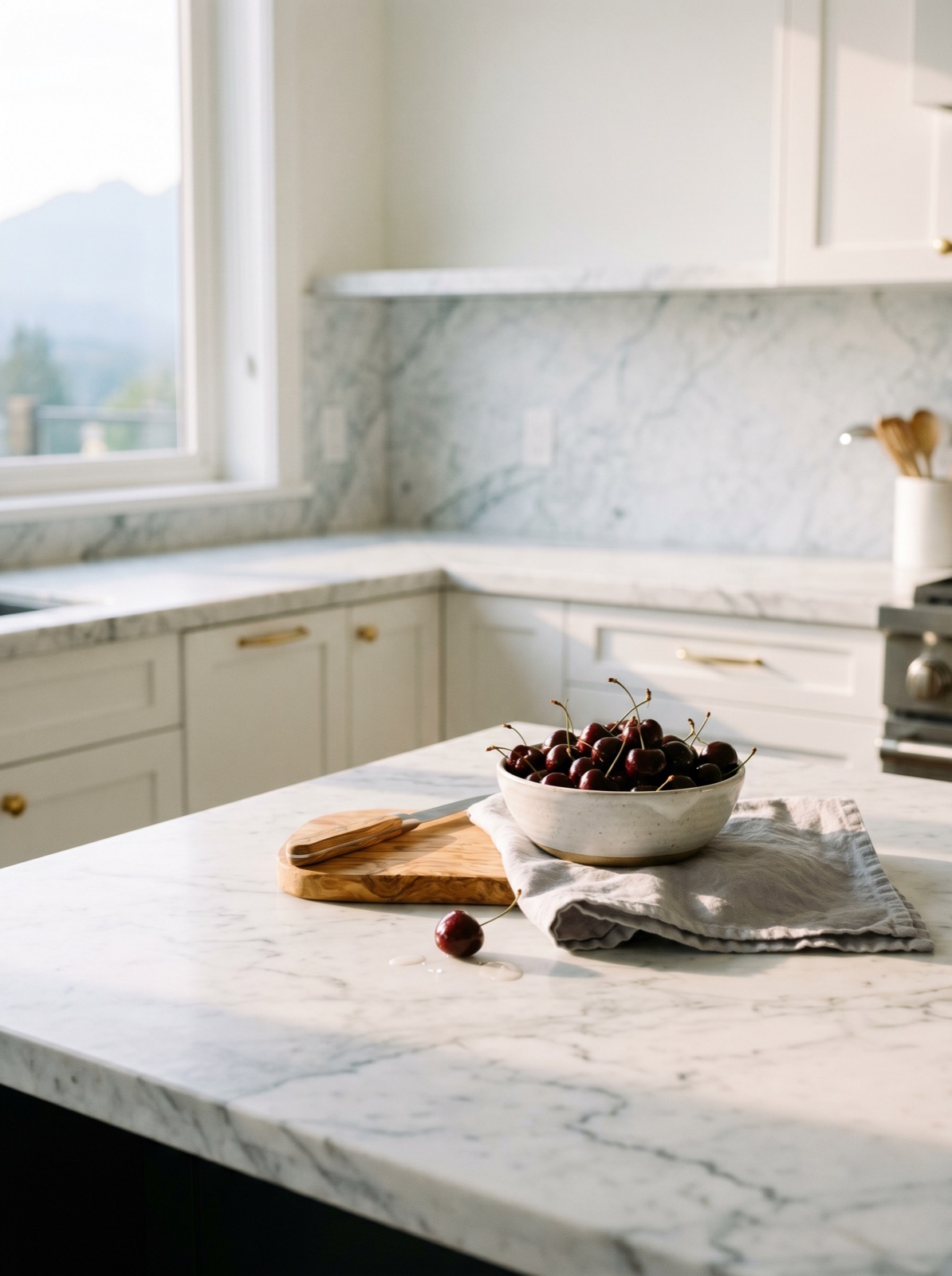
Marble is the original luxury countertop, and despite a hundred years of newer materials trying to displace it, it remains the surface designers reach for when the brief is timeless rather than trend-driven. Carrara, Calacatta, Statuario, Calacatta Gold — these names carry weight in Vancouver kitchens and bathrooms for good reason. The veining is unrepeatable, the cool feel under the hand is unique, and the patina marble develops over years is, for the right client, half the point. Alpine Countertops has been fabricating marble from our Richmond facility since 2015, and we are BBB Accredited Business with an A+ rating. We are also direct with our clients about how marble actually behaves in everyday use — which is the only way to make a good decision about it.
Why marble works in some Vancouver kitchens (and not others)
Marble is a metamorphic rock made primarily of recrystallized calcium carbonate — chemically, the same calcite that limestone is built from. That mineralogy is what gives marble its luminous translucence and soft veining; it is also what makes marble vulnerable to acid. Lemon juice, vinegar, white wine, tomato sauce, and a number of common kitchen cleaners contain enough acid to react with the calcite at the surface. The result is etching: a dull, slightly rougher patch where the polish has been chemically eaten away. No sealer can prevent it because sealers protect against absorption (staining), not chemical reaction (etching).
Etching and staining are two different problems clients often confuse. Staining happens when a coloured liquid soaks into the porous stone — red wine, coffee, oil — and leaves a darker mark. Sealing prevents most staining. Etching is a chemical change in the surface itself caused by acid contact, regardless of seal. The dull spots people associate with old marble are almost always etches, not stains.
This makes marble a poor fit for a busy family kitchen where citrus, vinegar, and wine are part of the daily rhythm and the homeowner expects the surface to look new for twenty years. It makes marble an excellent fit for two distinct Vancouver scenarios. The first is a homeowner who genuinely welcomes the patina — for whom etches and softening are character, not damage. The second is a kitchen where marble is reserved for surfaces that do not see acidic spills: butler’s pantries, baking stations, statement islands used more for hosting than cooking, and en suite vanities. For a side-by-side with engineered quartz on a vanity application, see our marble vs. quartz bathroom vanity guide.
Marble varieties and options at Alpine
The marble that reaches Vancouver is overwhelmingly Italian, with a smaller share from Greece, Turkey, and Spain. We work through BC importers including Margranite to bring in slabs across the classic palette, and we hand-select stone with our clients for projects where the specific veining matters.
- Carrara — the most familiar marble, quarried in the Apuan Alps of Tuscany. Soft white-grey background with feathery, mid-grey veining, finer and more diffuse than its more dramatic cousins. The workhorse of bathroom vanity work in Vancouver.
- Calacatta — also from the Carrara region but a different, rarer quarry classification. Whiter background and bolder, more defined grey veining with occasional warm-gold tones. The marble most often specified by Vancouver designers when the counter is the focal point. Sub-varieties (Borghini, Vagli, Lincoln) vary in vein density.
- Calacatta Gold — Calacatta with pronounced gold and amber veining alongside the grey. Reads warmer, suits cabinets and floors with cream, walnut, or aged-brass tones.
- Statuario — the rarest classic Italian white. Bright, almost cool-white background with sharp, well-defined grey veining. Specified when the brief is the most refined possible white marble. Very limited supply.
- Thassos and Bianco Dolomiti — Greek marbles with very white, almost crystalline backgrounds and minimal veining. Used most often in bathrooms and shower surrounds where a clean, quiet surface is wanted.
- Calacatta Viola and Rosso Levanto — varieties with deep purple, burgundy, or rust veining for a more dramatic statement. Beautiful on a single feature piece, particularly a powder-room vanity.
Because every marble slab is unique, we recommend in-person yard selection for any project where the specific veining is part of the design intent. We mark up cuts on your selected slab to place the best movement where the eye lands. Browse current options on our products and suppliers page.
Marble care in Vancouver’s climate
Marble needs more attention than quartz or granite, but the routine is not complicated once you understand what the stone wants. Three things matter. First, seal it — a penetrating stone sealer applied every 6 to 12 months reduces porosity and protects against staining. Second, wipe acidic spills immediately; lemon, wine, tomato, vinegar, coffee, and many cleaning products will etch on contact, and the longer they sit the worse the etch. Third, clean only with stone-safe pH-neutral products; never use vinegar, lemon-based cleaners, oven cleaner, or bleach.
For homeowners who want the marble look without the maintenance, modern marble-effect quartz is genuinely impressive. For homeowners who want the real thing, the patina that develops over years of use is, in the right setting, beautiful in itself. See our product care page for a fuller routine and our 2026 kitchen countertop trends post for context on how marble is being specified now.
Pricing — what affects marble cost
Marble pricing in Vancouver varies more than most materials because the variety and slab tier matter so much. A standard Carrara and a select Statuario can differ by a factor of four or more on the same square footage. We itemize quotes so the variables are visible. Major drivers include:
- Variety and quarry tier. Carrara is the accessible end of the marble spectrum. Calacatta sits significantly higher, and select Statuario higher still. Specialty varieties (Calacatta Viola, Rosso Levanto) follow their own pricing logic based on quarry availability.
- Slab grade. Within a single variety, slabs are graded on background clarity, vein definition, and absence of natural fissures. Higher-grade slabs from the same quarry command meaningfully more.
- Slab thickness and edge profile. Most kitchen tops use 3 cm slabs. Mitred waterfall edges, ogees, and stacked profiles add fabrication time.
- Cut-outs and complexity. Undermount sinks, faucet holes, and vanity cut-outs each add labour. Marble cuts more easily than granite but is more prone to chipping at edges, so fabrication takes care.
- Seam planning. For a long run or a large island, vein-matched seams across multiple slabs require additional layout time and slab inventory.
Our process — template to installation
A marble project at Alpine moves through four steady stages. First, an in-home consultation where we bring physical samples, talk through the look you want, and have a frank conversation about how the surface will live in your kitchen or bathroom. For a marble-led project we then arrange a yard visit so you can choose your specific slab. Second, digital laser templating once your cabinets are installed. Third, fabrication in our Richmond shop on our own equipment — marble requires a careful hand at fabrication, and keeping it in-house lets us control the result. Standard turnaround is 2 to 3 weeks from template to install. Fourth, installation by Alpine crews, including the first sealer application before we leave the site. Read more on the about page.
Marble countertop FAQs
What is the difference between etching and staining on marble?
Staining is a coloured liquid soaking into the stone (red wine, coffee, oil), creating a darker mark. Sealing prevents most staining. Etching is a chemical reaction where an acid (lemon, vinegar, wine, many cleaners) eats away the polished surface, leaving a dull spot. Sealers do not prevent etching because etching is a chemical change in the stone itself, not absorption. Both can occur on marble; only one can be prevented by sealing.
Should I use marble in a busy family kitchen?
Generally, no — unless you genuinely welcome the patina that develops from everyday use. Marble will etch from acidic spills (lemon, wine, vinegar, tomato) within seconds of contact, and over years a busy family kitchen will visibly soften and dull the polish. For a family kitchen where you want the surface to look new for decades, engineered quartz or granite is a better fit. Marble shines in butler’s pantries, baking stations, statement islands, and bathroom vanities.
How often does marble need sealing?
Every 6 to 12 months for a kitchen application is a reasonable cadence; bathroom vanities can often go longer. The water-bead test tells you when the sealer is breaking down — drops should bead on the surface, not soak in. Sealing itself is straightforward: apply a penetrating stone sealer, let it absorb, buff off the residue. Note that sealing protects against staining but not against etching.
Get a quote
Considering marble for your Vancouver home? Call 604-630-5700 or email info@alpinecountertops.com to book a free in-home consultation. We bring samples, talk through the trade-offs honestly, and send a detailed itemized quote within 48 hours. You can also reach us through our contact page or read more on our Vancouver countertops page.

BBB Accredited Business · A+ rating
Accredited since October 31, 2016.
Confirm current colours, slab availability, pricing and lead times with our team before placing an order. Manufacturer warranties and care requirements depend on the product selected.
Request a countertop quote