
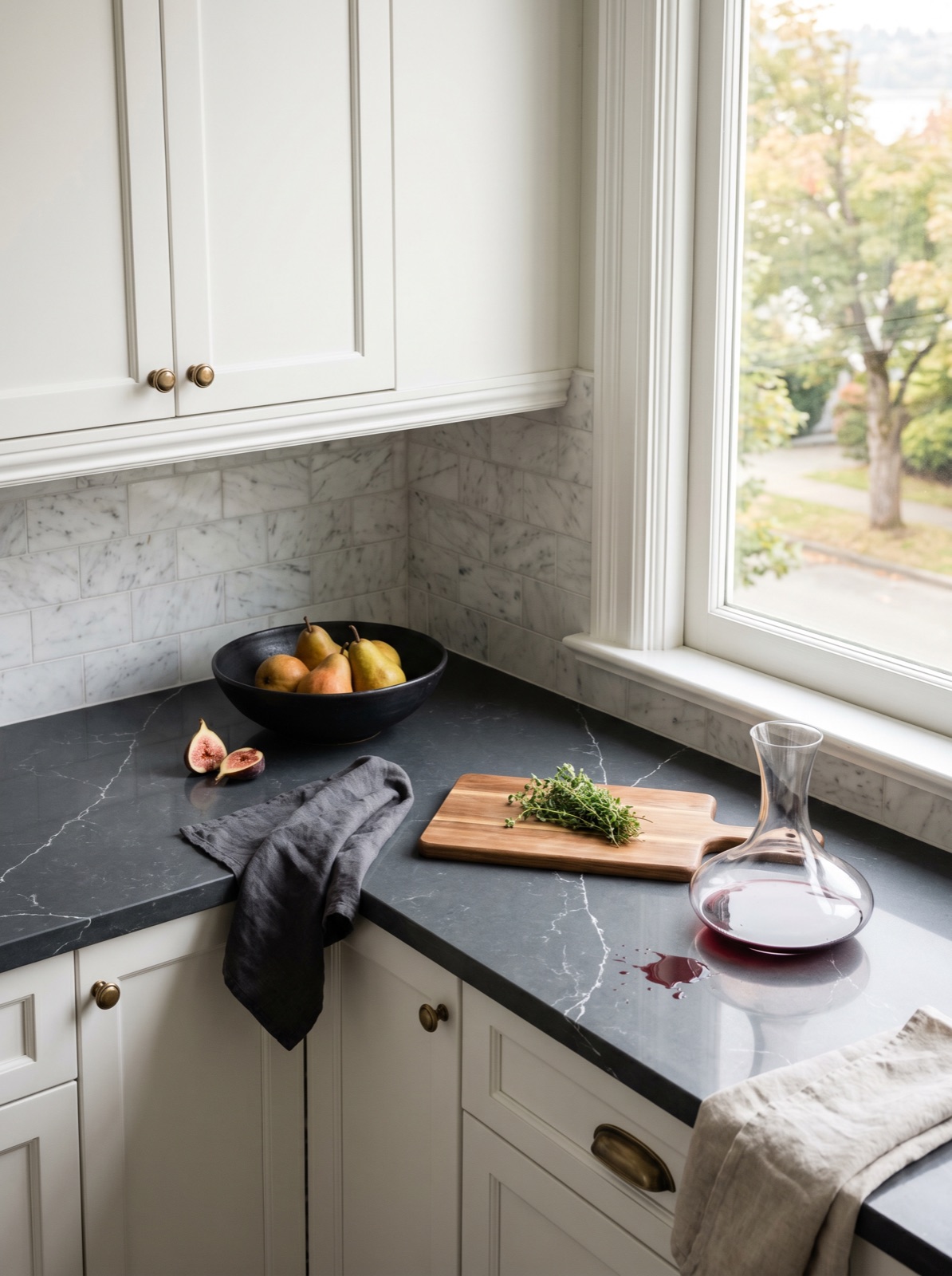
New Westminster Countertops
New Westminster is BC’s oldest city, and that history shows in the kitchens. Heritage homes in Queens Park and Sapperton sit beside Quay condominiums along the Fraser, walk-up apartments on the Brow of the Hill, and post-war family homes in Uptown and Glenbrook North. The Royal City asks something specific from a countertop fabricator: respect for the existing fabric, efficient workmanship in tight spaces, and the right materials for kitchens that are often older, smaller, and cabinet-rich. Alpine Countertops has been fabricating granite, quartz, marble, quartzite, and porcelain surfaces from our Richmond, BC facility since 2015, and we treat New Westminster work with the care a heritage city deserves — slowing down where the home demands it, and bringing a finished surface that respects what was already there.
How New Westminster kitchens are different
New West is unlike any other Metro Vancouver city we serve, and we adjust our approach accordingly. Queens Park, Sapperton, and Brow of the Hill are heritage neighbourhoods where homes commonly date to the early 1900s. Kitchens in these homes tend to be smaller and more efficient than what you’d find in a Surrey or Langley new-build — often U-shaped or galley layouts, frequently with a window over the sink and original wood trim around the perimeter. Many homeowners are restoring rather than replacing, and the countertop has to honour that choice.
The Quay along the Fraser is a different conversation. Condo kitchens here are compact, modern, and often part of a single sightline that runs from the kitchen through the dining area to the river. Homeowners want a quartz that reads cleanly against contemporary cabinetry without competing with the view. Engineered quartz with subtle, classic veining tends to win out — Caesarstone Calacatta-pattern slabs, Silestone equivalents, and Cambria’s lighter colour stories are all common selections.
Uptown and Glenbrook North sit somewhere between the two: post-war detached homes that have been steadily renovated. These kitchens often pair classic-looking quartz with shaker cabinetry — a combination that reads well in mid-century and traditional builds alike. Across all of it, New West homeowners preserve heritage millwork wherever possible. That means we frequently template around existing trim, work with cabinetry we cannot remove, and plan seam placement to avoid disturbing original elements. It’s careful work, and we’ve learned where to slow down.
The other constant across New West is access. Older heritage homes in Queens Park and Sapperton can have narrow staircases, tight kitchen entries, and limited turning room — all of which factor into how slabs are sized and brought in. Quay condo installs require strata coordination, elevator booking, and floor protection. North-of-Sixth Uptown homes sometimes have lane-only access. We plan for all of it during templating, so install day runs cleanly. It’s the kind of detail you don’t think about until you’re standing in a 1908 Queens Park kitchen wondering how a 9-foot slab makes the corner — and the answer is that the templating phase has already accounted for it.
Connaught Heights and Glenbrook North round out the picture — quieter detached neighbourhoods where steady, thoughtful renovation work is the norm. These kitchens often retain their original footprint and call for a countertop that updates the surface without forcing a wholesale redesign. Engineered quartz with classic veining is the most common request, with the occasional warm-toned granite for homeowners who prefer natural stone.
Materials we fabricate for New Westminster homes
We carry the full range of countertop materials and over 100 colours and patterns, with material recommendations weighted to what actually works in New West kitchens:
- Quartz with classic veining — engineered stone from Caesarstone, Silestone, Vicostone, Hanstone, Cambria, OmniaQuartz, and Firstone. The most-requested category in New West, especially for Quay condos and Uptown renovations. Non-porous, very low-maintenance, consistent across slabs.
- Marble — when the home calls for it. Queens Park heritage kitchens and primary-bath vanities often suit Carrara or Calacatta marble. Honest about its softness, but unmatched for character. Read more in marble vs. quartz for bathroom vanities.
- Granite — durable, heat-tolerant natural stone for working kitchens that don’t need to read as period-correct. Common in Sapperton and Glenbrook North family homes.
- Quartzite — the natural-stone alternative when you want marble’s look with granite’s hardness. Worth a conversation for high-use heritage kitchens.
- Porcelain and Dekton — large-format ultra-compact surfaces that work beautifully for modern Quay condos and design-forward Uptown renovations.
For a side-by-side, our quartz vs. granite guide sets out the practical differences, the products and suppliers page lists every brand we fabricate, and the designs gallery shows recent installations with detail on edges, sinks, and seam placement.
Care and maintenance is straightforward for most of these materials, and we walk through it in detail at install. Our how to clean quartz guide and broader product care page cover the essentials. For heritage homes specifically, we recommend leaning toward non-porous engineered quartz wherever the aesthetic allows — it pairs cleanly with classic cabinetry and asks almost nothing of the homeowner over time.
Our process — template to installation
Every New Westminster project starts with an in-home consultation. We come to you with physical samples and look at the kitchen as it actually is — heritage trim, existing cabinetry, sightlines, light, and the working triangle. For heritage homes, this consultation is where we identify constraints early: trim we cannot remove, plumbing rough-ins from the 1950s, walls that have moved over a century.
Once a slab is selected, we book laser-accurate digital templating on-site. This is critical in older homes where walls are rarely plumb and corners are rarely square. The laser captures every variation.
Fabrication happens at our Richmond facility on our own equipment. We own the schedule, we own the quality, and we own the install. Standard turnaround is 2–3 weeks from template to installation, with our trained crews completing the work in your home. Floor and surface protection goes in before any heavy lifting starts, and we walk you through care and maintenance once the job is finished.
Why New Westminster chooses Alpine
- BBB A+ Accredited Member — a verifiable accountability record.
- 10+ years across the Lower Mainland, including extensive Queens Park and Sapperton heritage work.
- Heritage-aware fabrication — we template around constraints rather than asking you to remove them.
- In-house Richmond facility — no middlemen, faster turnaround.
- Compact-kitchen specialists — efficient seam planning for Quay condos and Brow apartments.
- Designer- and builder-friendly — we partner regularly with New West renovation contractors and interior designers.
- Transparent quoting — see our quartz countertop cost guide.
- Free in-home consultation across every New West neighbourhood.
If you’re still vetting fabricators, how to choose a countertop fabricator in Vancouver lays out the questions to ask.
Neighbourhoods we serve in New Westminster
We install across the entire Royal City. Queens Park — heritage homes, marble and softer-veined quartz read well with original millwork. Sapperton — early-1900s character homes, often undergoing thoughtful renovation. Brow of the Hill — walk-up apartments, condos, and some heritage detached homes; compact-kitchen efficiency is the priority. The Quay — Fraser-front condominiums, modern quartz with classic veining is the dominant selection. Uptown — post-war detached homes around Sixth and Sixth Street, mid-century kitchens steadily renovated. Glenbrook North — established detached homes with generous family kitchens. Connaught Heights — quieter detached neighbourhood near the Patullo. We also serve neighbouring Burnaby and Coquitlam.
New Westminster countertop FAQs
Can you work in heritage homes without disturbing original trim or cabinetry?
Yes. We routinely fabricate for Queens Park and Sapperton homes where original millwork must stay in place. Templating is done with heritage constraints in mind, and seams are planned to be visually unobtrusive.
Do you install in Quay condominium buildings with strata access requirements?
Yes. We coordinate with strata management on access timing, elevator booking, and protection requirements. Quay-area installs are routine for us; we’ll handle the building-side logistics so you don’t have to.
What’s the best countertop choice for a smaller heritage kitchen?
For heritage character, classic-veined quartz from Caesarstone, Silestone, or Cambria is the most common selection — durable enough for daily use, period-appropriate in appearance, and very low-maintenance. Marble is an option for baking-focused kitchens or vanities where character matters more than acid-etch resistance. We’ll walk through both during the in-home consultation with physical samples in your kitchen’s actual light.
How do you handle older homes where walls aren’t square or plumb?
This is the rule rather than the exception in Queens Park, Sapperton, and Brow of the Hill. Our laser-accurate templating captures the actual shape of every wall, corner, and overhang, not the shape they’re supposed to be. The fabricated countertop is cut to match what’s there, so the finished surface fits cleanly even when the underlying structure has shifted over a century.
Get a free quote
Book a free in-home consultation anywhere in New Westminster and we’ll measure your space, recommend materials suited to the home, and send a detailed itemized quote within 48 hours. Call 604-630-5700, email info@alpinecountertops.com, or use the contact form. Showroom visits at our Richmond facility are by appointment only.