
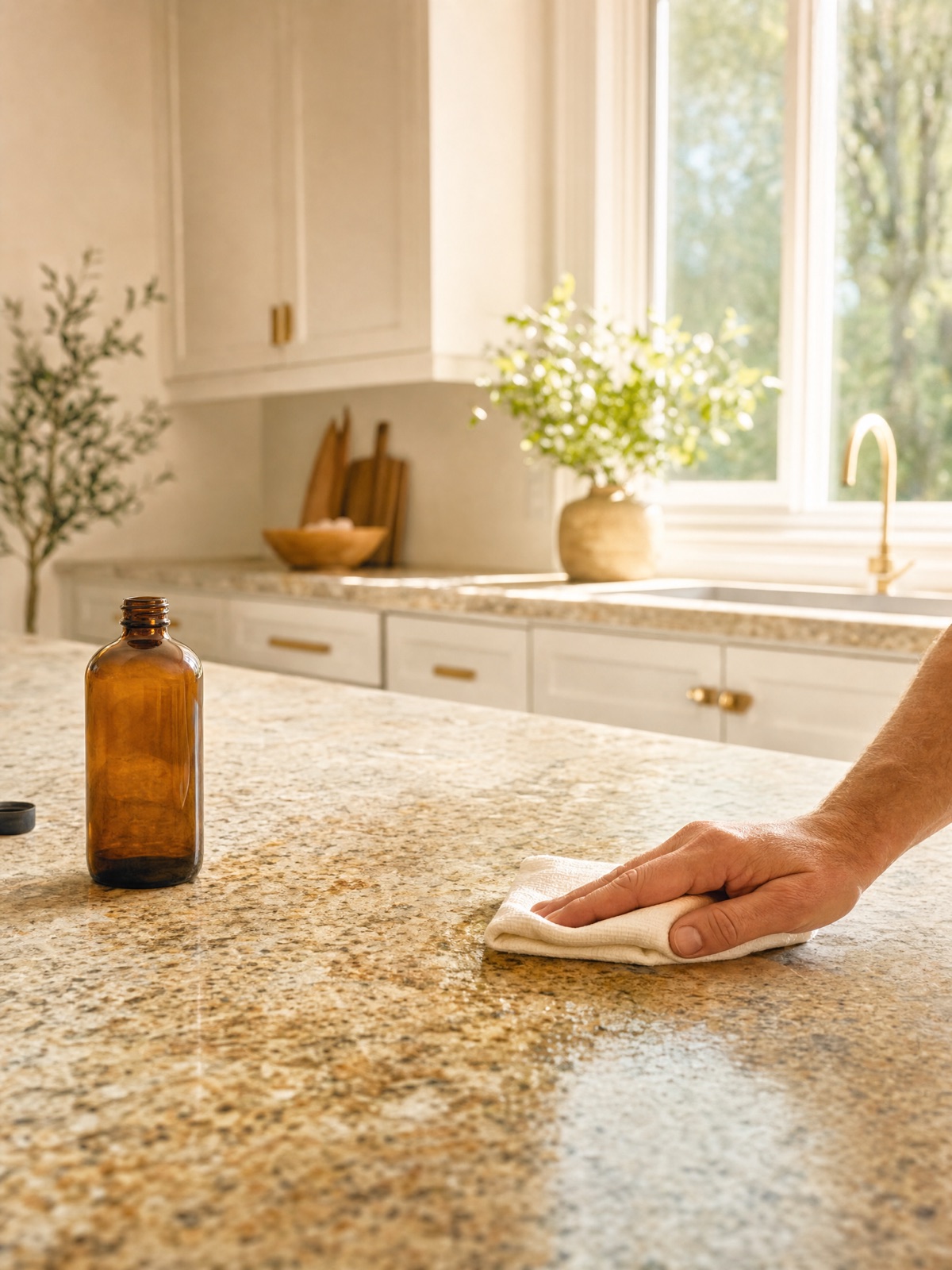
Countertop Sealing: When, How, and How Often (A Pacific Northwest Guide)
Sealing is one of the most misunderstood parts of owning a stone countertop. Some homeowners seal every six months whether the counter needs it or not; others never seal at all and wonder why a glass of red wine left an outline. And a surprising number of people seal surfaces that should never be sealed. At Alpine Countertops, we fabricate and install granite, marble, quartzite, quartz, and porcelain across Metro Vancouver and the Fraser Valley, so we field these questions constantly. This guide explains which countertops actually need sealing, which never do, how sealing works, the honest truth about how often to reseal, and how our damp Pacific Northwest climate fits into the picture.
Quick reference: which countertops need sealing
If you remember nothing else from this guide, remember this short list. It settles most of the confusion in one read.
- Natural granite — porous; benefits from a penetrating sealer. Seal on installation and reseal based on testing (see below).
- Marble — porous and acid-sensitive; benefits from sealing, though sealing slows staining only and does not stop acid etching.
- Quartzite — natural stone, generally porous; benefits from sealing like granite.
- Natural stone generally (limestone, travertine, slate, soapstone, onyx) — porous to varying degrees; most benefit from an impregnating sealer.
- Engineered quartz (Caesarstone, Cambria, Silestone, HanStone and similar) — non-porous; never needs sealing. Cambria states plainly that its quartz “never require[s] sealing, polishing, or reconditioning.”
- Porcelain / sintered slabs (Dekton and similar) — effectively non-porous; do not seal.
The dividing line is porosity. Natural stone is quarried rock with a network of microscopic pores that can absorb liquid. Engineered quartz is roughly 90% ground quartz bound with a polymer resin (about 6–10% of the slab) that fills those pores at the factory, so liquid sits on top rather than soaking in. Porcelain slabs are fired into a dense, vitrified body. Sealing a non-porous surface accomplishes nothing: the sealer cannot penetrate, so it either wipes away or dries into a faint haze you then have to remove. If a cleaning product or a well-meaning relative tells you to seal your quartz, ignore it.
How sealing actually works
Most countertop sealers are penetrating (also called impregnating) sealers. They are thin liquids that soak a few millimetres into the stone and cure inside the pores, leaving the surface looking and feeling unchanged. They do not form a glossy film and they do not change the stone’s finish. What they do is line the pores so that spilled liquid is slowed down — it beads or sits on the surface long enough for you to wipe it up before it absorbs and stains.
That is the key mental model: a sealer buys you time; it is not a force field. On granite, a good seal turns a quick coffee spill from a potential dark mark into a non-event. But two limits matter:
- Sealing does not stop etching on marble. Etching is a chemical reaction, not a stain. When an acid — lemon juice, vinegar, wine, tomato, many household cleaners — touches marble, it reacts with the calcium carbonate in the stone and dulls the polished surface, leaving a lighter, slightly rough spot you can often feel. A sealer sits in the pores; it does not put an acid-proof layer over the polish, so even a freshly sealed marble counter will still etch under a slice of lemon. Sealing reduces staining (absorbed liquid); it does nothing for etching (surface chemistry). The Natural Stone Institute confirms that acids “dull or etch calcareous stones” such as marble regardless.
- Sealing does not make stone bulletproof. Heavily pigmented liquids left for a long time can still stain even a sealed surface. The sealer extends your reaction window; prompt wiping does the rest.
Sealer types explained
Three broad categories show up on shelves and in spec sheets. Knowing the difference helps you buy the right thing.
- Penetrating / impregnating sealers — the standard choice for kitchen and bathroom counters. They soak in and protect from within without altering appearance. Most consumer stone sealers sold in Canada fall here.
- Premium fluorocarbon / aliphatic-resin impregnators — a higher-end subset of penetrating sealers. According to Bob Vila, sealers built on “fluorocarbon aliphatic resin” can deliver roughly 5 to 10 years of protection, versus the 6 months to 3 years from basic sealers. If you want to reseal as rarely as possible, this is the category to look for.
- Topical sealers — these sit on top of the stone as a coating rather than soaking in. They are less common for stone countertops because they can alter the finish, wear unevenly under daily kitchen use, and need stripping to reapply. They are more typical on floors or decorative stone than on a working kitchen counter.
For almost every counter we install, a quality penetrating impregnator is the right answer — a premium fluorocarbon-resin version if you value the longest interval between applications.
How often should you reseal? (The honest answer)
This is where the internet contradicts itself, and we are not going to pretend there is one tidy number. The recommendations genuinely disagree across reputable authorities:
- This Old House says granite “only needs to be sealed every six months,” and that marble and limestone should be done about four times a year.
- Bob Vila says reseal “every 1 to 5 years” — roughly every 1 to 2 years for more porous granite, every 3 to 5 years for denser stone — and notes premium fluorocarbon-resin sealers can stretch to 5 to 10 years.
- MSI and the broader fabrication trade generally land on every 1 to 5 years depending on the stone’s porosity, colour, and how hard the surface is used.
Why such a wide spread? Because the right interval depends on variables no calendar can capture: how porous your particular slab is (lighter, more open granites absorb faster than dense dark ones), what sealer was used (a basic impregnator versus a fluorocarbon-resin product), and how heavily the counter is used. A six-month rule is cautious; a five-year rule assumes a dense stone and a premium sealer. Both can be right for different kitchens. So rather than picking a number, we give every client the practical rule all the major sources actually agree on underneath the disagreement: test, don’t guess.
The water-bead test: the answer to “how often”
The water-bead test resolves the whole debate in about five minutes, and it costs nothing. It is endorsed by This Old House, Bob Vila, and MSI alike.
- Clean and dry a section of the counter that gets heavy use — usually around the sink or the main prep zone, where sealer wears first.
- Drip a few small drops of water onto the stone and leave them.
- Wait a few minutes (about three to five) and watch what happens.
Reading the result:
- If the water beads up or sits on the surface and the stone underneath stays the same colour, your seal is doing its job. No need to reseal yet — retest in a few months.
- If the water soaks in and the stone darkens where the drops sat (the dark mark usually fades as it dries), the stone is absorbing. It is time to reseal.
This is the honest, reliable way to decide. Resealing on a fixed schedule when the seal is still intact wastes product and your afternoon; waiting on a calendar when the seal has already failed leaves the stone exposed. The water-bead test tells you what the stone actually needs. We cover it in full detail in our dedicated guide, the water-bead test for countertop resealing.
Sealing in the Pacific Northwest: what our climate does and doesn’t change
We want to be straight with you here, because there is a lot of climate-themed marketing that overstates the case. Metro Vancouver has a damp, mild maritime climate with long wet winters and high ambient humidity, and it is reasonable to ask whether that affects countertop sealing. The honest answer: not dramatically. Humidity in the air does not meaningfully accelerate the breakdown of a penetrating sealer inside your stone. What actually wears a seal is use — wiping, scrubbing, acidic spills, and the passage of time — far more than the weather outside. A busy family kitchen in a dry climate will need resealing sooner than a lightly used one in a wet climate. So we do not tell Vancouver clients that our rain ruins their sealer; that would not be true.
There are two genuine, modest local notes worth making:
- Tip the cadence toward testing, not the calendar. Because kitchens here see the same heavy daily use as anywhere, base your resealing on the water-bead test rather than a season. Spring or early autumn makes a convenient memory anchor for running the test — not because the season itself degrades sealer.
- Drying matters at application time. When you do seal, the stone must be fully dry, with decent ventilation while the sealer cures. In a humid winter, allow a little extra dwell and cure time and run a fan or open a window. This is an application-day detail, not a reason to reseal more often.
One more local point worth correcting, since it comes up constantly: Metro Vancouver tap water is very soft — roughly 2.5 to 4.8 mg/L as calcium carbonate, drawn from the Capilano, Seymour, and Coquitlam mountain reservoirs (Metro Vancouver 2024 Water Quality Annual Report). Soft water is not a sealing factor. It will not leave the hard mineral scale you might see in harder-water regions, and it has no bearing on how often you reseal. If you live in parts of the Fraser Valley served by groundwater wells — areas of Abbotsford or Langley Township — your water can be harder, but that affects spotting and cleaning, not the integrity of your sealer.
Sealing it yourself: the overview
Sealing natural stone is well within reach for a confident homeowner. The procedure is the same in principle for granite, quartzite, and marble: clean, dry, apply a penetrating sealer evenly, let it dwell, wipe off the excess before it dries, buff, allow it to cure, and repeat the coat if the stone is still thirsty. Rather than duplicate the full method here, we have written a complete step-by-step walkthrough: how to seal granite countertops, with Canadian products, dwell and cure times, and how to tell when a second coat is needed. The same procedure adapts directly to quartzite and marble.
A few overview points worth knowing before you start:
- Use a stone-specific impregnating sealer. In Canada you can pick up the Miracle Sealants 511 Impregnator at Home Depot Canada and on Amazon.ca, or spray sealers such as Weiman Granite & Stone Sealer and Rock Doctor Granite & Stone Sealer at Canadian Tire. For products and where to buy them, see the best stone cleaners and sealers you can buy in Canada.
- Wipe the excess off before it dries. The single most common DIY mistake is letting penetrating sealer dry on the surface, which leaves a hazy residue. Apply, let it soak, then wipe off whatever has not absorbed.
- Mind the cure time. Most sealers want the counter kept dry and unused for a stated period after application. Read the label and respect it.
When to let Alpine seal for you
Plenty of homeowners seal their own counters happily. But there are sensible reasons to have a professional do it:
- On a new installation. When we fabricate and install natural stone, we seal it as part of the job, using the right product for that specific stone. You start sealed and protected from day one.
- Large or intricate stone. A big island, a full perimeter with backsplashes, or a very porous, light-coloured stone benefits from a methodical, even application.
- If a test fails and you would rather not. If your water-bead test shows the stone is absorbing and DIY is not your thing, we can reseal existing counters we have access to.
- Marble that is etching, not just staining. If your real problem is dull etch marks rather than absorbed stains, sealing will not fix it — that needs honing or polishing. We can tell you which problem you actually have, in person, and recommend the right remedy.
We work throughout Metro Vancouver and the Fraser Valley. If you are not sure whether your counter needs sealing, resealing, or something else entirely, a quick call usually sorts it out.
Frequently asked questions
Do I need to seal my quartz countertop?
No. Engineered quartz such as Caesarstone, Cambria, Silestone, and HanStone is non-porous and never needs sealing. Cambria states directly that its quartz never requires sealing, polishing, or reconditioning. Applying sealer to quartz does nothing useful and can leave a faint haze. The same applies to porcelain and sintered slabs like Dekton — do not seal them.
How often should I reseal granite?
There is no single agreed number — recommendations range from every six months (This Old House) to every 1 to 5 years (Bob Vila, MSI), and premium fluorocarbon-resin sealers can last 5 to 10 years. The reliable approach is the water-bead test: drip a few drops of water on a well-used area, wait a few minutes, and if the water beads, your seal is intact; if it soaks in and darkens the stone, it is time to reseal. Test rather than follow a fixed calendar.
Does sealing stop my marble from etching?
No, and this is a common and costly misunderstanding. Etching is a chemical reaction between acids and the calcium carbonate in marble that dulls the polished surface; it is not a stain. A penetrating sealer fills the stone’s pores to slow absorption, but it does not place an acid-proof barrier over the polish. Sealing reduces staining; it does nothing for etching. The fix for etching is honing or polishing, not sealing.
Does Vancouver’s wet climate mean I have to seal more often?
Not really. Ambient humidity does not meaningfully speed up the breakdown of a penetrating sealer inside the stone. What wears a seal is daily use and acidic spills, not the weather. We do not tell clients that Pacific Northwest rain ruins their sealer, because it is not true. Base your resealing on the water-bead test, not the season. The one practical effect of humidity is at application time: let the stone dry fully and ventilate the room while the sealer cures.
What kind of sealer should I buy?
For countertops, use a penetrating (impregnating) sealer, which soaks in and protects without changing the finish. For the longest interval between applications, look for a premium fluorocarbon-resin impregnator. Avoid topical sealers on working kitchen counters, as they coat the surface, wear unevenly, and need stripping to reapply. In Canada, the Miracle Sealants 511 Impregnator (Home Depot Canada, Amazon.ca) and spray sealers such as Weiman and Rock Doctor (Canadian Tire) are readily available.
Does soft Vancouver tap water affect sealing?
No. Metro Vancouver tap water is very soft — about 2.5 to 4.8 mg/L as calcium carbonate from the Capilano, Seymour, and Coquitlam reservoirs. Soft water leaves little to no mineral scale and has no effect on how long your sealer lasts. Parts of the Fraser Valley on groundwater wells can have harder water, but that influences spotting and cleaning, not the durability of your seal.
Related guides
Go deeper on sealing with our dedicated spokes:
- How to seal granite countertops: a step-by-step Vancouver guide — the full DIY procedure, with Canadian products and timings.
- The water bead test: does your countertop need resealing? — the simple test that settles the “how often” question.
- The best stone cleaners and sealers you can buy in Canada — a practical buyer’s guide with where to buy each.
For day-to-day care of specific materials, see our sibling guides:
- Granite countertop care guide
- Marble countertop care guide
- Quartz countertop care guide (and why quartz never needs sealing)
- Countertop repair guide
Thinking about new stone, or comparing materials? Our granite countertops in Vancouver page covers selection and pricing, and quartz vs. granite in Vancouver weighs the practical trade-offs, including sealing. You can also browse our full product care resources or existing posts on how to clean quartz countertops and removing stains from countertops.
Get help from Alpine
Not sure whether your counter needs sealing, resealing, or a different fix entirely? We are happy to take a look. Alpine Countertops has fabricated and installed stone across Metro Vancouver since 2015, we are BBB A+ accredited, and we run our own fabrication facility in Richmond. Call 604-630-5700 or email info@alpinecountertops.com, or reach us through our contact page. If you are planning new countertops, we seal natural stone as part of every installation, so your surfaces start protected from the first day.