
Countertop Repair: Chips, Cracks, Scratches and Burns
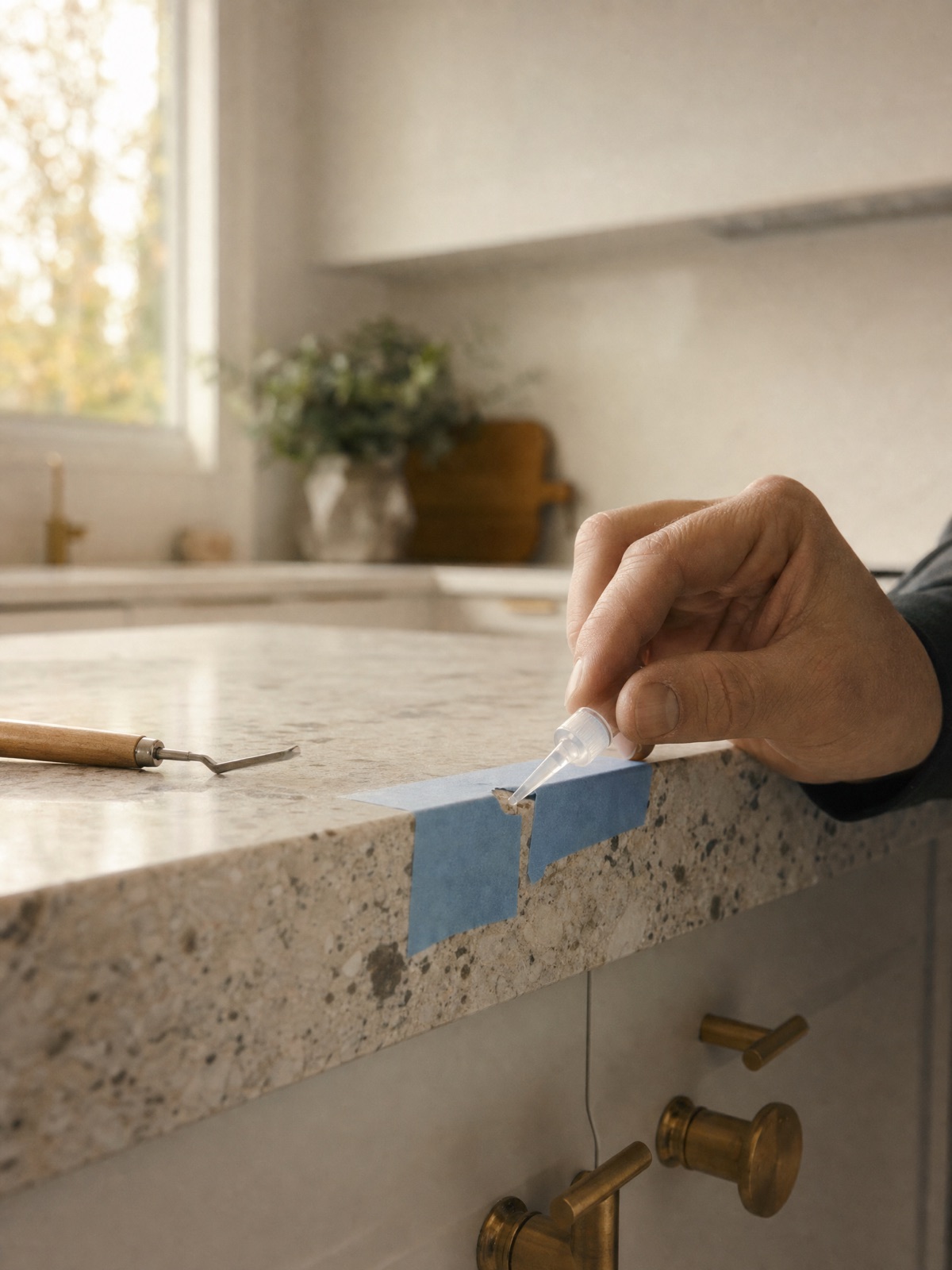
Search “countertop repair” in Metro Vancouver and you will mostly find restoration companies promising to make any damage disappear. Some of that work is genuinely excellent. But a fabricator sees these problems from the other side of the bench — we cut, polish, and seam these surfaces for a living — and the honest truth is that some countertop damage is a sensible afternoon’s work for a careful homeowner, while some is a false economy that costs more to fix twice. This guide separates the two, covering chips, cracks, separated seams, scratches, and burn or heat marks across quartz, granite, and marble, and being direct about when a DIY repair is reasonable, when it is a waste of money, and when calling a professional actually saves you. Alpine Countertops has fabricated and installed stone surfaces across the Lower Mainland since 2015; this is the perspective we give our own clients.
Quick reference: repair triage by issue and material
The right response to countertop damage depends almost entirely on two things: what kind of damage it is, and what the surface is made of. Engineered quartz, natural granite, and natural marble all behave differently under a chip, a crack, or a hot pan. The table below is the short version of everything that follows.
| Issue | Quartz (engineered) | Granite (natural) | Marble (natural) |
|---|---|---|---|
| Small surface chip (edge or sink) | Colour-matched epoxy fill — reasonable DIY for a small chip; colour-matching is harder on patterned quartz | Colour-matched epoxy fill, then can be polished flush — reasonable DIY | Epoxy fill; marble can also be re-honed/re-polished by a pro for a near-seamless result |
| Deep scratch | Limited — quartz cannot be re-polished at home like stone; fine marks may buff, deep ones usually stay | Often buffable/re-honable by a pro; minor marks may respond to careful DIY | Re-honing and re-polishing by a pro; light marks may take a polishing powder |
| Crack (through the slab) | Professional — structural, often signals a support or stress issue; warranty-sensitive | Professional | Professional |
| Separated seam | Professional in nearly all cases — needs colour-matched stone adhesive, support correction, and re-levelling | ||
| Burn / heat mark | Often not fully repairable — resin scorch is permanent; severe cases need section replacement | Often buffable by a pro (granite tolerates high heat); light marks may lift | Variable — light marks may polish out; scorching usually needs a pro |
| Large chip / broken corner | Professional — large fills rarely look good and may need a dropped-in repair or piece replacement | ||
If you take one thing from this table: cracks, failed seams, large chips, and burns through the surface are professional territory on every material. Small chips and light scratches are where a homeowner can reasonably get a good result — with realistic expectations.
Repairing chips
Chips are the most common countertop damage and the most DIY-friendly — within limits. A chip is a small piece of the surface broken away, usually at a vulnerable edge: the front lip of the counter, the rim of an undermount sink cut-out, or a corner in a high-traffic zone. A dropped pan or a knock from a cast-iron skillet is the usual cause.
A small chip — roughly a grain of rice up to a small fingernail in size — is a reasonable repair for a careful homeowner. The method is the same in principle across materials: clean and dry the chip, tape around it, fill with a two-part clear or colour-matched epoxy (or a colour-matched stone adhesive), level slightly proud, cure fully, then shave and polish flush. Set your expectations correctly: a good chip repair is much less visible, not invisible. On a busy granite pattern or a flecked quartz, a careful fill can be genuinely hard to spot; on a solid dark colour or a clean white, even a good repair often catches the light at a certain angle.
The honest line on materials: granite and other natural stone re-polish well after a fill, because a pro can hone and buff the repair into the surrounding finish. Engineered quartz cannot be re-polished the same way — its sheen comes from the factory, not from on-site polishing, so a quartz chip repair relies almost entirely on colour-matching the filler. That makes quartz chips on plain colours the hardest to hide and the most worth a professional opinion before you start.
When a chip is large — a broken corner, a piece bigger than a coin, or one that has taken a bite out of the edge profile — stop. Large fills slump, discolour, and rarely sit flush. A fabricator may be able to drop in a colour-matched piece or re-profile a damaged edge, a far better outcome than a thumb-sized lump of epoxy you will look at every day.
Repairing scratches
Scratches divide cleanly by material. Natural stone — granite, marble, quartzite — can be re-honed and re-polished, because you are working the stone itself. A light scratch in granite may respond to careful buffing; deeper marks are a job for a stone professional with diamond pads who can blend the area back into the finish. Marble, being softer and calcareous, scratches more easily but also re-polishes readily in skilled hands.
Engineered quartz is the hard case. Because quartz gets its finish at the factory and not on site, you cannot simply sand and re-polish a scratch out the way you can with stone. Very fine surface marks sometimes diminish with a gentle non-abrasive polish, but a deep scratch in quartz usually stays, and aggressive buffing can leave a dull patch worse than the scratch. This is one of the most over-promised repairs online — be sceptical of any guide claiming you can make a deep quartz scratch vanish at home. If one genuinely bothers you, a professional assessment is the honest next step. Prevention — a cutting board, never dragging cookware or ceramics across the surface — is far more effective than any repair.
Cracks and separated seams
Cracks and separated seams look similar to a homeowner but have different causes, and both are professional repairs.
A crack runs through the slab itself, and rarely at random — it usually points to an underlying cause: inadequate support under a span, stress concentrated at a sink or cooktop cut-out, a cabinet that has shifted, or thermal shock from sudden heat. Because a crack is structural, filling the visible line without addressing the cause tends to fail. A fabricator assesses why it happened, stabilises and supports the slab, fills with a colour-matched structural adhesive, and advises whether the section can be saved or needs replacing. Cracks are also the most warranty-sensitive damage — see the warranty section below before anyone touches it.
A separated seam is the join between two slabs opening up, lifting, or discolouring — usually from house settling, adhesive failure over time, inadequate support beneath the join, or a shifted level. Proper repair means cleaning out the old adhesive, correcting the support or levelling problem underneath, re-bonding with fresh colour-matched stone adhesive, and tooling the joint flush. Matching cured adhesive to a patterned stone is a fabricator’s skill, which is why a separated seam is almost always a professional job. Our guide on fixing a cracked or separated countertop seam explains what you can assess yourself and why the repair is best left to a pro.
Burns and heat marks
Heat damage is where honesty matters most, because the most common surface in Vancouver kitchens — engineered quartz — is also the one most likely to be permanently marked by heat, and where false promises do the most harm.
Quartz. Engineered quartz is roughly 90% ground quartz bound with a polymer resin (about 6–10% of the slab), and that resin is the heat-weak link. Quartz is heat-resistant, not heat-proof. A hot pan can scorch or discolour the resin, leaving a white, yellow, or brown mark — and once the resin has burned, that change is generally permanent. There is no reliable home fix for true resin scorch: mild surface marks may sometimes be cleaned, but a genuine burn usually cannot be polished out, and severe damage may require replacing the affected section. Caesarstone, for example, advises never placing anything hotter than about 300°F (≈150°C) directly on the surface and always using a trivet (a separate Caesarstone note puts the resin’s sensitivity lower still). The practical takeaway: trivets and hot pads, every time. We cover this in our guide to heat marks on quartz countertops.
Granite. Natural granite tolerates high heat far better — the stone itself withstands temperatures well beyond any kitchen pan. Light heat marks or a scorched residue on granite can often be buffed out by a professional, and granite is the most heat-forgiving common countertop. (Sealer and resin treatments on the surface can still be affected by direct heat, so a trivet is still wise.)
Marble. Marble sits in between — light marks may polish out, but scorching or a heat-related dull patch usually needs professional honing.
Our companion piece on repairing burn marks on countertops breaks this down by material, including laminate, with realistic outcomes for each.
When DIY is fine — and when it is a false economy
This is the section restoration marketing leaves out. Doing it yourself is genuinely the right call sometimes. Other times it costs you the price of a proper repair plus the materials you wasted plus, occasionally, a voided warranty.
Reasonable DIY:
- A small chip on a forgiving, patterned surface, filled with colour-matched epoxy and your expectations set to “much less visible.”
- A light surface scratch on natural stone, gently buffed.
- Routine prevention — the single highest-value thing a homeowner can do (see our countertop dos and don’ts checklist).
False economy — call a professional:
- Any crack. Filling the line without fixing the cause means it cracks again, and a bad fill can make professional repair harder.
- A separated seam. Colour-matching and re-levelling are fabricator skills; a DIY attempt usually shows.
- A deep quartz scratch or a quartz burn. These over-promise online and under-deliver at home; aggressive buffing on quartz can create a dull patch worse than the original mark.
- Large chips or broken corners. Big fills look like big fills.
- Anything on a surface still under warranty — a DIY repair can void coverage that would have fixed the problem for free.
How a fabricator repairs — and why colour-matching matters
A professional repair looks different from a DIY one mostly because of colour-matching and finish. A fabricator does not reach for a single tube of clear epoxy — we tint a structural adhesive or resin to match the specific stone’s base colour, veining, and flecks, and on natural stone we then hone and polish the repair so its sheen matches the surrounding surface. On a separated seam we correct the support and level before re-bonding, so the join does not simply re-open. On a chipped corner we may re-cut and re-profile the edge rather than build it up with filler.
Because Alpine fabricates in our own Richmond facility, we keep records of what we install, which makes colour-matching a repair on our own work more precise. We can often repair installs done by others, too — when we can match the stone and the damage is repairable, we are happy to look. The honest caveat: heavily patterned or discontinued quartz can be difficult to match perfectly, and we will tell you that up front rather than after the fact.
Warranty considerations
Before you, or anyone, repairs a countertop, check whether it is still covered. Manufacturer and fabricator warranties vary widely, and several points catch homeowners out:
- Heat damage is excluded from most quartz warranties. Engineered-quartz makers generally do not cover scorching or discolouration from direct heat, which is exactly why trivets matter so much.
- A DIY repair can void remaining coverage. If your surface is still under warranty, an attempted home fix on a crack or manufacturing defect may forfeit a free professional remedy. Call the fabricator first.
- Cracks may indicate a covered defect — or an installation issue. Either way, documenting it before touching it protects you.
If Alpine installed your countertop, call us before attempting any repair on a crack, seam, or possible defect — it may be covered, and we would rather fix it properly than inherit a DIY attempt.
Countertop repair in Metro Vancouver
A few things are specific to the Lower Mainland. First, on residue that looks like damage: Metro Vancouver’s tap water is very soft — roughly 2.5 to 4.8 mg/L hardness, drawn from the Capilano, Seymour, and Coquitlam mountain reservoirs — so the cloudy film some homeowners mistake for etching or surface damage is far more often soap film, cleaner residue, or dishwasher rinse-aid carryover than true hard-water scale. That is good news: a residue problem is a cleaning problem, not a repair. Genuine mineral spotting is more plausible for Fraser Valley households on groundwater wells, in parts of Abbotsford and Langley Township.
Second, our wet winters and the marine air in coastal communities like White Rock and West Vancouver mean any wood substrate under a counter should be properly sealed — a swollen or shifting cabinet can stress a seam or span and is a hidden cause of cracks. Alpine serves the full region, from Vancouver and Burnaby to Surrey, Richmond, Coquitlam, the North Shore, and the Fraser Valley. If you are unsure whether you are looking at damage or residue, a photo and a phone call usually settle it before you spend on a repair you do not need.
Frequently asked questions
Can I repair a chipped countertop myself?
A small chip — up to roughly a small fingernail in size — is a reasonable DIY repair using a two-part clear or colour-matched epoxy: tape off the area, fill slightly proud, cure fully, then level and polish flush. Set realistic expectations — a good repair is much less visible, not invisible, and it is hardest to hide on plain dark or solid white surfaces. Large chips, broken corners, and chips on warranty-covered surfaces are better left to a professional.
Can a cracked countertop be repaired, or does it need replacing?
Many cracks can be repaired by a professional, but a crack almost always has an underlying cause — inadequate support, stress at a cut-out, or a shifted cabinet — that must be addressed, or the repair fails. A fabricator stabilises and supports the slab, fills with a colour-matched structural adhesive, and advises whether the section can be saved or replaced. Filling the visible line yourself rarely holds. Check your warranty before anyone touches it.
Can burn marks be removed from a quartz countertop?
Usually not completely. Engineered quartz is bound with a polymer resin that can scorch or discolour permanently when it burns, and there is no reliable home fix for true resin scorch. Mild surface marks may sometimes be cleaned, but a genuine burn often cannot be polished out, and severe damage may require replacing the affected section. Granite, by contrast, tolerates heat far better and light marks can often be buffed out by a professional.
Why can’t quartz scratches be polished out like granite?
Engineered quartz gets its finish at the factory during manufacturing, not from on-site polishing, so you cannot sand and re-polish a scratch out the way you can with natural stone. Very fine marks may diminish with a gentle non-abrasive polish, but deep scratches usually remain, and aggressive buffing can leave a dull patch worse than the scratch. Granite and marble, being natural stone, can be re-honed and re-polished by a professional.
Will a DIY repair void my countertop warranty?
It can. If your surface is still under a manufacturer or fabricator warranty, an attempted home repair on a crack, seam, or possible manufacturing defect may forfeit a remedy you would otherwise get free. Heat damage is separately excluded from most quartz warranties regardless of who repairs it. The safe move is to call your fabricator before attempting anything on structural or defect-related damage.
Can Alpine repair a countertop another company installed?
Often, yes. When we can match the material and the damage is repairable, we are happy to assess installs originally done by others. The honest caveat is that heavily patterned or discontinued surfaces — some quartz especially — can be difficult to colour-match perfectly, and we will tell you that before starting rather than after. Send a photo and we can usually give you an honest read over the phone.
Related guides
Repair is one part of looking after a countertop. These guides go deeper:
- How to fix a cracked or separated countertop seam
- How to repair burn marks on countertops
- Countertop dos and don’ts: a care checklist by material
- Quartz countertop care guide
- Granite countertop care guide
- Marble countertop care guide
- Countertop sealing guide
- How to choose a countertop fabricator in Vancouver
Planning a new countertop or replacing a damaged one? See our city pages for Vancouver, Richmond, Surrey, and Burnaby.
Get help from Alpine
Not sure whether your countertop damage is a DIY job or a professional one? Send us a photo and we will give you an honest assessment — sometimes the answer is “that is a cleaning problem, not a repair,” and we will tell you so. Call 604-630-5700 or email info@alpinecountertops.com. Alpine Countertops fabricates in our own Richmond facility and serves homeowners across Metro Vancouver and the Fraser Valley. You can also reach us through our contact page.