
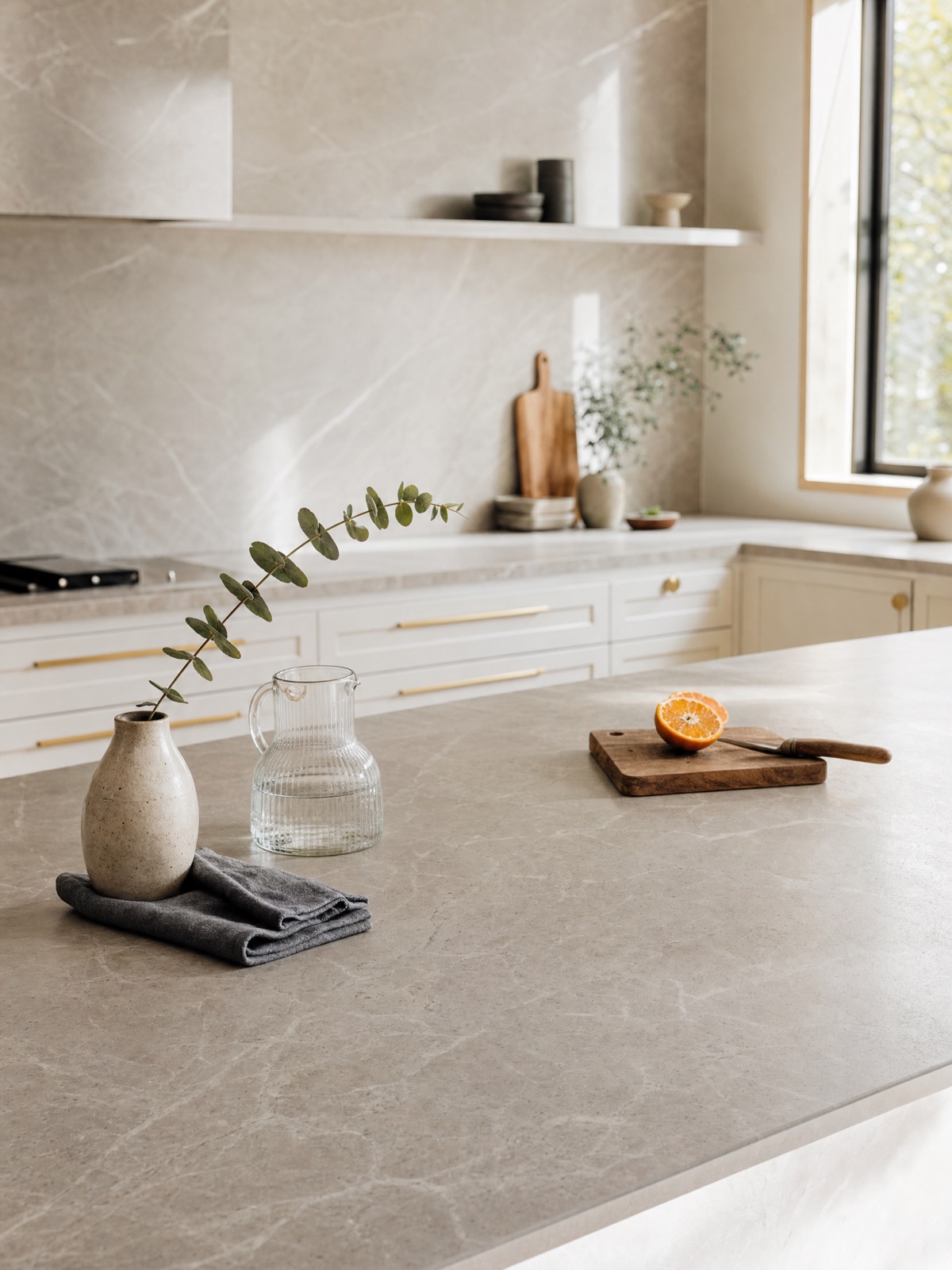
Dekton vs Quartz vs Granite for Vancouver Kitchens
Quick answer: For an indoor Vancouver kitchen, quartz and granite are both excellent — quartz for low-maintenance consistency, granite for natural-stone character. Dekton (a sintered stone made by Cosentino) pulls ahead when you need extreme performance: it’s UV-stable, takes direct heat, and resists scratches better than the other two, which makes it the standout for outdoor kitchens and sun-exposed counters. The catch is that Dekton’s thin, rigid slabs can chip at edges under hard impact and it’s typically the priciest of the three. Pick by use case: indoor/budget leans quartz or granite; outdoor/heavy-duty leans Dekton.
Last updated: June 2026
Three of the surfaces we fabricate most often at our Richmond shop are quartz, granite, and Dekton — and clients frequently ask us to line them up against each other. They sit in three different families: granite is natural stone, quartz is engineered stone, and Dekton is sintered stone. Each is the right answer for a different kind of Vancouver kitchen. Below is a straight three-way comparison framed around how you’ll actually use the counter — indoors, outdoors, on a budget, or in a kitchen that takes a beating. (For the full lineup of every material side by side, see our complete countertop materials comparison.)
What is Dekton, exactly?
Dekton is a brand of sintered stone made by Cosentino (the same company behind Silestone). It’s produced by blending raw materials found in glass, quartz, and porcelain, compressing them under enormous pressure, and firing them at very high temperatures — a process that mimics, in hours, the heat and pressure that form natural stone over millennia. The key thing for performance: Dekton contains no polymer resin. That single fact is why it’s UV-stable and extremely heat-tolerant, where engineered quartz (which does contain resin) is neither. Sintered stone is a broader category — Neolith is another well-known brand — but “Dekton” is the name most Vancouver homeowners have heard, so that’s the term we’ll use here.
Dekton vs quartz vs granite at a glance
| Dimension | Dekton (sintered) | Quartz (engineered) | Granite (natural) |
|---|---|---|---|
| Material | Glass, quartz & porcelain minerals, sintered; no resin | Ground stone (predominantly quartz) + polymer resin | 100% natural quarried stone |
| UV stability / outdoor | UV-stable; built for outdoors | Not UV-stable; outdoor use voids warranty | UV-stable; works outdoors (sealed) |
| Heat | Excellent — withstands direct hot cookware | Limited — resin is heat-sensitive and can scorch from hot pans | Excellent — handles hot cookware well |
| Scratch resistance | Outstanding — harder than granite | Very good | Very good (~6–7 Mohs) |
| Impact / chipping | Thin, rigid; edges/corners can chip on hard impact | More forgiving of impact | Durable; corners can chip if struck hard |
| Staining / porosity | Non-porous; no sealing | Non-porous; no sealing | Porous; seal periodically (~every 1–2 years) |
| Look | Engineered patterns, large format, often matte | Huge range of consistent colours | Natural, one-of-a-kind, varied |
| Relative cost | Typically the highest of the three | Wide range; many price points | Wide range; many affordable options |
| Best for | Outdoor kitchens, sun, heavy heat & scratch use | Low-maintenance indoor kitchens | Natural-stone lovers, indoor or covered outdoor |
Which is best for an outdoor Vancouver kitchen?
Dekton, with granite as a solid natural-stone alternative — and quartz off the table. This is the clearest dividing line of the three. Dekton is UV-stable because it has no resin to degrade, so it won’t fade or discolour through years of BC sun, and it handles the temperature swings and direct grill heat of an outdoor kitchen without trouble. Granite is also UV-stable and works outdoors when properly sealed and maintained, so it’s a legitimate natural-stone option for a covered patio. Quartz, by contrast, is not UV-stable: under sustained, direct sun its resin breaks down, causing yellowing or fading, and manufacturers void warranties on outdoor installs. For any sun-exposed or outdoor counter, choose Dekton or granite. Our outdoor kitchen countertops guide and our porcelain vs quartz comparison cover the outdoor decision in more detail.
Which handles heat and scratches best?
On heat, Dekton and granite are both very strong — both tolerate hot cookware set directly on the surface (we still suggest trivets as good habit). Quartz is the outlier: its resin binder is heat-sensitive and can scorch or discolour from a hot pan, so trivets aren’t optional with quartz.
On scratches, Dekton leads. It’s harder than granite and the most scratch-resistant of the three — a real advantage if you’re the type who occasionally cuts straight on the counter (still not recommended on any surface). Granite is also very scratch-resistant at roughly 6–7 on the Mohs scale, and quartz holds up well too. None of the three scratches easily in normal use; Dekton just has the most headroom.
What are the trade-offs with Dekton?
Dekton’s strengths come with two honest caveats we always raise:
- Edge and corner chipping. Because Dekton slabs are thin and extremely rigid, a hard impact on an exposed edge or corner — think dropping heavy cast iron — can chip it, and impact cracks generally aren’t covered by warranty. Proper fabrication, the right edge profile, and good substrate support (what a trained shop provides) reduce this risk significantly, but it’s a genuine characteristic of the material.
- Cost and fabrication. Dekton is typically the most expensive of these three materials, and its hardness means it requires specialized cutting and experienced installers. That’s a feature, not a bug — but it’s reflected in the price.
Quartz and granite each have their own trade-offs: quartz needs heat protection and can’t go outside; granite is porous and needs periodic sealing (see our granite care guide and quartz care guide).
How do the three compare on price?
All three are priced per square foot installed, and each spans a range driven by the specific slab or line, thickness, edge profile, cutouts, and install complexity. As a general pattern, granite and quartz both offer options across many price points, while Dekton typically sits at the higher end given the material and its specialized fabrication. For real side-by-side ranges across all the materials Alpine fabricates — including porcelain and sintered stone — see our Vancouver countertop cost comparison. For a figure tied to your slab and layout, request a quote.
Which should you choose?
Frame it by how and where you’ll use the counter:
- Indoor kitchen, low maintenance, widest colour choice → quartz. Non-porous, no sealing, hundreds of consistent looks. Just use trivets and keep it indoors.
- Indoor (or covered outdoor) kitchen, natural-stone character, value options → granite. One-of-a-kind slabs, great heat tolerance, broad price range; just plan on periodic sealing.
- Outdoor kitchen, sun exposure, heavy heat or scratch use, max performance → Dekton. UV-stable, extremely tough, no sealing — accept the higher cost and mind hard impacts at edges.
- On a tight budget → granite or quartz will almost always give you more options than Dekton.
Frequently asked questions
Is Dekton better than quartz and granite?
Dekton outperforms both on UV stability, heat tolerance, and scratch resistance, which makes it the strongest choice for outdoor and heavy-duty use. For typical indoor kitchens, however, quartz and granite are excellent and usually more affordable, so “better” depends on your use case rather than a single winner.
Is Dekton the same as porcelain or quartz?
No. Dekton is a sintered stone made by Cosentino from glass, quartz, and porcelain minerals fired under high heat and pressure, with no polymer resin. Engineered quartz uses ground stone (predominantly quartz) bound with resin. Porcelain is a related sintered surface, but Dekton is a specific ultra-compact product.
Can quartz go outdoors if granite and Dekton can?
Quartz is not recommended outdoors because its resin degrades under sustained UV light, leading to yellowing or fading, and outdoor installs void manufacturer warranties. Granite (sealed) and Dekton are both UV-stable and suitable for outdoor kitchens.
Does Dekton chip easily?
In normal use Dekton is highly durable, but its thin, rigid slabs can chip at exposed edges or corners under hard impact, and impact damage typically isn’t covered by warranty. Quality fabrication, appropriate edge profiles, and proper support reduce the risk substantially.
Which is cheapest: Dekton, quartz, or granite?
Granite and quartz both offer options across a wide price range and are generally more budget-friendly, while Dekton typically sits at the higher end because of the material and its specialized fabrication. Exact pricing depends on the slab, edge, and layout, so a project quote is the most accurate guide.
Talk to Alpine about your kitchen
Alpine Countertops fabricates Dekton, quartz, and granite for Metro Vancouver and Fraser Valley homes from our Richmond shop, and we’ve been doing it since 2015 (BBB A+ accredited). Tell us where the counter is going and how you’ll use it, and we’ll match the material to the job and quote your exact layout. Call 604-630-5700, email info@alpinecountertops.com, or contact us here. Serving Vancouver, Burnaby, Richmond, Surrey, North Vancouver and beyond.