
Outdoor Kitchen Countertops in Vancouver: What Survives Our Coastal Climate
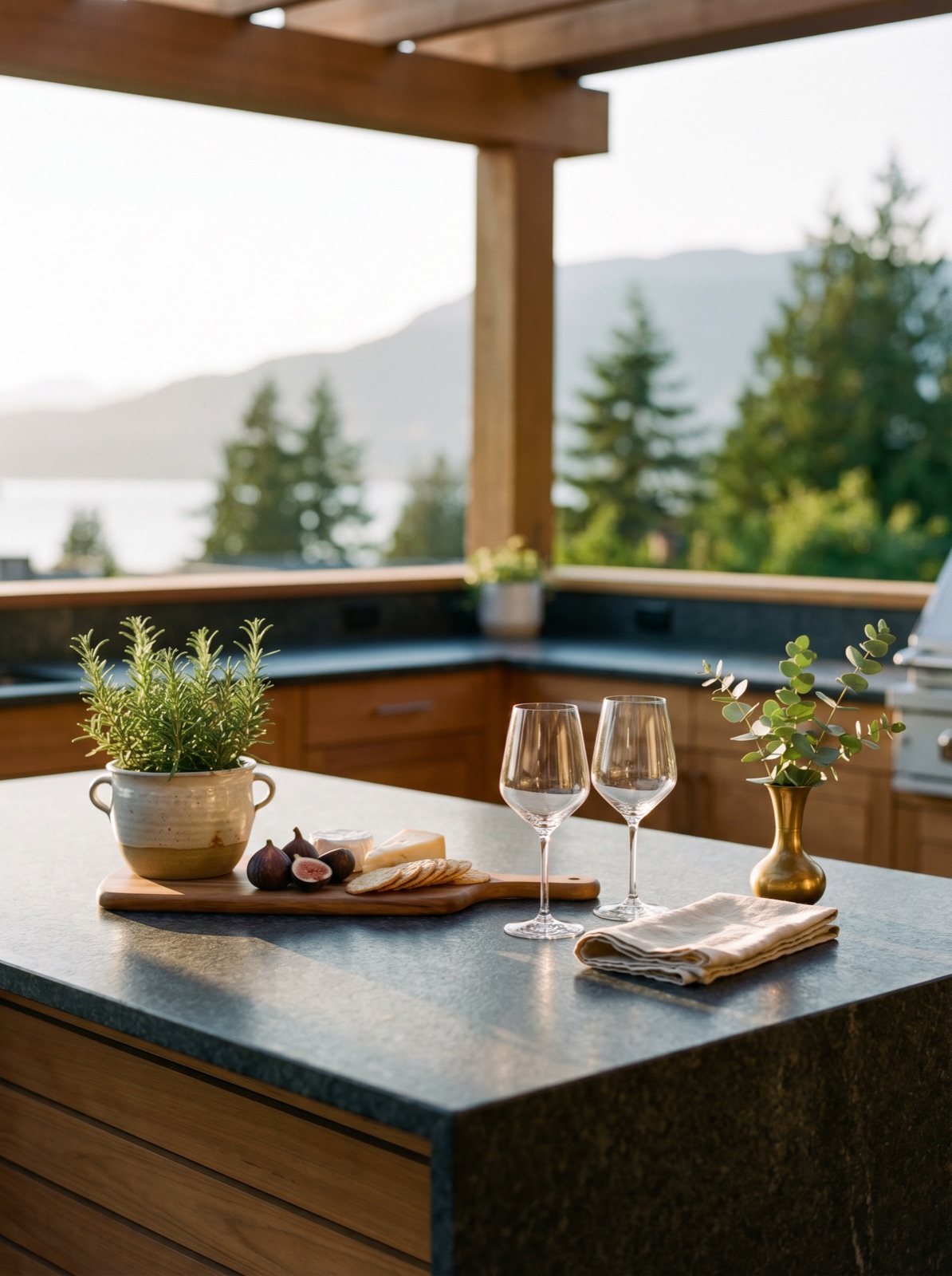
July in North Vancouver. You’re grilling salmon on the deck, wine in hand. By October, your deck is taking sheets of rain. Winter brings the occasional frost down the Sea-to-Sky corridor and an overnight dip below zero. Your countertop sees it all.
Choosing outdoor kitchen countertops in Vancouver isn’t the same decision as picking an indoor surface. The material has to handle roughly 1,160 mm of rain a year, weeks of UV exposure in summer, and the freeze-thaw cycles that occasionally punish West Vancouver decks in January. Most indoor countertop materials — quartz especially — simply don’t belong outside. Here is what actually survives, what’s been oversold, and what we at Alpine recommend for Metro Vancouver backyards.
What Metro Vancouver weather does to outdoor countertops
Environment Canada’s 1991–2020 climate normals put annual precipitation at Vancouver International Airport at about 1,159.5 mm — the bulk of it falling October through March. Mean January daily lows hover around 1.4°C at YVR, which looks mild until you remember that North Shore decks at elevation can drop several degrees below that, with snow accumulation in some years.
Three forces do the damage:
- Water and humidity. Constant wetting and drying. Any porous material that isn’t sealed will stain, absorb moisture, and eventually fail.
- Freeze-thaw cycles. Water enters micro-pores, freezes, expands, and cracks the material from within. Rare at YVR, real at 300 metres elevation.
- UV exposure. Long summer days in Vancouver — June solstice brings more than 16 hours of daylight — bleach and degrade anything sensitive to ultraviolet light.
An outdoor countertop has to shrug off all three.
Quartz is NOT for outdoor use — here’s why
Engineered quartz countertops (Caesarstone, Silestone, Cambria, Vicostone) are about 90–93% ground natural quartz bound with roughly 7–10% polymer resin. That resin is the problem outdoors. UV degrades polymers — they yellow, become brittle, and separate from the quartz matrix.
This isn’t our opinion. Caesarstone Canada sells two separate product lines: their standard indoor quartz and a dedicated Outdoor Collection engineered with “weather and UV resistance technology” that their indoor quartz doesn’t have. Cosentino’s Silestone indoor line is likewise marketed for kitchens, baths, and interior cladding — exterior applications are steered toward their separate Dekton product. Cambria’s standard lifetime residential warranty is written for interior installation.
If a fabricator offers to install standard indoor Caesarstone or Silestone on your covered deck, get a second opinion — the warranty ends the moment the sun hits it.
If you want the quartz look outdoors: specify the manufacturer’s outdoor-rated line (Caesarstone Outdoor Collection, for example), not their indoor SKUs. These are newer, more limited in color, and priced at a premium.
Porcelain and sintered stone (Dekton, Neolith): the top outdoor choice
Sintered porcelain slabs are the strongest all-round performer for a Vancouver outdoor kitchen. Cosentino states directly that “Dekton is unaffected by ultraviolet rays. Its colour does not fade or degrade overtime, maintaining the same appearance as the first day it was installed in any interior or exterior application.” That single sentence explains why designers default to Dekton and Neolith for exterior countertops.
The case for porcelain outdoors:
- UV-stable colour. No yellowing, no fading.
- Near-zero water absorption. The sintering process at around 1200°C produces a vitrified body that doesn’t drink in rain.
- Heat-tolerant for BBQ zones. Cosentino notes Dekton carries A1 non-combustible fire rating and a low coefficient of thermal expansion, meaning it handles hot-pan-off-the-grill events better than most surfaces.
- Low freeze-thaw risk. A body that barely absorbs water has little for ice to expand inside.
The trade-offs: fabrication is demanding (see our porcelain countertops guide for Vancouver), and colour range is narrower than quartz.
Granite — a solid natural choice
Granite is a respectable outdoor countertop material and has been used on patios longer than most engineered products have existed. Darker granites — Absolute Black, Steel Grey, Impala Black — perform particularly well: UV-stable colour, dense mineral structure, and stains less visible when they do happen.
The catch is sealing. Indoors, a good granite sealer lasts one to three years. Outdoors, the UV and constant wetting-drying cycle break sealers down faster — plan on resealing annually, sometimes twice a year for unprotected installations. Lighter granites and stones with visible mineral inclusions can also develop staining around the BBQ zone from grease and bird droppings.
If you like the look of granite and want a natural material that will still look good in 2040, specify a dense, darker slab and commit to the maintenance schedule. Browse our granite offerings to see what we keep in stock. For the indoor comparison most homeowners start with, see our quartz vs granite guide for Vancouver kitchens.
Soapstone and lava stone — niche but beautiful outdoor options
Soapstone is a quiet favourite among homeowners who like a material that patinas gracefully. It’s dense, non-porous enough to resist staining, and unbothered by UV. It darkens over time — most soapstone fans consider that a feature. Periodic mineral oil keeps the tone even.
Lava stone (volcanic basalt, sometimes glazed) is another niche option — weather-stable, heat-resistant, often finished with ceramic enamel glazes. Rare in Metro Vancouver fabrication but available by special order. Both are expensive relative to granite and require a fabricator comfortable with the material.
Concrete countertops — handle with care
Concrete can work outdoors, but it’s the most demanding choice on this list. An outdoor concrete counter needs high-quality sealing, frequent re-sealing, and careful edge detailing. Micro-cracks from freeze-thaw are the biggest risk — water enters a tiny fissure, freezes on a January night, widens the crack. A well-done outdoor concrete install often approaches porcelain or granite in cost without the same durability. In Vancouver’s wet climate, we steer homeowners elsewhere unless the concrete look is non-negotiable.
Materials to avoid outdoors in Vancouver
- Standard indoor quartz. Covered above. Will yellow and void warranty.
- Marble. Etches from acid rain, stains from leaves and tannins, and the softer varieties erode visibly within a few seasons. Keep it indoors.
- Laminate. Delaminates in the first wet winter.
- Wood butcher block. Rots in Vancouver humidity even under a pergola. Fine for cutting boards, not for the counter itself.
Design considerations for a BC outdoor kitchen
Cover what you can. A pergola, retractable awning, or pitched roof extends every material’s lifespan — even UV-stable porcelain lasts longer when it isn’t pounded by 1,160 mm of annual rain.
Thickness matters. We recommend 20 mm (3/4”) minimum slab thickness for outdoor structural stability, 30 mm for unsupported spans. Thinner 12 mm porcelain can work with the right substrate but leaves less margin.
Plan the BBQ cutout. Built-in grills need clearances per the manufacturer’s installation manual; anchor points go into the template before fabrication.
Edges take abuse. A simple eased or 1/4” bevel holds up better than intricate ogees. If you want a waterfall island, porcelain and dark granites hold the mitre best — see our waterfall edge countertop guide.
Maintenance schedule for Metro Vancouver outdoor counters
- Spring (March–April): Deep clean with a pH-neutral stone cleaner. Inspect for winter damage — hairline cracks, loose sealer, displaced caulking.
- Mid-summer: Quick inspection. Wipe grease build-up around the BBQ zone.
- Fall (September–October): Clean, then reseal granite. Porcelain doesn’t need sealing. Concrete gets a fresh sealer coat.
- Winter: If your property takes real snow or ice (Cypress, Lions Bay, higher elevations), cover exposed counters with a breathable outdoor cover. Most Metro Vancouver properties below 100 m elevation don’t need one.
Cost: what outdoor kitchen countertops actually run
Qualitatively, for a Metro Vancouver outdoor kitchen:
- Porcelain / Dekton / Neolith: The highest tier, driven by slab cost and fabrication demands.
- Granite (darker, denser varieties): Usually the mid-range choice — reasonable slab cost, routine fabrication, but factor in ongoing sealer costs.
- Caesarstone Outdoor Collection and similar branded outdoor quartz: Priced in line with premium porcelain, narrower colour choice.
- Soapstone and lava stone: Premium pricing driven by sourcing and rarity.
- Concrete: Widely variable — a well-done outdoor concrete counter can rival porcelain in cost.
A covered outdoor kitchen in a Vancouver backyard usually runs several thousand dollars in counter surface alone, before BBQ, cabinetry, and plumbing. It’s an investment — pick a material that will still look good a decade from now.
Planning a Kitchen or Bath Countertop Project in Metro Vancouver?
Alpine Countertops has been crafting premium quartz, granite, marble, and porcelain surfaces in our Richmond facility since 2015. We serve homeowners across Vancouver, Burnaby, Richmond, Surrey, West Vancouver, North Vancouver, Coquitlam, New Westminster, and Langley.
Book a free design consultation:
– 📞 604-630-5700
– 📍 Fabrication facility: Richmond, BC
– 🌐 Browse our gallery · View countertop materials · Get in touch
Alpine Countertops — Professionals Bringing Style to Life.