
BC Farm-to-Table Kitchens: Countertops Built for Fresh Local Produce
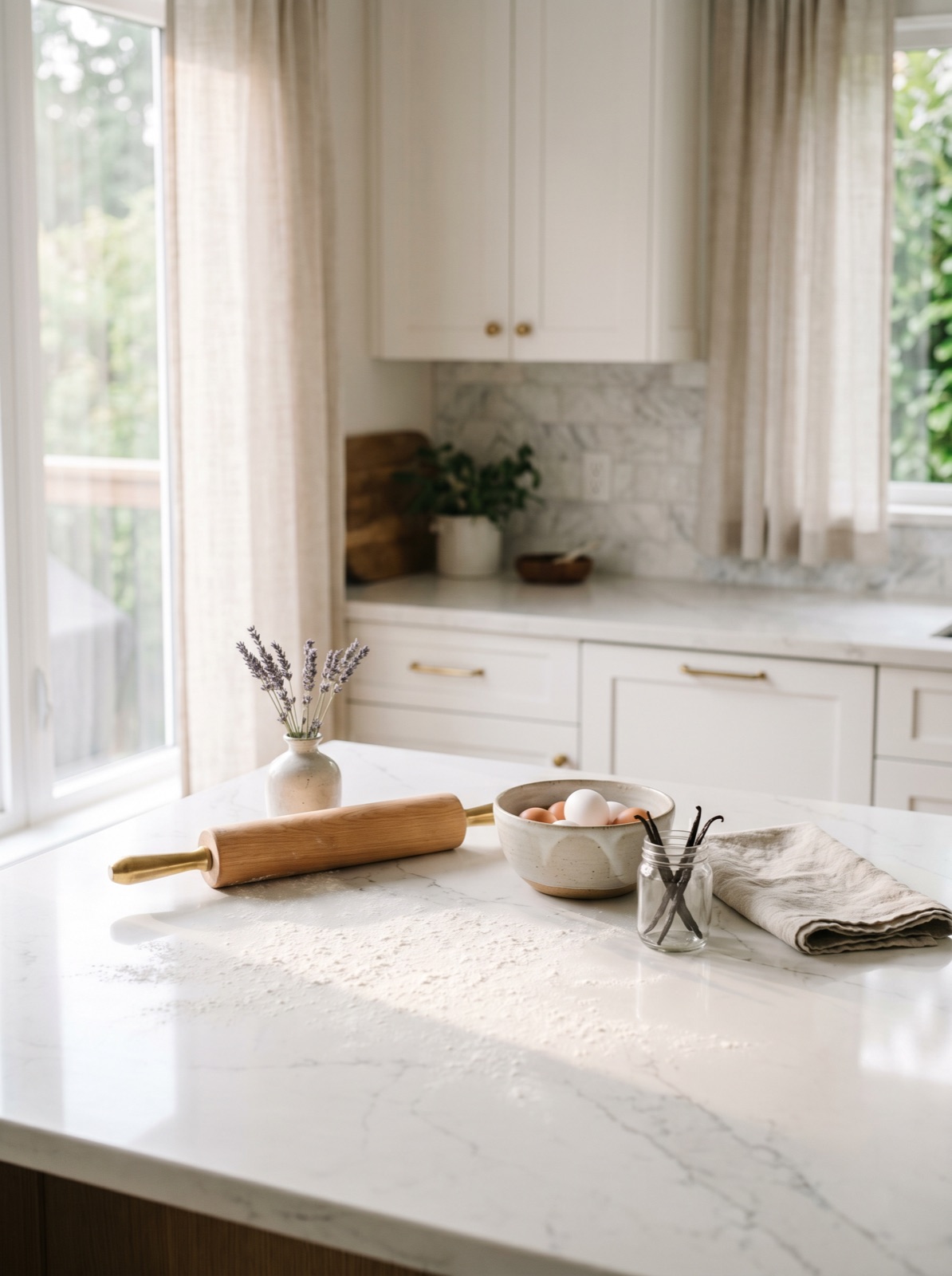
Saturday morning, Trout Lake Farmers Market. You leave with Okanagan peaches, Fraser Valley heirloom tomatoes, Salt Spring goat cheese, and a pound of Steveston spot prawns. By noon they’re on your island, waiting to become lunch.
That moment — shopping bags down, produce spread across the counter — is where a BC farm to table kitchen either works or doesn’t. The countertop takes tomato juice, peach nectar, prawn shells, and a cutting board at an angle. The choices that make this easy happen long before the basil hits the board.
We build countertops in Richmond for Vancouver homeowners who cook this way — seasonally, bought that morning, usually for more people than the recipe calls for. Here’s what matters when the kitchen is the working end of a BC harvest.
What makes a kitchen farm-to-table ready?
Not a style — a set of working realities.
- A real prep station. 36”+ of clear counter, next to a sink, for landing groceries and washing greens.
- Washable surfaces. Beet juice, fish brine, tomato acid, turmeric — the countertop shrugs them off.
- Generous counter depth for staging a platter and a draining colander side by side.
- Good natural light for judging ripeness; a window over the prep zone changes how you cook.
- An island or table that seats people. Farm-to-table is social.
Nail those five and the rest is finish and preference.
The prep station — where countertop choice matters most
Every farmers’ market haul ends on one square metre of counter. That square metre does heavy work — and the wrong material complains within a season.
Quartz — the everyday workhorse
Engineered quartz (Caesarstone, Silestone, Cambria, Vicostone) is nonporous, so peach juice, tomato acid, and prawn water wipe off with soap and water. Caesarstone’s care guide describes its surfaces as “hard, nonporous, and stain-resistant” — the attribute that matters when the counter is wet from 9 a.m. to noon on market Saturdays.
The tradeoff: heat. Caesarstone’s Canadian care guide is explicit that cookware “above 300°F” shouldn’t sit directly on the surface — the polyester resin binding the quartz can cloud. A roasting pan lands on a trivet. For most prep-zone use, quartz is our default.
Porcelain — the heat-and-stain specialist
Sintered porcelain slabs handle more heat than quartz (no resin to melt), and they’re UV-stable — useful if your prep zone catches afternoon sun. Through-body porcelain shows veining throughout the slab, and it’s often thinner (12mm). If you want a marble look that survives citrus, porcelain is where we send you. See our guide to porcelain countertops for Vancouver kitchens.
Butcher block — cut-safe, on its own terms
A wood butcher block insert or island end-cap is a real farm-to-table move. You can cut directly on it, and it ages into its own story.
Wood needs upkeep, though: food-safe mineral oil monthly at first, then quarterly once seasoned. It stains if left wet. We specify butcher block as a zone within a larger quartz or porcelain counter, not as the whole run.
Not natural marble here
Marble is gorgeous and it etches on contact with citrus — a lemon wedge on honed Carrara leaves a dull spot no cleaner removes, because the acid has dissolved the calcite surface (geology.com’s marble reference). For a vanity, marble is defensible. For a prep station that sees lemons and tomatoes weekly, it’s the wrong stone. We cover the details in our marble vs quartz bathroom vanity comparison.
Counter depth and staging for BC harvests
Standard North American base cabinets are 24” deep; with an inch of overhang, that’s roughly 25–26” working depth. For a farm-to-table kitchen, that’s the floor, not the ceiling.
On a dedicated prep run — sink, landing zone, cutting area — we often push to 27–28”. Those extra two inches are the difference between prepping a pound of tomatoes and laying out eight pints of berries, a cutting board, and a salad bowl side by side.
For islands that double as seating, we plan a prep face of at least 25” and a seating-side overhang of 12” — the clearance most designers cite from NKBA-style guidelines. Specify depth before cabinets are ordered; once the boxes land, depth is fixed.
A second prep sink with a grove drainer
The single move that changes farm-to-table cooking most: a second sink near the prep zone, ideally with a grove drainer milled directly into the slab.
Why it matters on BC harvests — washing sandy summer greens from Delta and Fraser Valley fields, rinsing Sunshine Coast chanterelles in fall, scrubbing beets without turning the main sink pink, all without tying up the dishwashing queue.
A slab-milled drainer — shallow channels cut into the quartz or porcelain, angled toward the basin — is fabrication we do in our Richmond shop. It reads as a detail; in use, it’s what makes the kitchen feel designed around how you actually cook.
Materials pairing — BC-grown design
Farm-to-table kitchens in Vancouver look different from the white-on-white Instagram version. They borrow from the province:
- BC Douglas fir or Western red cedar cabinetry — locally milled, warm-grained, pairs with matte-finish quartz in oat, mushroom, or pale grey.
- Honed or matte counter finishes — polished high-gloss reads like a showroom; honed reads like a home, and echoes the softness of BC’s wet winters.
- Mixed metals — brushed brass and blackened bronze handle kitchen humidity better than polished chrome in our climate.
We’ve seen this direction gain steam across Metro Vancouver kitchen countertop trends in 2026 — warmer neutrals, textured finishes, locally sourced wood.
Colour palette — Okanagan and Coast Mountain inspiration
Pull your counter palette from the landscapes the food comes from:
- Warm oat and sand — Okanagan orchards and dry grasslands.
- Mountain grey and soft charcoal — the Coast Mountains in winter light.
- Creamy carrara-look quartz — the neutral that lets tomatoes and peaches pop on the island.
- Cherry-blossom white with a pink undertone — Vancouver springs.
Avoid stark bright-white quartz in a produce-heavy kitchen; it makes every beet stain look worse than it is and clashes with natural wood and linen.
Entertaining flow — from prep to plate to table
On a farm-to-table Saturday the island is three things within four hours: a grocery staging area, a prep counter, and a buffet. Design has to serve all three.
- 12” overhang on the seating side for stools; 18” for elbow room.
- 42–48” clearance between island and perimeter counters — two cooks can pass.
- Sightlines to the dining area so the host isn’t isolated from guests.
- Outlets flush into the island so slow cookers and immersion blenders plug in without cords across walkways.
For the morning end of that same island, see our breakfast bar design ideas for Vancouver kitchens.
Sustainability considerations
Farm-to-table eating is partly an environmental position; the countertop under it can be too — with caveats.
Recycled-content quartz. Cosentino’s HybriQ+ technology (used across newer Silestone collections including the low-silica Sunlit Days and Loft ranges launched in 2020) is documented to contain “minimum 20% recycled materials,” with manufacturing using “100% renewable electricity” and “99% reused water” per Cosentino. Caesarstone reports that “31% of our entire portfolio contains at least 40% recycled materials, and we expect to incorporate up to 50% recycled materials across our mineral collection by 2026.” Both brands publish EPDs and hold certifications including Greenguard and SCS. We won’t quote a single category-wide recycled % — it varies by colour, collection, and brand. We’ll pull the current spec for the colour you choose.
Local processing. Slabs are quarried worldwide; fabrication, templating, and installation happen here in Richmond — where your project’s freight footprint is smallest.
Longevity. The most sustainable countertop is the one you don’t rip out in ten years.
The year-round market rhythm
Vancouver farmers’ markets run year-round, thanks to the BC Association of Farmers’ Markets and the Vancouver Farmers Markets cooperative. Trout Lake opens in April and runs Saturdays through October, joined by Kitsilano, Riley Park, Mount Pleasant, West End, Downtown, and False Creek (eatlocal.org). Kitsilano and Riley Park winter markets cover the off months.
That year-round rhythm is why the countertop choice compounds — this isn’t an August-only kitchen. For the seasonal reset that accompanies market-season opening, see our spring kitchen refresh ideas.
Bringing it home
A BC farm to table kitchen isn’t a style brief — it’s a decision about how the room serves the food. The countertop makes or breaks that decision.
Our working shortlist:
- Primary surface: quartz in a warm neutral, honed or matte finish.
- Hot zone: porcelain near the range if heat tolerance matters.
- Cutting zone: butcher block insert or island end-cap, oiled.
- Second sink with a slab-milled grove drainer.
- Local wood cabinetry — fir or cedar — tying the kitchen to the food’s origin.
Build the kitchen around the market bag, not the magazine spread, and it’ll still be working on the Saturday morning fifteen Octobers from now.
Planning a Kitchen or Bath Countertop Project in Metro Vancouver?
Alpine Countertops has been crafting premium quartz, granite, marble, and porcelain surfaces in our Richmond facility since 2015. We serve homeowners across Vancouver, Burnaby, Richmond, Surrey, West Vancouver, North Vancouver, Coquitlam, New Westminster, and Langley.
Ready to translate one of these ideas into your own kitchen or bath? Alpine Countertops turns trend inspiration into real, livable surfaces for Vancouver homes.
Book a free design consultation:
– 📞 604-630-5700
– 📍 Fabrication facility: Richmond, BC
– 🌐 Browse our gallery · View countertop materials · Get in touch
Alpine Countertops — Professionals Bringing Style to Life.