
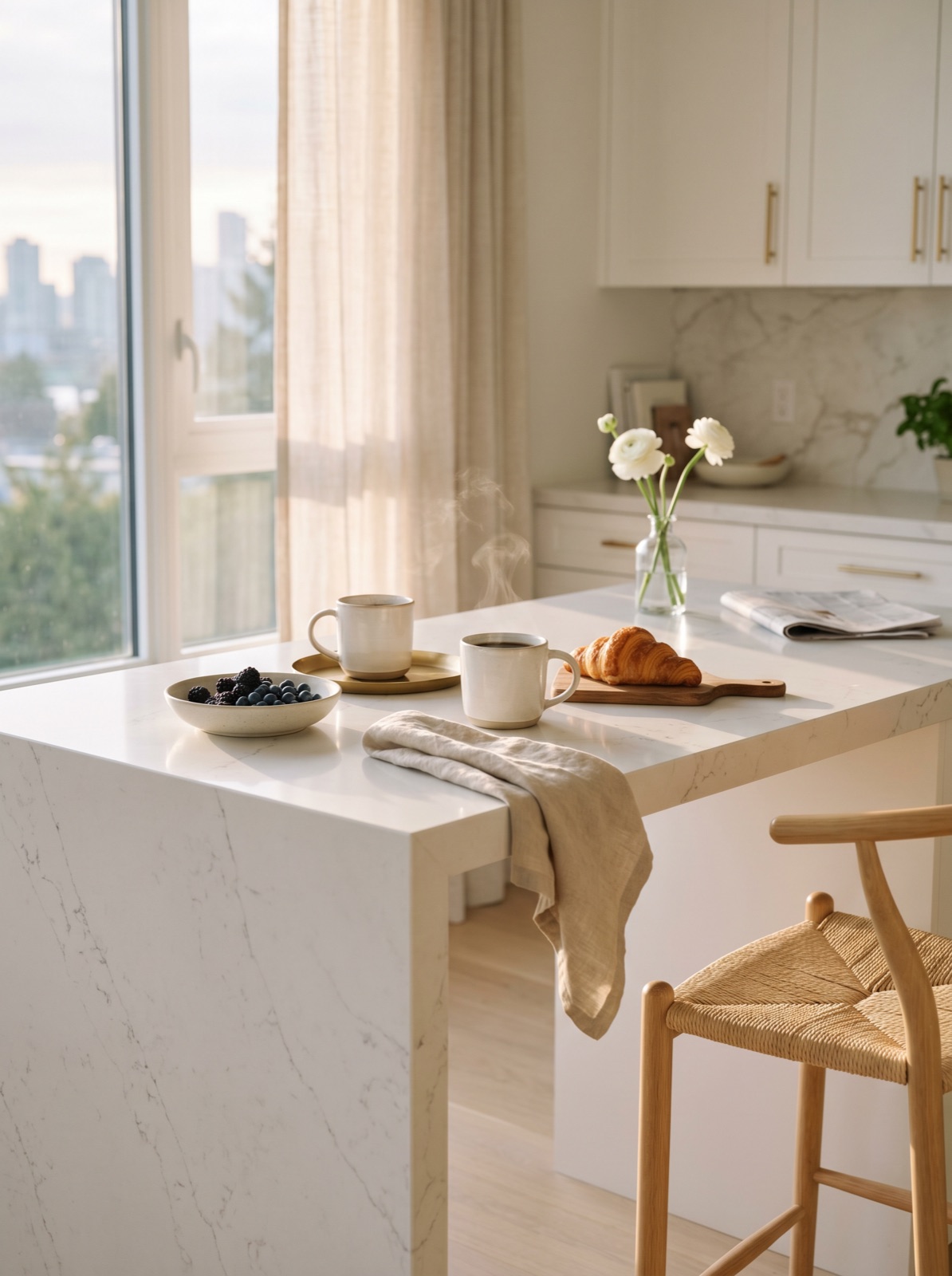
It’s 6:52 a.m. The kettle ticks in the corner. Steam climbs off a ceramic mug onto a pale quartz ledge, catching the first flat light that comes through a Richmond window. Your teenager slides onto a stool with one sock on, laptop open, half a piece of toast in hand. The countertop wipes clean in one swipe — coffee ring, crumbs, a smear of peanut butter — and the day starts. This is what a breakfast bar quartz countertop is supposed to do: carry the small, messy, repeated moments of a real morning without flinching.
Most breakfast bars in Metro Vancouver kitchens get used for about fifteen minutes a day, then sit empty. The good ones get used constantly — homework at 4 p.m., wine and olives at 6, a laptop at 10. The difference almost always comes down to three decisions: height, material, and how the edge lands where your knees sit. Below is how we think about those choices at Alpine, pulled from the kitchens we’ve fabricated in Richmond, Burnaby, the West End, and the North Shore.
Raised breakfast bar vs flush — which height belongs in your kitchen
There are really two heights worth discussing. A flush breakfast bar sits at the same 36” (91cm) as the main counter — an extension of the workspace that happens to have stools under the overhang. A raised breakfast bar steps up to 42” (107cm), creating a visual break between the cooking side and the seating side.
Both are standard per the NKBA Kitchen Planning Guidelines. The raised version has a few advantages:
- It hides the prep mess from anyone sitting on the seating side (a real factor when you cook while guests watch).
- It gives you a second, taller work surface — good for rolling pastry while someone else sits at the lower level.
- The vertical face becomes an opportunity for a statement — waterfall quartz, a book-matched slab, a wood reveal.
The flush version is quieter, cleaner, and reads more contemporary. It’s also friendlier for kids and seated work, because 36” takes a standard 24”-high stool rather than a 30” barstool. If your island is under roughly 9’ (2.7m) long, flush usually wins — a raised step can make a short island feel chopped in half.
How quartz handles the morning — spills, heat, coffee rings
Morning is a quartz test. Coffee, acidic juice, tomato from last night’s pasta, the underside of a cast-iron pan someone forgot about. Here’s how engineered quartz actually performs against those:
- Spills and stains. Quartz is non-porous — Caesarstone describes it as having a low absorption rate so stains don’t penetrate. Cambria states its quartz is “nonabsorbent and nonporous” and never needs sealing. Note the language though: quartz is stain-resistant, not stain-proof. Coffee and turmeric left overnight can still mark the surface. Wipe within the hour and you’re fine.
- Heat. This is where people get into trouble. Caesarstone advises against placing cookware hotter than roughly 300°F (150°C) directly on the surface. The resins that bind quartz together begin to discolor above that threshold. A hot pour-over kettle won’t hurt anything; a cast-iron pan straight off a 400°F burner can. Keep a trivet on the bar side of the island — it doubles as a landing pad for serving dishes.
- Thermal shock. Silestone warns about sudden temperature changes more than sustained heat. Don’t rest a freezer-cold sheet pan next to a boiling stockpot on the same section of slab.
For a breakfast bar specifically, heat is the smaller worry. Staining is the real one — and the lighter your quartz, the more diligent you’ll need to be with tomato sauce, red wine, and coffee rings.
Waterfall edge or square edge on a breakfast bar
A waterfall edge runs the quartz vertically down the side of the island to the floor, turning the countertop into a single continuous plane. On a breakfast bar it does two things: it protects the cabinet edge from kicked feet and stray stool-backs, and it becomes the visual anchor of the kitchen. We’ve written more on the structural and cost tradeoffs in our waterfall edge countertops guide.
A square eased edge (the standard ¼” radius we install by default) is less dramatic, uses less material, and disappears. On a flush breakfast bar surrounded by busy cabinetry, square tends to be the calmer choice. On a raised bar with clean lines and a dark base, waterfall earns its cost.
A practical note: waterfall installations require a book-matched or vein-matched cut at the mitered corner. That’s a fabrication decision, not a retail one — ask to see the slab before the cut gets made.
Color choices for a small Vancouver condo kitchen
In a 700–900 sq ft condo kitchen (the Yaletown / Olympic Village / Brentwood reality), the breakfast bar is often the largest uninterrupted surface in the home. Three things change how it reads:
- Light. Vancouver gets a lot of overcast, soft sky. That light flatters cool-leaning whites and pale grays, and it makes warm creams look yellow by November. If your condo faces north or east, lean cool — a white quartz with subtle gray veining reads crisp all year.
- Sightline. In open-plan condos, you see the breakfast bar from the sofa. Busy movement in the stone competes with art and textiles. A calm, low-contrast slab keeps the living area visually quieter.
- Seam strategy. Most slabs run around 120” × 55” (305cm × 140cm). A condo island longer than 10’ needs a seam — plan where it lands before you pick the stone, not after. A subtle vein pattern hides seams; a dramatic bookmatch highlights them on purpose.
If you’re still weighing material, our quartz vs granite comparison for Vancouver kitchens covers the daily-use differences that matter in a condo.
Seating clearance — the one number that decides comfort
More breakfast bars fail on clearance than on anything else. The NKBA standard, which our fabricators use as a starting point:
- 24” (61cm) wide per seated diner — the minimum to avoid elbows colliding.
- 15” (38cm) knee depth at a 36” flush bar.
- 12” (30cm) knee depth at a 42” raised bar.
- 18” (46cm) knee depth at a 30” dining-height counter (rare in Vancouver kitchens, more common in dining extensions).
Translated: a 60” (152cm) wide island seats two adults comfortably. Three people need closer to 72” (183cm). The overhang that creates that knee space is structurally limited — most quartz slabs cantilever up to 10”–12” before requiring a steel plate or corbel. Plan the overhang and the support together, not after the stone is cut.
If your island is short on length, you can gain a seat by running seating on the short end — an “L” of stools — rather than forcing three seats along one edge.
Small details that separate good from great
A few things we’ve learned from installs that clients still email us about years later:
- Rounded corners on a waterfall edge on the stool side. Hip-height, and everyone eventually walks past.
- A small 1”–2” (2.5–5cm) lip on the cook side of a raised bar stops peas from rolling across the work zone.
- Under-counter lighting aimed at the seating side, not the backsplash. Reading menus, homework, phone screens — all happen there.
- A second outlet flush-mounted in the side of the island. Laptops and phone chargers live on breakfast bars now, whether or not that’s the plan.
If you’re early in the design process, browse our quartz countertop collection or the project gallery — seeing a slab in a real Vancouver kitchen beats a showroom chip, every time. And once quartz is in, our guide to cleaning quartz countertops the right way covers the day-to-day so your surface still looks like day one a decade in.
A breakfast bar that gets used every morning isn’t about the square footage. It’s about the height your teenager will actually sit at, the edge your knee finds, and a surface that shrugs off the coffee ring and keeps the day moving.
Planning a Kitchen or Bath Countertop Project in Metro Vancouver?
Alpine Countertops has been crafting premium quartz, granite, marble, and porcelain surfaces in our Richmond facility since 2015. We serve homeowners across Vancouver, Burnaby, Richmond, Surrey, West Vancouver, North Vancouver, Coquitlam, New Westminster, and Langley.
Book a free design consultation:
– 📞 604-630-5700
– 📍 Fabrication facility: Richmond, BC
– 🌐 Browse our gallery · View countertop materials · Get in touch
Alpine Countertops — Professionals Bringing Style to Life.