
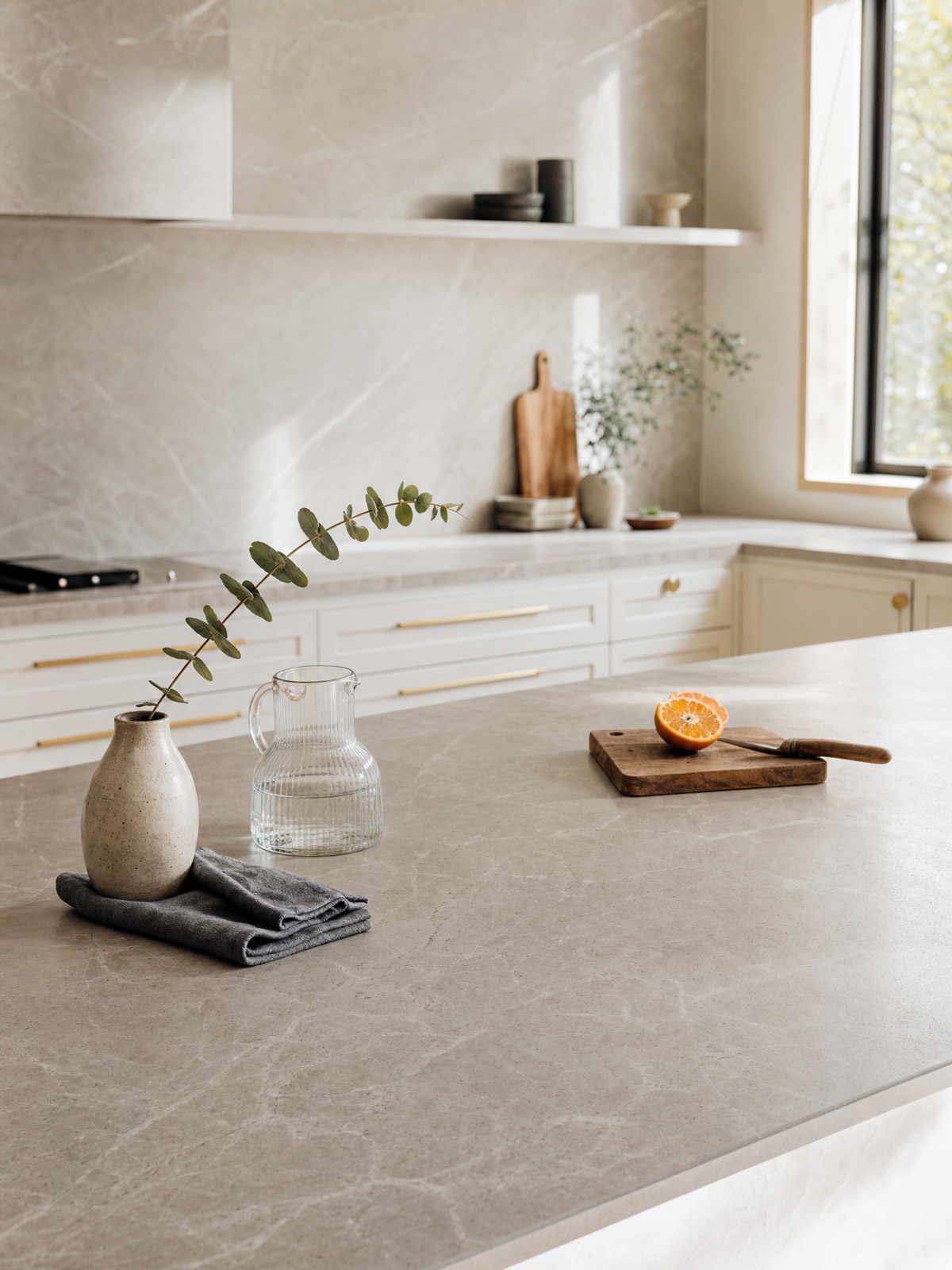
Porcelain & Dekton Countertop Cost in Vancouver (2026)
Quick answer: In Metro Vancouver, porcelain and Dekton (sintered-stone) countertops typically run about $90–$140 per square foot installed in 2026. Standard porcelain slabs sit toward the lower end, while premium sintered-stone collections like Dekton and Neolith push toward the top — and the most exotic designer lines can reach roughly $170/sq ft. The biggest cost drivers are the large-format slab size, the thin profile that makes the material harder to cut, and the specialized fabrication skill required — not the raw material alone. This is a typical Metro Vancouver range; exotic/premium slabs and complex fabrication run higher — request a quote.
Last updated: June 2026
At our Richmond fabrication shop we cut a lot of sintered stone, and it is the material homeowners most often misjudge on price. People assume porcelain is “just tile,” so they expect it to be cheap — then they get a quote and wonder why a sintered-stone kitchen can cost as much as quartzite. The short version: the slab is dense and brittle, the formats are huge, and cutting it cleanly takes equipment and experience that a lot of shops do not have. This guide breaks down what porcelain and Dekton actually cost in Metro Vancouver in 2026, what moves the number up or down, and how it compares to the materials people usually cross-shop it against.
How much do porcelain and Dekton countertops cost in Vancouver?
For a typical Metro Vancouver kitchen, budget $90–$140 per square foot installed, with the most premium Dekton and Neolith collections reaching around $170/sq ft. That installed figure bundles the slab, templating, fabrication, and installation — the way most local fabricators quote. Here is how the tiers break down:
| Sintered-stone tier | Installed cost (per sq ft) | What you’re paying for |
|---|---|---|
| Standard porcelain slab | $90–$120 | Solid colours and basic stone-looks, matte/textured finish, 12–20 mm |
| Premium porcelain / marble-look | $110–$140 | Veined and book-matched patterns, polished finishes |
| Dekton / Neolith (premium sintered stone) | $120–$170 | Ultra-compact slabs, designer collections, outdoor-rated colours |
To put that in context: a mid-size Vancouver kitchen with roughly 45–60 square feet of counter in mid-range porcelain often lands in the $4,000–$8,400 range all-in, before extras like a waterfall island or a slab backsplash. A Dekton kitchen with a thick-profile mitered edge can run higher. These project totals are illustrative planning estimates — confirm with a measured quote.
These ranges line up with what Vancouver contractors and Canadian cost guides report for 2026 — Walker General Contractors lists porcelain at $90–$140/sq ft installed for Vancouver homes, with the premium Dekton/Neolith tier sitting above that. This is a typical Metro Vancouver range; exotic/premium slabs and complex fabrication run higher — request a quote.
What drives porcelain and Dekton countertop cost?
Material price is only part of the story. With sintered stone, fabrication and handling drive a bigger share of the total than they do for quartz or granite. The main factors:
- Large-format slabs. Sintered stone comes in oversized sheets (commonly around 126×63 inches). That is great for seamless islands and full-height backsplashes, but the slabs are heavy, awkward, and require more careful handling and often more crew to move and set.
- Thin profile and brittleness. Many porcelain slabs are 12 mm or thinner. A thin, dense, brittle sheet is far less forgiving than a 30 mm granite slab — one wrong move at the saw and the piece cracks. Fabricators price in that risk.
- Cutting difficulty. Sintered stone needs specialized diamond tooling and CNC equipment, run slowly and cooled with water, to cut cleanly without chipping. Shops that lack the right blades or experience either decline the job or charge a premium for it.
- Edge work. A thin slab often gets a mitered edge — two pieces glued at 45 degrees to fake a thicker profile. Upgraded profiles (bevel, bullnose, ogee) add roughly $8–$45 per linear foot; a mitered edge adds about $30–$50 per square foot of mitered run; and a waterfall is quoted as a lump add-on of roughly $1,200–$2,500 because it consumes an extra section of slab. Confirm current edge pricing with your fabricator.
- Brand and collection. Designer Dekton and Neolith colours, ultra-compact bodies, and outdoor-rated lines cost more than entry porcelain. White and book-matched marble-looks sit at the top.
- Finish. Matte and textured finishes are usually base price; polished and book-matched faces typically add a 15–25% premium on the slab.
Because so much of the cost is labour and risk rather than raw stone, the single best way to control your porcelain budget is to choose a fabricator who cuts sintered stone regularly. A shop set up for it prices the work fairly; a shop that is guessing prices in a fat safety margin. (If you’re vetting shops, our guide on how to choose a countertop fabricator in Vancouver walks through the questions to ask.)
Porcelain vs other materials on price
Sintered stone overlaps heavily with quartz and quartzite on price, and sits above standard granite. Here is the quick comparison for Metro Vancouver, installed:
| Material | Installed (per sq ft) | Quick take |
|---|---|---|
| Granite | $60–$110 | Often the most affordable natural stone; needs periodic sealing |
| Quartz (engineered) | $70–$120 | Non-porous, consistent; resin can scorch under high heat |
| Porcelain / Dekton (sintered) | $90–$140 | Heat-, UV-, and scratch-resistant; harder to fabricate (premium Dekton higher) |
| Quartzite | $110–$180 | Hard natural stone; premium look, premium price |
This is a typical Metro Vancouver range; exotic/premium slabs and complex fabrication run higher — request a quote. The reason a homeowner pays porcelain money is performance: sintered stone is ultra-dense and effectively non-porous, highly resistant to heat, UV, and scratching, and it never needs sealing — which is why it is the go-to for outdoor kitchens and sun-drenched Vancouver patios where quartz resin would fade. For a full side-by-side of every material’s pricing, see our countertop cost comparison for Vancouver. If you’re weighing porcelain specifically against engineered stone, our porcelain vs quartz countertops breakdown covers the durability and use-case trade-offs in detail.
Is porcelain or Dekton worth it for your kitchen?
Sintered stone earns its price in specific situations. It is worth the premium if you:
- Want an outdoor kitchen or covered patio — it is UV-stable and weatherproof in a way quartz is not.
- Run a hot kitchen and want a surface you can set a pan on without a trivet (no resin to scorch).
- Love an ultra-thin, modern look or a seamless large-format island with minimal seams.
- Want a zero-maintenance, never-seal surface that resists scratches and stains.
It is probably not worth stretching for if you want a thick, chunky stone edge on a tight budget (the mitering adds up), or if you simply want a durable indoor counter where quartz or granite would serve just as well for less. The honest answer for a lot of Vancouver kitchens is that porcelain is a want, not a need — a beautiful one, but worth pricing against quartzite and quartz before you commit.
Frequently asked questions
Is porcelain cheaper than quartz in Vancouver?
Not usually. Entry-level porcelain can land close to mid-range quartz, but once you factor in the specialized fabrication and mitered edges that thin slabs typically need, a porcelain or Dekton kitchen often costs the same as or more than quartz. The material can be inexpensive; the labour to cut it well is not.
Why is Dekton so expensive to install?
Dekton is an ultra-compact sintered surface that is dense and brittle. It requires specialized diamond tooling, slow CNC cutting, careful handling of oversized slabs, and often mitered edges — all of which add labour and risk. Fewer shops are equipped to fabricate it, so the install premium reflects both the skill and the scarcity.
What size are porcelain and Dekton slabs?
Sintered-stone slabs are large-format, commonly around 126×63 inches, which lets fabricators run a full island or a floor-to-ceiling backsplash with few or no seams. The trade-off is weight and handling difficulty, which factor into the install cost.
Does porcelain ever need sealing?
No. Porcelain and Dekton are effectively non-porous, so they never need to be sealed — unlike granite, marble, or quartzite. That zero-maintenance trait is part of what justifies the higher upfront cost for many homeowners.
Can porcelain be used outdoors in Vancouver?
Yes — this is one of its strongest use cases. Sintered stone is UV-stable and weatherproof, so it won’t fade or break down on a covered patio or outdoor kitchen the way engineered quartz can. It is one of the few surfaces we recommend for Lower Mainland outdoor installations.
Get a porcelain or Dekton quote from Alpine
Sintered-stone pricing depends heavily on the slab you choose, the edge profile, and how much fabrication your layout needs — so the only accurate number is a measured one. We fabricate porcelain and Dekton at our Richmond shop and serve kitchens across Metro Vancouver and the Fraser Valley. Browse the porcelain countertops we offer in Vancouver, then contact us for a quote tailored to your project. Call 604-630-5700 or email info@alpinecountertops.com.
Last updated: June 2026. Prices are defensible 2026 Metro Vancouver ranges based on typical projects and current BC/Canada cost references; your actual cost depends on slab selection, square footage, edge profile, and site conditions. Request a quote for an exact figure.