
How to Repair Scratches on Quartz Countertops
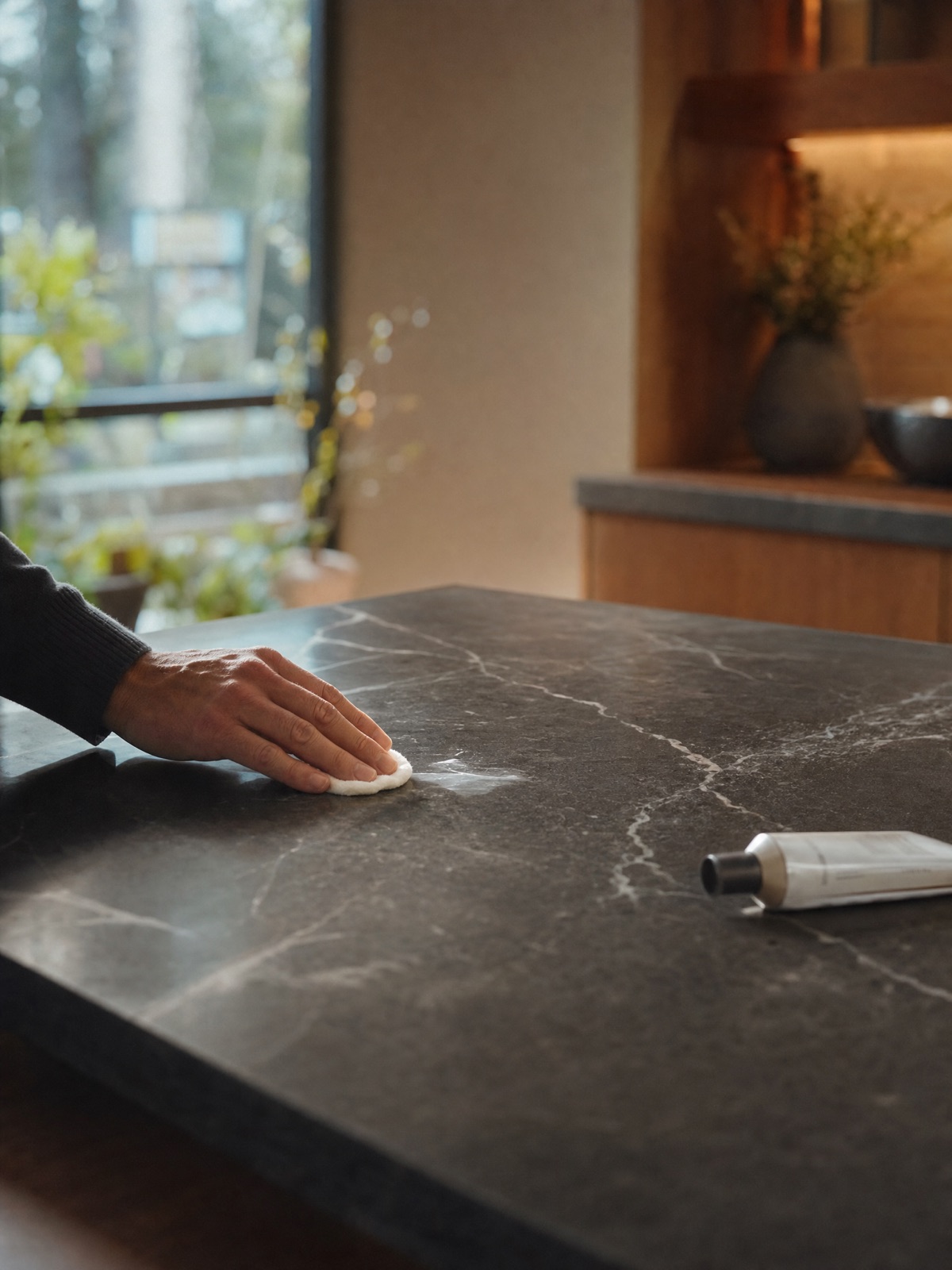
Quartz is one of the hardest countertop surfaces in the kitchen, which is exactly why a visible scratch comes as a surprise. The honest answer is that some marks on quartz are not scratches at all but metal residue that wipes away, some are shallow scuffs you can improve at home, and some are real gouges that only a fabricator should touch. This guide helps you work out which one you have, what is genuinely safe to attempt yourself, and — importantly — where DIY abrasives can dull your surface or affect your warranty. When in doubt, the safest move with quartz is to stop and ask, because the wrong fix is hard to undo.
What you’ll need
- Mild dish soap and warm water
- A soft or microfibre cloth
- A non-abrasive cloth and, if your brand permits, a non-scratch sponge (such as a white non-scratch Scotch-Brite) for testing metal marks
- Rubbing alcohol (isopropyl) for residue
- A plastic scraper or old card
- Good raking light (a flashlight held low across the surface) to see the mark clearly
Note what is deliberately not on this list: power tools, polishing compounds, and abrasive pads. Those belong to a fabricator, for reasons covered below.
First, work out what you’re actually looking at
Hold a light low across the surface and look closely, then run a fingernail over the mark.
- A grey or dark line that you cannot feel is very often a metal mark — aluminium from a pan, or marks transferred from cookware — sitting on top of the quartz, not a scratch in it. These usually clean off.
- A faint scuff you can barely feel is a shallow surface scratch. These are sometimes improvable at home with gentle methods.
- A line you can clearly catch a fingernail in is a real scratch or gouge in the surface. This is a fabricator’s job; home abrasives will not fill it and can damage the area around it.
- A dull or whitened patch is more likely an etch or chemical mark than a scratch. Treat it like a finish problem, not a scratch, and ask a professional.
Step-by-step: what’s safe to try at home
- Clean the area first. Wash with mild dish soap and warm water and dry it. A surprising number of “scratches” disappear at this step because they were grime or residue, not damage.
- Test for a metal mark. If a grey line remains and you cannot feel it, dampen a non-abrasive cloth and rub gently along the mark. Many metal marks lift with light pressure. A little rubbing alcohol on the cloth can help. If your countertop brand permits a non-scratch sponge, you may use one gently — but stop the moment you see no improvement.
- Re-clean and assess. Wipe away any residue, dry the surface, and look again under raking light. If the mark is gone, you are done. If a faint scuff remains and you cannot catch a nail in it, you have a shallow surface scratch.
- For a shallow scuff, check your manufacturer’s guidance before going further. Some brands permit a specific, gentle approach for minor marks; many do not. Use only what your brand’s own care documentation allows, and only on the scratch itself. Do not improvise with household abrasives.
- Know when to stop. If gentle methods are not improving the mark, stop. Continuing with anything more aggressive risks dulling the polished finish around the scratch, which is far more visible than the scratch itself — and it is the point where DIY commonly turns a small problem into a large one.
Why deep scratches are a fabricator’s job
Repairing a real scratch in quartz is not like sanding wood. The polished factory finish is created with industrial equipment, and the slab’s colour and pattern run only at the surface. A fabricator can assess whether a gouge can be filled with a colour-matched resin and re-polished, or whether the affected section needs replacing — and they can do it without dulling the surrounding area. A homeowner with sandpaper or a rotary tool almost always cannot, and the haze left behind is permanent.
There is also a warranty consideration that is easy to overlook. Manufacturers specify what you may and may not use on their surfaces, and several explicitly prohibit abrasive cleansers — HanStone, for example, bans abrasive Soft Cleanser and powder. Using prohibited abrasives or attempting a repair the manufacturer does not sanction can affect your warranty coverage. Before you take anything abrasive to your counter, it is worth a call to confirm you will not void protection you have paid for.
How to stop scratches happening in the first place
Because a deep scratch in quartz is difficult and sometimes impossible to make invisible, prevention is genuinely the best repair strategy — and it costs nothing but habit.
- Always use a cutting board. Quartz is harder than a steel kitchen knife, so a regular blade rarely marks it — but ceramic knives are harder than quartz and can scratch it, and cutting directly on the surface dulls your knives regardless. A board protects both.
- Lift, don’t drag. Sliding cast-iron pans, stoneware, ceramic dishes, slow cookers and small appliances across the surface is a common source of marks, especially if there is a fleck of grit underneath. Pick items up to move them.
- Keep grit off the surface. Sand, ceramic dust and similar fine grit act like sandpaper under anything you slide. Wipe the counter down before working on it, particularly after a renovation or a pot of soil from repotting plants.
- Put felt pads under decorative items. Metal canisters, ceramic crocks and appliance feet can leave marks over time; small felt pads underneath prevent both scratches and metal transfer.
None of this makes quartz fragile — it is one of the most scratch-resistant surfaces available. These are simply the habits that keep a polished finish looking new for years, and they sidestep the one type of damage that is hardest to put right.
What to avoid
- Sandpaper, rotary tools and buffing wheels. These remove the finish, not the scratch, and leave a dull patch that cannot be undone at home.
- Abrasive pads and scouring powders. Steel wool, green pads and gritty powders scratch and dull quartz. Several brands prohibit them outright.
- “Magic eraser” melamine pads. These are mildly abrasive and can dull a polished quartz finish with repeated use.
- Assuming every grey line is a scratch. Many are metal marks that simply clean off — try cleaning before you treat it as damage.
- Continuing when there’s no improvement. If gentle methods are not working, escalating force is how small marks become permanent ones. Stop and ask.
When to call a professional
Call a fabricator if you can catch a fingernail in the mark, if a scuff will not improve with gentle cleaning, if there is a dull or whitened patch, or simply if you are unsure and do not want to risk the finish. These are the situations where professional tools and a colour-matched approach make the difference between an invisible repair and a visible one. Alpine fabricates quartz in our own Richmond facility, so we can match your slab, advise honestly on whether a scratch is improvable, and handle the ones that are not — including chips and cracks, which we cover in our countertop repair guide.
Frequently asked questions
Can scratches in quartz be buffed out at home?
Only shallow scuffs, and only gently. A surface scuff you cannot catch a fingernail in may improve with careful cleaning and methods your brand specifically permits. A scratch you can feel is a fabricator’s job — home abrasives will not fill it and will dull the surrounding finish.
Will repairing a scratch myself void my quartz warranty?
It can. Manufacturers specify approved care, and several prohibit abrasive cleansers and unsanctioned repairs. Using prohibited abrasives or attempting a repair outside the manufacturer’s guidance may affect your coverage, so confirm with your brand or fabricator before using anything abrasive.
Is that grey line a scratch or something else?
Often it is a metal mark rather than a scratch — aluminium or cookware residue sitting on the surface. If you cannot feel it with a fingernail, try cleaning it gently with a damp non-abrasive cloth and a little rubbing alcohol first. Many marks that look like scratches simply wipe away.
Does quartz scratch easily?
No. Quartz is very hard and resists everyday wear, but it is not scratch-proof. Ceramic knives, dragged stoneware, and grit under a sliding appliance can mark it. Use a cutting board and lift heavy items rather than dragging them, and scratches will be rare.
This guide is part of our Quartz Countertop Care Guide.
Get help from Alpine
If you have a scratch you are not sure about, send us a photo before you try anything abrasive. Alpine Countertops has fabricated and installed quartz across Metro Vancouver and the Fraser Valley since 2015, from our own Richmond facility — BBB A+ accredited, our own install crews, no middlemen.
Phone: 604-630-5700
Email: info@alpinecountertops.com
Book a free consultation or learn more about Alpine.