
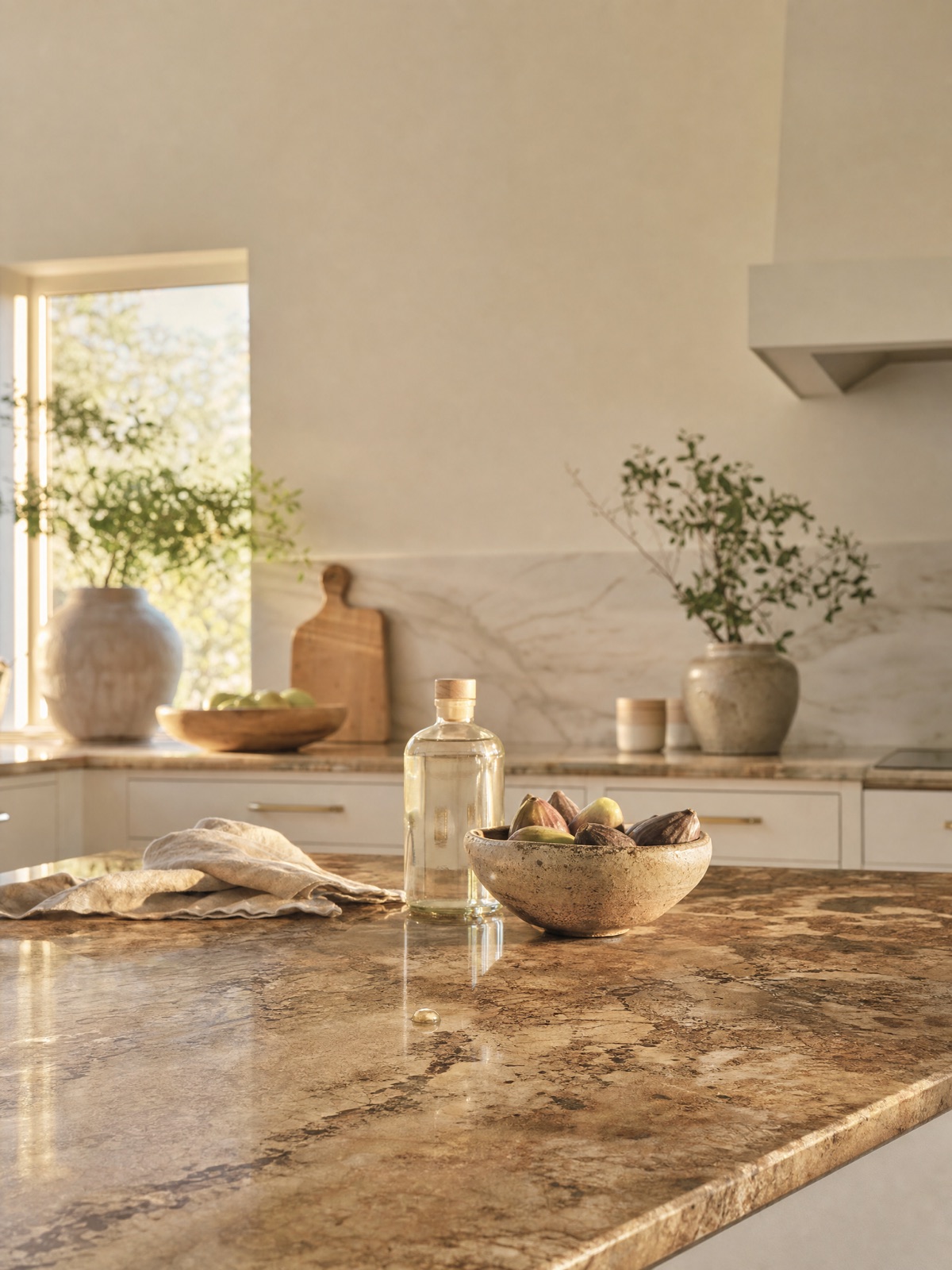
Granite Countertop Care & Maintenance: The Complete Vancouver Guide
Granite has been a Metro Vancouver kitchen staple for decades, and for good reason: it is a genuine natural stone, it shrugs off heat better than almost anything else on the counter, and a well-kept granite top can outlast the cabinets it sits on. It asks for a little more attention than engineered quartz, but not much — most of what people worry about, from water marks to sealing schedules, comes down to a few simple habits and one honest test you can do with a glass of water. This guide covers daily cleaning, what to avoid, the truth about how often granite really needs sealing, how to lift common stains, granite’s heat tolerance, and what the Lower Mainland’s soft tap water and damp winters actually mean for your stone. It is written from a fabricator’s bench, not a marketing desk.
Quick reference: granite care at a glance
- Daily: wipe with warm water and a few drops of mild dish soap, or a stone-safe spray cleaner, on a soft or microfibre cloth. Dry it off.
- Avoid: vinegar, lemon and other acids; harsh alkaline or bleach-based cleaners; abrasive powders and scouring pads. All of these wear down the sealer and can dull the polish over time.
- Sealing: granite is porous and benefits from periodic sealing, but how often is genuinely disputed (anywhere from every six months to every few years). Do not follow a fixed calendar — use the water-bead test below to decide.
- Spills: wipe them promptly. The longer a liquid sits on under-sealed stone, the more it can soak in.
- Heat: granite tolerates hot pans far better than quartz, but trivets are still the smart habit — mostly to protect the sealer and guard against thermal shock on stone with natural fissures.
- Vancouver note: our tap water is very soft, so true hard-water scale is uncommon here. Most “water marks” on granite are either temporary darkening in under-sealed stone or leftover soap and cleaner residue.
Daily cleaning
The everyday routine is refreshingly simple, and it is the one the major stone authorities and natural-stone makers all converge on. Use warm water with a few drops of mild dish soap on a soft cloth or microfibre, wipe the surface down, then dry it off with a clean cloth. Drying matters more than people expect: it prevents streaking and stops residue building up into film over time.
If you prefer a dedicated product, look for a pH-neutral stone-safe cleaner. Several are sold across Canada — Granite Gold Daily Cleaner and Weiman granite cleaner at Canadian Tire, and Method Daily Granite Cleaner at Home Depot Canada. Any is fine for routine use; what unites them is that they clean without acid and without abrasives, which is exactly what granite wants.
A couple of habits help. Wipe spills when they happen rather than letting them sit, and use a cutting board — not because granite scratches easily (it is one of the harder surfaces in the kitchen) but because cutting on stone dulls your knives and can wear the sealer in one spot over time.
What to avoid
This is the section worth committing to memory, because most granite that looks tired before its time was cleaned with the wrong things.
- Acids. Vinegar, lemon juice, and acidic cleaners are the classic mistake. Granite is a siliceous stone and far more acid-resistant than marble, so a splash of lemon will not etch it the way it would etch marble. But routine acid exposure degrades the impregnating sealer that keeps granite stain-resistant, leaving the stone more porous and the polish duller. The Natural Stone Institute is explicit that acidic cleaners are not recommended even on acid-resistant siliceous stone. Skip the DIY vinegar spray.
- Harsh alkaline and bleach-based cleaners. Strong degreasers, ammonia, and bleach products are too aggressive for sealed natural stone and shorten the life of the sealer.
- Abrasives. Scouring powders, gritty “soft scrub” creams, and abrasive pads scratch the polished finish and wear it flat in high-traffic spots. A non-abrasive cloth or soft sponge is all you need.
- Generic all-purpose sprays. Many contain citrus acids or strong alkalis. If a product is not labelled safe for natural stone, default to mild soap and water.
The simplest rule: if you are not sure whether something is stone-safe, it probably is not, and warm soapy water will do the job.
Sealing granite (and the honest truth about how often)
Granite is porous, which is why sealing matters. An impregnating sealer soaks into the top layer of the stone and slows how quickly liquids can penetrate, buying you time to wipe up a spill before it stains. Sealing does not make granite stainproof — nothing does — but it makes it far more forgiving.
Here is where we will be straight with you, because the internet often is not: there is no agreed-upon resealing interval. Reputable sources genuinely disagree.
- This Old House suggests sealing granite about every six months.
- Bob Vila and much of the fabrication trade put it at every one to five years — more porous and lighter-coloured stones at the shorter end, dense dark granites at the longer end.
- Premium fluorocarbon-aliphatic-resin impregnating sealers can last considerably longer than basic products — on the order of several years, with some sources citing five to ten.
The reason for the spread is simple: it depends on the specific stone’s porosity, its colour, how heavily the counter is used, and which sealer was applied. A blanket number is fake precision. So instead of following a calendar, use the test the authorities actually agree on.
The water-bead test. Drip a few drops of water onto a clean, dry area of the counter (the spots near the sink and stove see the most wear, so test there). Wait a few minutes. If the water beads up or sits on the surface, your seal is intact and there is nothing to do. If the water soaks in and the stone darkens where the drops were, it is time to reseal. That darkening is the stone absorbing water, and it is the same mechanism that lets a spill stain. The test takes two minutes and answers the question honestly for your specific counter, which a fixed schedule cannot.
Resealing is straightforward with a quality penetrating sealer. Miracle Sealants 511 Impregnator is sold at Home Depot Canada, and Weiman and Rock Doctor both offer stone sealer sprays at Canadian Tire. Clean and dry the surface, apply the sealer per the label, let it dwell, then buff off the excess thoroughly so none dries on the surface. Always follow the product’s own instructions, as dwell times and coats vary. If the counter fails the bead test and you would rather not do it yourself, it is a quick job for a fabricator.
Removing common stains and marks
Most marks on granite fall into a few categories, and the fix depends on which one you are dealing with. Act promptly: the longer a spill sits on under-sealed stone, the more it can absorb, so the easiest stain to remove is the one you catch early.
For stains that have set in, the workhorse technique is a poultice — an absorbent paste that draws the stain back out of the stone. Mix an absorbent material (baking soda or a proprietary poultice powder) with the right liquid for the stain type into a thick paste, spread it about a centimetre thick over the mark, cover it with plastic wrap taped at the edges, and leave it to dry for 24 to 48 hours. As it dries it pulls the staining material out with it. Stubborn stains sometimes need a second application.
| Mark or stain | What it is | How to treat it |
|---|---|---|
| Oil or grease (cooking oil, butter) | An oil-based stain that darkens the stone | Poultice using an absorbent powder mixed with a little acetone or a stone-safe degreaser; cover, dry 24–48 hours, rinse. Repeat if needed. |
| Organic (coffee, tea, wine, food) | A brownish or reddish discolouration | Poultice using an absorbent powder mixed with a few drops of hydrogen peroxide (12%) and a little water; cover, dry, rinse. |
| Dark water mark | Temporary darkening from water absorbed by under-sealed stone | Usually fades on its own as the stone dries. If it keeps happening, the sealer has worn — run the water-bead test and reseal. |
| Cloudy film or surface residue | Soap film or cleaner residue, not a stain in the stone | Wash with warm water and a few drops of mild dish soap, rinse with clean water, and dry. No poultice needed. |
A note on rust or metal marks (from a wet can or cast-iron pan left to sit): these are stubborn and a general poultice may not lift them fully. There are rust-specific stone poultices, but if a metal stain will not budge, it is worth a call to a professional rather than reaching for harsher chemicals that could damage the finish.
Heat tolerance: granite versus quartz
This is one area where granite genuinely outperforms engineered quartz. Granite is formed under enormous heat and pressure, and the polished slab tolerates direct contact with hot cookware far better than quartz does. Engineered quartz is mostly mineral bound with a polymer resin, and that resin is the heat-weak link — Caesarstone, for example, advises never exceeding about 300°F (≈150°C) on its quartz and always using a trivet, because the binder can scorch or discolour. Granite has no such resin to damage.
Even so, we still recommend trivets and hot pads on granite, for two reasons. First, repeated direct heat can degrade the impregnating sealer in that spot, undoing your stain protection. Second, natural granite can contain fissures, and a sudden severe temperature change — a screaming-hot pan onto cold stone — carries a small risk of thermal shock. The risk is low, but a trivet costs nothing and removes it. Treat granite’s heat resistance as a generous safety margin, not an invitation to use the counter as a cooktop.
Granite care in Metro Vancouver
Local conditions actually make granite care easier here than in most of North America, and they change how you should read certain problems.
Our water is very soft. Metro Vancouver’s tap water comes from the Capilano, Seymour, and Coquitlam mountain reservoirs, and it is among the softest municipal water on the continent — roughly 2.5 to 4.8 mg/L hardness as calcium carbonate, per Metro Vancouver’s 2024 water quality report. Soft water leaves very little mineral residue, so the chalky hard-water scale that plagues counters elsewhere is genuinely uncommon in Vancouver, Burnaby, Richmond, the North Shore, Coquitlam, and New Westminster.
That changes what a “water mark” on your granite usually is. Here it is most often one of two things: a temporary dark patch where water has soaked into under-sealed stone (it fades as the stone dries, and it is a signal to check your seal), or soap and cleaner residue on the surface (which wipes off with warm soapy water and a rinse). It is rarely true mineral scale. The Fraser Valley is the exception — parts of Abbotsford, Langley Township, and other areas on groundwater wells have noticeably harder water, where genuine mineral spotting is more plausible. If you are on a well rather than municipal supply, drying the counter after use helps.
Wet winters and humidity. The Lower Mainland’s damp, mild winters do not harm sealed granite, but sustained humidity is a reason to keep the surface dried off and to stay on top of sealing — a counter that is absorbing water (failing the bead test) will pick up moisture more readily. For homes near the water in White Rock, West Vancouver, or Tsawwassen, salt air is more a concern for metal fixtures than for the granite, but keeping the stone clean and sealed is sound practice in any coastal kitchen.
Brand and material notes
One useful thing to understand: granite is a natural stone, so unlike engineered quartz it does not come from a single manufacturer with a single care sheet. Care guidance comes from stone-care authorities such as the Natural Stone Institute and from sealer makers, not from a brand — and the headline points are consistent across all of them: clean with pH-neutral products, avoid acids and abrasives, seal periodically, and act on spills promptly.
It is worth contrasting granite with engineered quartz, since Alpine fabricates both and homeowners often weigh them against each other. Quartz brands such as Cambria state their surfaces never need sealing because the material is non-porous — a real convenience over granite. But quartz is more sensitive to heat thanks to its resin binder, whereas granite is more heat-tolerant. Neither is better across the board; they trade strengths. If you are still choosing, our quartz vs. granite comparison for Vancouver lays out the differences in plain language.
When to call a professional
Plenty of granite care is genuine DIY, but some jobs are better handed to a fabricator. Call a professional when:
- A stain will not lift after a couple of poultice attempts, or you have a stubborn rust or ink mark you are wary of treating.
- The polish has gone dull or scratched across an area — restoring a polished finish is a specialist job, not a home repair.
- There is a chip, crack, or failing seam. Small chips can sometimes be filled at home, but anything on a visible edge, near a sink, or along a seam is worth professional attention. Our guide on repairing a chipped granite countertop shows where the DIY line sits.
- The whole counter is failing the water-bead test and you would rather have it sealed properly, or assessed during a renovation.
Alpine Countertops has fabricated and installed natural stone across Metro Vancouver since 2015. We run our own facility in Richmond, work in granite every week, and are glad to advise on whether a problem is a quick fix or something that needs hands-on work.
Frequently asked questions
How often should I seal my granite countertop?
There is no single correct answer: reputable sources range from every six months (This Old House) to every one to five years (Bob Vila and much of the trade), with premium fluorocarbon-resin sealers lasting longer still. Rather than follow a calendar, use the water-bead test — drip water on the stone, and if it soaks in and darkens within a few minutes, reseal. If it beads, you are fine.
Can I use vinegar to clean my granite?
We do not recommend it. Granite resists acid far better than marble, so an occasional splash will not etch it, but routine vinegar use breaks down the sealer and can dull the polish over time. Warm water with a few drops of mild dish soap, or a pH-neutral stone cleaner, is the better daily choice.
Why does my granite get a dark mark when it gets wet?
A temporary dark patch where water sits usually means the stone is absorbing it — a sign the sealer has worn thin there. The mark fades as the stone dries. Run the water-bead test, and if water soaks in rather than beading, reseal. In Metro Vancouver, where tap water is very soft, this is far more common than true hard-water spotting.
Is granite heat-resistant enough to set a hot pan on it?
Granite tolerates heat much better than engineered quartz, whose resin binder can scorch. In practice granite handles a hot pan, but we still recommend a trivet: repeated direct heat can wear the sealer, and a sudden temperature change carries a small thermal-shock risk on stone with natural fissures.
Does Vancouver’s water leave hard-water marks on granite?
Generally no. Metro Vancouver tap water is very soft (about 2.5 to 4.8 mg/L as calcium carbonate, from the mountain reservoirs), so it leaves little mineral residue. Marks here are usually absorbed-water darkening or soap and cleaner residue, not mineral scale. Genuine hard-water spotting is more likely in parts of the Fraser Valley on groundwater wells, such as areas of Abbotsford and Langley Township.
What is the safest everyday cleaner for granite?
Warm water with a few drops of mild dish soap on a soft or microfibre cloth, dried off afterward — that is what the stone-care authorities recommend. If you prefer a bottled product, choose a pH-neutral stone-safe cleaner; Granite Gold Daily Cleaner (Canadian Tire), Method Daily Granite Cleaner (Home Depot Canada), and Weiman granite cleaner (Canadian Tire, Walmart.ca) are all sold in Canada.
Related guides
Care guides in this series:
- How to clean granite countertops: a Vancouver homeowner’s guide
- How to remove water marks and rings from granite countertops
- How to repair a chipped granite countertop
Care guides for other materials:
- Quartz countertop care & maintenance guide
- Marble countertop care & maintenance guide
- Countertop sealing guide
- Countertop repair guide
- How to remove stains from countertops
Thinking about a new granite kitchen? See our granite countertops in Vancouver and granite countertops in Surrey pages.
Get help from Alpine
If your granite needs resealing, has a stain you cannot shift, or you are weighing a new natural-stone counter, we are glad to help. Alpine Countertops fabricates in our own Richmond facility and installs across Metro Vancouver and the Fraser Valley with our own crews. Call 604-630-5700 or email info@alpinecountertops.com, or reach us through our contact page. Our showroom at 230-11181 Voyageur Way, Richmond is open by appointment.