
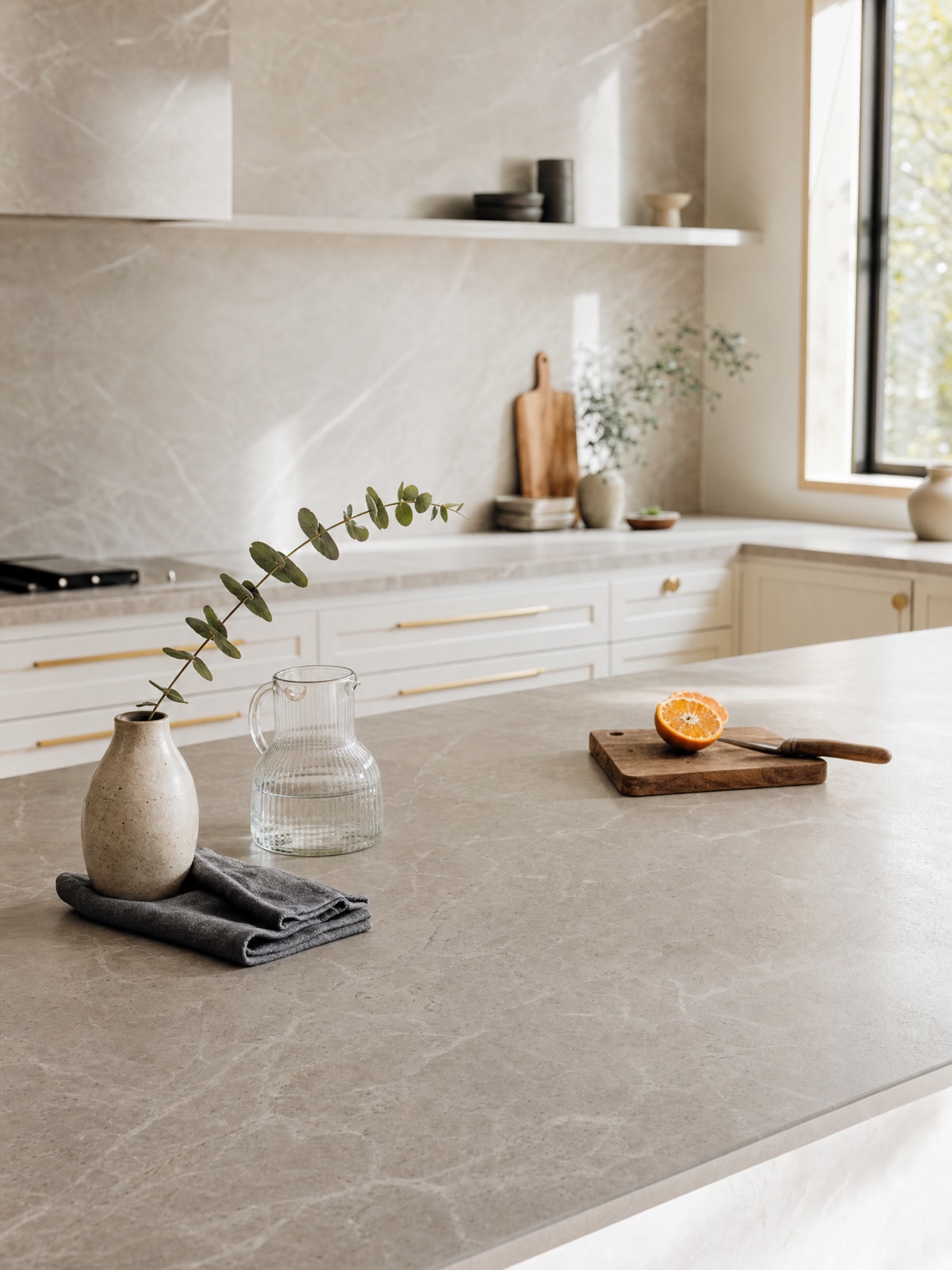
Porcelain vs Quartz Countertops: Which Is Better for BC Kitchens (Indoor and Out)?
Quick answer: Quartz is the go-to for indoor kitchens — it’s non-porous, comes in hundreds of consistent colours, and is easy to live with. But quartz is not UV-stable and is not warrantied for outdoor use, so for a covered patio kitchen, a sunroom counter, or any surface in strong BC sun, porcelain (a sintered surface) is the better material: it’s UV-stable, takes direct heat, and comes in large-format slabs with fewer seams. Indoors, choose by priorities; outdoors or in heavy-sun spots, choose porcelain.
Last updated: June 2026
This is one of the most useful comparisons we run through with clients, because porcelain and quartz are both engineered, both non-porous, and both excellent — but they’re built differently and they fail differently. Around Metro Vancouver we see a specific pattern: people pick quartz indoors and then ask about extending it to a deck or covered outdoor kitchen, and that’s exactly where the materials part ways. As a Richmond fabricator working with both, here’s how they actually compare, with the local use-case angle front and centre. (For the outdoor side specifically, our outdoor kitchen countertops guide goes deeper, and our porcelain countertops page covers the material in detail. For the full lineup of every material side by side, see our complete countertop materials comparison.)
Why does this matter for BC outdoor kitchens?
Let’s lead with the thing that decides many projects. Quartz is engineered from ground stone (predominantly quartz) bound with a polymer resin and pigments. That resin is what makes quartz non-porous and stain-resistant indoors — but it’s also a liability outside. Under sustained, direct UV exposure the resin breaks down, and quartz can yellow, fade, or discolour over time. This is not a fringe risk: every major quartz manufacturer explicitly excludes outdoor installation from its warranty. So if you put quartz on a sunny patio in a BC summer, you’re on your own if it changes colour. (Ordinary sunny indoor kitchens are generally fine — the real risk is sustained, direct sun and outdoor exposure.)
Porcelain has no polymer resin. It’s a sintered surface fired at extreme temperatures, which makes it UV-stable — it won’t fade, yellow, or discolour in direct sunlight. That’s why for outdoor kitchens, sunrooms, and counters under sustained direct sun, porcelain (or its denser cousin, sintered stone like Dekton) is the material we steer people toward. If your project has any meaningful sun exposure, that single fact often makes the decision for you. For a full three-way look at outdoor-grade surfaces, see our Dekton vs quartz vs granite guide.
Porcelain vs quartz at a glance
| Dimension | Porcelain (sintered) | Quartz (engineered) |
|---|---|---|
| What it is | Clay and minerals fired at very high heat (no resin) | Ground stone (predominantly quartz) bound with polymer resin |
| UV stability / outdoor use | UV-stable; suitable outdoors | Not UV-stable; outdoor use voids warranties |
| Heat resistance | Excellent — handles direct hot cookware | Limited — resin is heat-sensitive and can scorch from hot pans |
| Porosity / staining | Non-porous, highly stain-resistant | Non-porous, highly stain-resistant |
| Sealing | Never needs sealing | Never needs sealing |
| Large format / seams | Large slabs (up to ~63″ x 126″) — fewer seams | Standard slab sizes; more seams on big runs |
| Edges & impact | Thinner slabs; edges/corners more chip-prone | Less prone to chipping; more decorative edge options |
| Pattern depth | Often surface-printed; may not run full thickness (full-body lines exist — varies by product) | Colour/pattern typically consistent through slab |
| Best for | Outdoor kitchens, sunrooms, large islands, heavy heat use | Indoor kitchens, busy prep counters, edge detailing |
Is porcelain or quartz more heat resistant?
Porcelain, clearly. Porcelain countertops are fired at temperatures well above 2,000°F during manufacturing, so a hot pot or pan set directly on the finished surface generally won’t harm it. Quartz is the weak link on heat: its polymer-resin binder is heat-sensitive, so a pan straight off the burner can scorch, discolour, or crack the surface — and that damage is usually permanent. Caesarstone, a major quartz manufacturer, states that quartz is “heat resistant, not heat proof” and advises always using hot pads or trivets. The takeaway for an indoor kitchen is simple: quartz is fantastic, but always use trivets and hot pads. If you’re someone who routinely sets scorching pans straight down, porcelain (or a natural stone) tolerates that habit better. Our quartz countertop care guide covers heat protection and daily care.
What about looks, seams, and large islands?
Both materials offer hundreds of colours and convincing natural-stone looks. Two real differences matter for design:
- Large format. Porcelain comes in big slabs — up to roughly 63 by 126 inches — which means a large island or a long run can be done with fewer (or no) visible seams. For a waterfall island or a wide expanse, that’s a genuine aesthetic edge.
- Pattern depth. On many porcelain products the pattern is printed on the surface and may not run all the way through the slab thickness, which can matter at mitred edges or undermount sink reveals. Quartz colour generally runs consistently through the slab. (Full-body porcelain options exist, but they vary by line — ask which you’re getting.)
For edge profiles, quartz is the more flexible material — it shapes into a wider variety of decorative edges. Porcelain’s thinner slabs and harder body mean simpler edge details and a bit more care needed at corners.
Which is tougher day to day — chips, scratches, stains?
Both are non-porous and highly stain-resistant, and neither needs sealing — a big advantage over natural stone for both. On scratches and surface hardness, porcelain is extremely hard. The trade-off is impact: because porcelain slabs are thin and very rigid, edges and corners can chip if struck hard (a dropped cast-iron pan on an exposed corner, for example). Quartz is generally more forgiving of impact and less prone to edge chipping. Neither is fragile in normal use — this is about worst-case knocks, and good fabrication and proper edge support (which is exactly what a trained shop handles) reduce the risk substantially.
Porcelain vs quartz on price
Both are priced per square foot installed, and both span a range depending on the line, thickness, edge work, cutouts, and install complexity. Quartz has a very wide market with options at many price points; premium porcelain and the large-format slabs that reduce seams can sit toward the higher end, and porcelain fabrication can require specialized handling. Rather than guess at your project, see the side-by-side ranges in our Vancouver countertop cost comparison, and ask us for a quote tied to your actual layout.
Which should you choose?
- Choose quartz if it’s an indoor kitchen, you want the widest selection of consistent colours and decorative edges, and you’re comfortable using trivets for hot cookware. It’s the easiest, most popular indoor surface for good reason.
- Choose porcelain if the counter sees real sun (outdoor kitchen, covered patio, sunroom, or a counter under sustained direct sun), you want a large island with minimal seams, or you set hot pans down directly and don’t want to think about it.
- Going fully outdoor? Porcelain or sintered stone is the right family — quartz simply isn’t built for it. Compare options in our outdoor kitchen countertops guide.
Frequently asked questions
Can quartz countertops be used outdoors in BC?
We don’t recommend it. Quartz contains a polymer resin that breaks down under sustained UV exposure, causing yellowing or fading, and major manufacturers exclude outdoor installation from their warranties. For outdoor BC kitchens, porcelain or sintered stone is the appropriate choice because it’s UV-stable.
Is porcelain better than quartz for heat?
Yes. Porcelain is fired at very high temperatures and tolerates direct contact with hot cookware, while quartz has a heat-sensitive resin binder that can scorch or discolour from hot pans. Caesarstone, a major quartz maker, describes quartz as heat resistant but not heat proof, so we still recommend trivets on quartz as standard practice.
Does porcelain chip more easily than quartz?
Porcelain’s edges and corners can be more prone to chipping under hard impact because the slabs are thin and very rigid. In normal daily use both hold up well, and proper fabrication with good edge support reduces the risk. Quartz is generally a bit more forgiving of impact.
Do porcelain or quartz countertops need sealing?
Neither needs sealing. Both are non-porous and highly stain-resistant, which is a major advantage over natural stone. Routine care is just a soft cloth and a pH-neutral cleaner.
Which has fewer seams on a large island?
Porcelain often wins here because it comes in large-format slabs (up to roughly 63 by 126 inches), allowing big islands and long runs with fewer or no visible seams. Standard quartz slabs may require more seams on very large surfaces.
Talk to Alpine about your project
Alpine Countertops fabricates both porcelain and quartz for Metro Vancouver and Fraser Valley homes, and we’ve helped many clients sort out the indoor-vs-outdoor question before they commit. We’re BBB A+ accredited and have run our Richmond shop since 2015. Come see slabs in person and we’ll match the material to where and how you’ll use it. Call 604-630-5700, email info@alpinecountertops.com, or reach us here.