
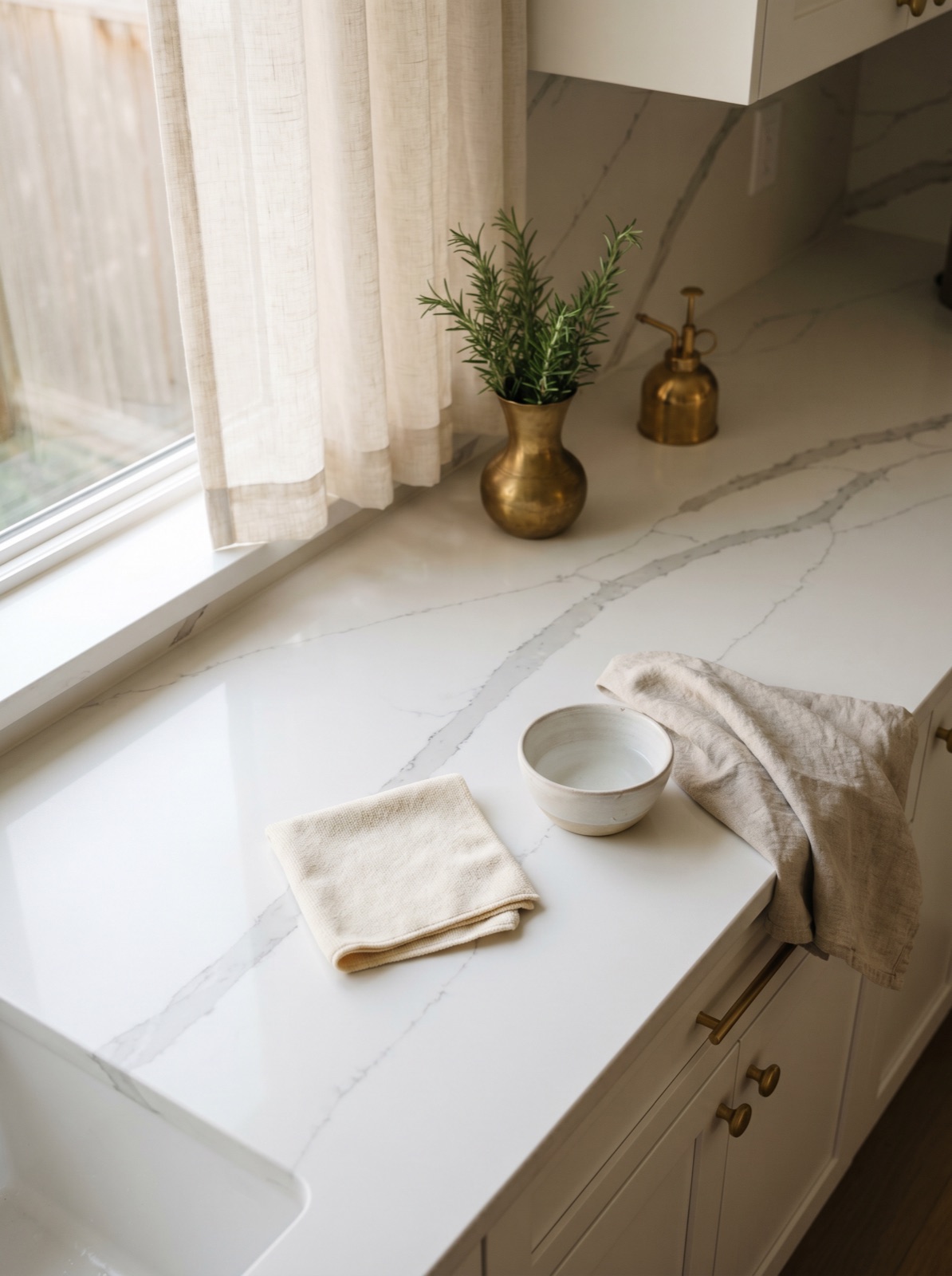
title: “How to Clean Quartz Countertops: A Vancouver Homeowner’s Daily Guide”
slug: how-to-clean-quartz-countertops
focus_keyword: how to clean quartz countertops
description: “A practical, manufacturer-sourced guide to cleaning quartz countertops in Vancouver kitchens. What to use, what to avoid, and why.”
author: Alpine Countertops
date: 2026-04-23
Olive oil drops from a pizza box at 9 p.m. on a Saturday. You wipe it, it looks clean. Monday morning, there’s a dull shadow where the oil sat. If you’ve ever had that moment on a new island, you already know why the question of how to clean quartz countertops matters more than it sounds. Quartz is forgiving — but only when you respect what the resin binder actually is.
This is the short version we give every Vancouver homeowner who picks up their slab from our Richmond facility: manufacturer-sourced routines that keep polished quartz looking new, plus the short list of products that will dull or damage it.
Daily quartz care — the 60-second routine
For almost every spill in a normal week, the answer is the same across every major brand:
- Warm water on a soft microfiber cloth.
- A small amount of gentle, pH-neutral dish soap.
- Wipe the surface. Rinse the cloth. Wipe again with clean water.
- Dry with a fresh microfiber.
Caesarstone puts it simply: “wipe the surface with a soft cloth or a non-abrasive scourer dipped in warm water mixed with a mild detergent. Rinse with water, and dry with a soft cloth or paper towel” (Caesarstone Care & Maintenance). Cambria’s own product care page says the same thing in different words: “use a little warm water, soft cotton cloth, and mild soap, if desired” (Cambria Product Care). Silestone recommends a neutral soap with a damp microfiber cloth, rubbing gently in a circular motion (Silestone Maintenance).
That’s the entire daily routine. If you’re reaching for a spray bottle of specialty stone cleaner every night, you’re overthinking it.
What NOT to use on quartz
Quartz is roughly 90–93% ground quartz bound with polyester resin. The resin is what wipes clean — and it’s also what reacts poorly to harsh chemistry. Each major brand publishes a slightly different “do not use” list. What follows is the safe intersection. If your brand’s guidance differs, follow your brand.
- Abrasive powder cleaners (Comet, Ajax, baking-soda scrubs). Cambria names “Comet®, Soft Scrub®, S.O.S.® pads, products with pumice” as prohibited (Cambria Product Care). Caesarstone warns that “abrasive powder cleaners, steel wool, scrubbing sponges” can leave dull spots or superficial scratches (Caesarstone — What Not To Use).
- Ammonia-based cleaners, which includes classic blue Windex. Caesarstone advises avoiding products “containing high concentrations of ammonia, which can dull the product’s surface over time,” and recommends that only ammonia-free glass cleaners be used sparingly (Caesarstone — What Not To Use).
- High-pH alkaline cleaners long-term: oven cleaner, grill cleaner, dishwasher detergent used straight. Caesarstone and Cambria both prohibit these outright.
- Strong acids and paint strippers: paint removers, furniture strippers, tarnish cleaners, silver cleaners, nail polish remover containing acetone. Cambria lists most of these by name.
- Wax, sealers, and polishes. Quartz is non-porous. It does not need sealing and should not be waxed. Cambria is explicit: “do not apply any sealers, penetrants, or topical treatments” (Cambria Product Care).
A good rule of thumb: if a product is aggressive enough to strip paint or unclog drains, it’s aggressive enough to dull a quartz resin.
Can I use vinegar on quartz?
Short answer: not for daily cleaning. Diluted, occasional use is tolerated by some brands but not all, so follow your brand’s guide.
- Caesarstone permits vinegar only heavily diluted — “equal parts vinegar and water” — and positions it as an option, not a default; undiluted vinegar risks dulling the surface or degrading the resin over time (Caesarstone — What Not To Use).
- Silestone (Cosentino) allows “cleaning vinegar to clean and disinfect Silestone surfaces” as an accepted option (Silestone Maintenance).
- Cambria takes the strictest position. Its product care page prohibits exposure to “abrasive, strong alkaline, acid, free radicals, oxidizers, or cleaners of the like (whether high, neutral, or low pH)” (Cambria Product Care).
The practical translation: for daily wiping, skip the vinegar. If you occasionally want to disinfect and your slab is Silestone or Caesarstone, dilute it. If your slab is Cambria, don’t.
Can I use bleach on quartz?
Same principle — diluted and occasional only, and follow your brand.
- Silestone allows bleach for food stains at a specific dilution: “Dilute bleach in water (15% bleach solution) and rub on the stain with a damp cloth… Leave it to work for 2 minutes and then rinse.” It then warns that “bleach is an alkaline product that can damage a Silestone surface if exposure is prolonged (from 2 hours)” (Silestone Maintenance).
- Caesarstone says “concentrated bleach can leave stains, so only use diluted bleach according to the manufacturer’s instructions,” and treats it as a last-resort option rather than a routine cleaner (Caesarstone — What Not To Use).
- Cambria prohibits bleach explicitly: “Do not use or expose Cambria Product to certain cleaning products, including, but not limited to, bleach” (Cambria Product Care).
So: yes for diluted, occasional, well-rinsed disinfection on Silestone or Caesarstone. No on Cambria. Never neat, never for routine wiping, and never left sitting on the surface.
Daily, weekly, monthly — a simple schedule
- Daily (under a minute): warm water + mild dish soap on microfiber. Wipe down after cooking. Dry with a clean cloth.
- Weekly: a more thorough wipe with the same soap-and-water routine, working in small sections. Pay attention to the area behind the faucet and around the cooktop.
- Monthly (optional): spot-check for any dulled areas where oil or coffee may have sat. Most will lift with a second round of dish soap and a fresh microfiber. If one won’t, see our guide on removing stubborn stains from countertops before reaching for anything harsher.
- As needed: disinfect per your brand’s guidance — diluted bleach (Silestone), ammonia-free glass cleaner, or a dedicated quartz-safe cleaner. Rinse and dry afterwards.
Most Vancouver homeowners we talk with overclean their quartz in the first month and then underclean it after year one. The 60-second routine, done consistently, beats any deep-clean product.
Streak-free finish — the microfiber trick
Polished quartz shows streaks when soap residue dries on the surface. The fix is a three-cloth habit: one soapy, one rinse, one dry. Buff the final pass in a light circular motion.
Keep cleaning microfibers in their own drawer, washed separately from kitchen towels and without fabric softener — softener coats fibers and leaves smears on polished stone. This one change is responsible for most of the “why does my island always look streaky” complaints we hear.
A note on Vancouver tap water
Metro Vancouver is lucky on this front. Our drinking water comes from rain and snowmelt in the Capilano, Seymour, and Coquitlam watersheds, and because “it doesn’t spend a lot of time stored in rocks it has low mineral content” (Metro Vancouver — Water Quality & Testing). The 2022 Greater Vancouver Water District report put Capilano source water hardness at roughly 3.2–24.0 mg/L CaCO₃ — comfortably inside Health Canada’s soft-water classification (under 60 mg/L).
The practical quartz implication: hard-water spotting is rare in most Metro Vancouver kitchens. If you do notice faint mineral haze near the faucet — more common closer to the Fraser Valley or on private wells — wiping the area dry after each use resolves it.
What about heat? Can I set a pan down?
Cleaning advice is only half the care story — the other half is heat. Quartz resin has a ceiling. Caesarstone specifies that surfaces should not be exposed to extremely hot pots and pans above 300°F (about 150°C) directly on the surface; always use a trivet or hot pad. For cast iron from a 450°F oven, the answer is always a trivet.
Heat damage, stubborn oil shadows, and the occasional permanent marker — those are a separate topic. We cover the full rescue playbook in our guide to removing stubborn stains and heat marks from countertops.
A few related reads
If maintenance is weighing on your material decision, our quartz vs granite for Vancouver kitchens guide lays out the daily-life trade-offs side by side. If your island doubles as breakfast bar — the source of most of the coffee rings and olive-oil drops we just walked through — our breakfast bar countertop guide is worth a skim. For finishes and veining, browse our quartz countertop collection.
Still seeing a stain that won’t come out? Bring us the slab details — Alpine’s fabrication team has handled nearly every stone type and finish you’ll find in Metro Vancouver homes.
Planning a Kitchen or Bath Countertop Project in Metro Vancouver?
Alpine Countertops has been crafting premium quartz, granite, marble, and porcelain surfaces in our Richmond facility since 2015. We serve homeowners across Vancouver, Burnaby, Richmond, Surrey, West Vancouver, North Vancouver, Coquitlam, New Westminster, and Langley.
Book a free design consultation:
– 604-630-5700
– Fabrication facility: Richmond, BC
– Browse our gallery · View countertop materials · Get in touch
Alpine Countertops — Professionals Bringing Style to Life.
Our complete countertop care guides
For the full picture, explore our in-depth guides: