
How to Repair Burn Marks on Countertops
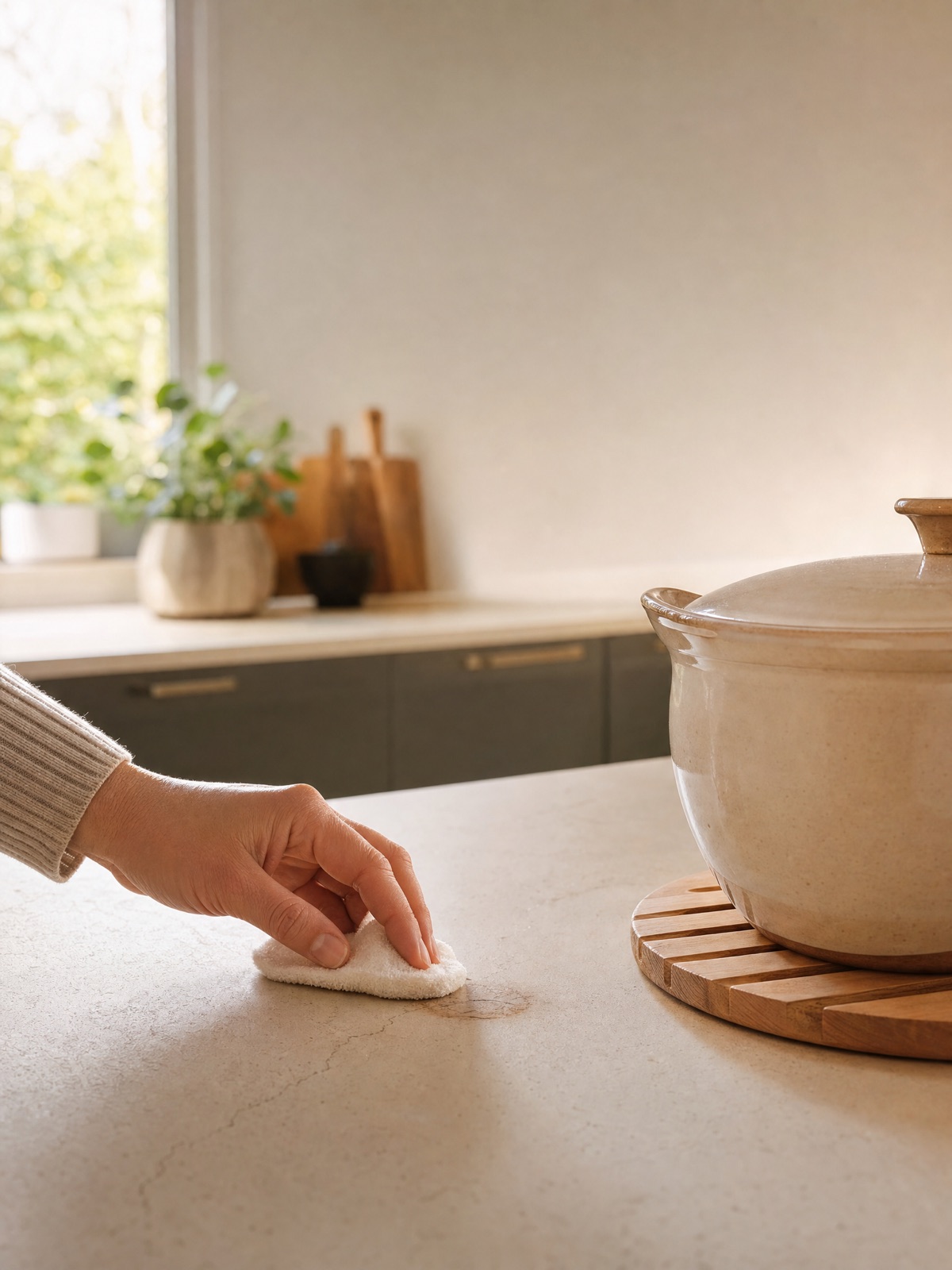
A hot pan set down a moment too long leaves a mark, and the first question is always the same: can it be fixed? The honest answer depends entirely on what your countertop is made of, and you deserve a straight one rather than a promise that everything buffs out. Some burn marks genuinely lift with the right approach. Others — particularly on engineered quartz — are permanent, and no home remedy will fully remove them. This guide to countertop burn marks goes material by material, tells you what to realistically expect, and shows you how to assess and treat a burn before deciding whether a professional or a section replacement is the answer. Prevention, as you will see, is by far the cheapest repair.
What you’ll need
For assessing and attempting a light burn mark — recognising that on some materials there is no DIY fix at all:
- pH-neutral dish soap and warm water — the first thing to try, because some “burns” are scorched residue, not damaged surface.
- A soft cloth and a non-abrasive sponge.
- A clean microfibre cloth for drying.
- For granite only: a stone-safe polish, or access to a professional with diamond pads for anything beyond light marks.
- A trivet or hot pad — to prevent the next one (the most useful item on this list).
Note what is not here: aggressive abrasives, scouring powders, or sandpaper. On quartz especially, these turn a discoloured spot into a dull, scratched patch that looks worse and cannot be undone.
Step-by-step: assess and treat a burn mark
- Let it cool, then clean it. Once the surface is cool, wash the mark with mild dish soap and warm water and dry it. Surprisingly often, what looks like a burn is scorched food residue or a transfer mark from the pan, and it simply washes off. If it does, you are done.
- Identify your material. This determines everything that follows. Engineered quartz, natural granite, and laminate respond completely differently to heat damage. If you are unsure, check your original paperwork or send a photo to your fabricator.
- For granite, try a gentle approach first. A light heat mark or scorched film on granite can sometimes be cleaned away or eased with a stone-safe polish and a soft cloth. Work gently and assess. Granite tolerates heat well, so genuine damage to the stone itself is uncommon; most granite “burns” are surface residue or a mark in a surface treatment rather than the stone.
- For quartz, set expectations before you touch it. If cleaning did not remove it, you are likely looking at resin scorch — a permanent discolouration. Do not reach for an abrasive. A very mild, non-abrasive surface polish may slightly reduce a faint mark, but a true burn will not polish out, and aggressive attempts make it worse. Stop and get a professional assessment.
- For laminate, assess the depth. A light surface scorch on laminate sometimes responds to gentle cleaning, but laminate burns through to the core cannot be repaired invisibly; the options are a filler that is visible up close, a cosmetic cover, or replacing the affected section.
- Decide: live with it, professional, or replace. Be realistic. A faint mark you can only see in raking light may be best left alone. A noticeable burn on granite is often a job for a professional with the right pads. A noticeable burn on quartz usually comes down to accepting it or replacing the affected section. Your fabricator can tell you which, from a photo.
Burn marks by material — what to realistically expect
Granite (and most natural stone). Granite is the most heat-tolerant common countertop. The stone withstands temperatures far beyond any kitchen pan, so a hot pot rarely damages the granite directly. What you usually see is scorched residue or a mark in a surface sealer, which can often be cleaned or buffed out — light marks by a careful homeowner, anything more by a professional with diamond pads who can blend the spot into the finish. Outcome: usually repairable.
Quartz (engineered). This is the honest hard case. Engineered quartz is roughly 90% ground quartz bound with a polymer resin (about 6–10% of the slab), and resin is the heat-weak link. Quartz is heat-resistant, not heat-proof: a hot pan can scorch or discolour the resin, leaving a white, yellow, or brown mark, and once the resin has burned, that change is generally permanent. There is no reliable home fix for true resin scorch. Mild surface marks may sometimes be cleaned; a genuine burn cannot be polished out, and severe scorch may require replacing the affected section. Quartz makers underline this with strict heat guidance — Caesarstone, for example, advises never placing anything hotter than about 300°F (≈150°C) directly on the surface and always using a trivet (a separate Caesarstone note puts the resin’s sensitivity lower still). Outcome: often not fully repairable. We cover this further in our guide to heat marks on quartz countertops.
Marble. Marble sits between the two. Light heat marks may polish out, because marble can be re-honed, but scorching or a heat-related dull patch generally needs professional refinishing. Outcome: sometimes repairable by a pro.
Laminate. Laminate burns differently — a hot pan can scorch or melt the thin decorative layer. A very light surface scorch may clean up, but a burn that has reached the core cannot be made invisible; the realistic options are a colour-matched filler (visible on close inspection), a cosmetic cover such as a trivet or board over the spot, or replacing the section. Outcome: light marks sometimes; real burns are not invisibly repairable.
What to avoid
- Do not use abrasive powders, scouring pads, or sandpaper on quartz. They convert a discoloured spot into a dull, scratched patch that is worse and permanent. Quartz cannot be re-polished at home.
- Do not assume every mark is a burn. Clean first — scorched residue and pan transfer marks look like burns and often wash off.
- Do not believe “any burn buffs out.” It is true for some granite, false for quartz resin scorch. Be wary of guides that promise a universal fix.
- Do not keep applying heat to a marked spot. Repeated heat deepens resin discolouration on quartz and stresses the surface.
- Do not attempt a large or deep burn yourself. Section replacement or professional refinishing gives a far better result than a home patch.
Prevention: the only guaranteed fix
Because the most common kitchen surface — quartz — is also the one that scorches permanently, prevention genuinely matters more here than for almost any other countertop issue. The rules are simple and they work:
- Always use a trivet or a closed-weave hot pad under hot pots, pans, slow cookers, and oven trays. Never set cookware straight from the burner or oven onto the surface.
- Keep small heat-producing appliances — kettles, air fryers, toaster ovens — off the bare surface or on a heat-resistant pad.
- Mind the area beside the stove and around the cooktop cut-out, where most heat damage happens.
- On granite and natural stone, a trivet is still wise: it protects any surface sealer or treatment even though the stone itself is heat-tolerant.
Our full countertop dos and don’ts checklist covers heat protection alongside the other habits that keep a surface looking new.
When to call a professional
Call a fabricator when a burn on granite or marble is more than a light mark and you want it blended into the finish properly, when a quartz burn is noticeable and you need to know whether the section can be replaced, or whenever you are simply not sure what you are looking at. For quartz in particular, a professional can give you the honest verdict — repairable, or replace the section — that saves you from buying products that cannot fix resin scorch. Check your warranty first, too: heat damage is excluded from most quartz warranties, but documenting the mark before any work protects you regardless.
Frequently asked questions
Can you remove a burn mark from a quartz countertop?
Usually not completely. Engineered quartz is bound with a polymer resin that scorches or discolours permanently when it burns, and there is no reliable home fix for true resin scorch. Cleaning may remove scorched residue, and a very mild non-abrasive polish might slightly soften a faint mark, but a genuine burn will not polish out. Aggressive buffing makes it worse. Severe scorch may require replacing the affected section, which a fabricator can assess from a photo.
Will a burn mark come off granite?
Often, yes. Granite tolerates heat far better than quartz, so a hot pan rarely damages the stone itself. What you usually see is scorched residue or a mark in a surface sealer, which can frequently be cleaned away or eased with a stone-safe polish; anything beyond a light mark is best handled by a professional with diamond pads who can blend it into the finish. Granite is the most heat-forgiving common countertop.
Why does quartz burn when it is sold as heat-resistant?
Heat-resistant is not heat-proof. Quartz is about 90% ground stone, which tolerates very high heat, but the polymer resin that binds it (roughly 6–10% of the slab) does not. Direct contact with a hot pan can scorch or discolour that resin even though the mineral is unaffected, leaving a permanent mark. This is why every quartz maker insists on trivets, and Caesarstone, for example, advises never exceeding about 300°F (≈150°C) on the surface.
Can a burned laminate countertop be repaired?
A very light surface scorch on laminate sometimes cleans up, but a burn that has reached the core cannot be made invisible. The realistic options are a colour-matched filler that is visible on close inspection, a cosmetic cover over the spot, or replacing the affected section. If the laminate is dated, a burn is often the prompt homeowners use to upgrade to a more heat-tolerant surface. Call 604-630-5700 to talk through options.
This guide is part of our Countertop Repair Guide →. For quartz specifically, see our deeper guide to heat marks on quartz countertops.
Get help from Alpine
Send us a photo of the burn mark and we will tell you honestly whether it cleans up, buffs out, or needs the section replaced — no upselling a fix that cannot work. Call 604-630-5700 or email info@alpinecountertops.com. Alpine Countertops fabricates in our own Richmond facility and serves homeowners across Metro Vancouver and the Fraser Valley. You can also reach us through our contact page.