
Countertops for Small Condo Kitchens: Making Metro Vancouver Square Footage Work Harder
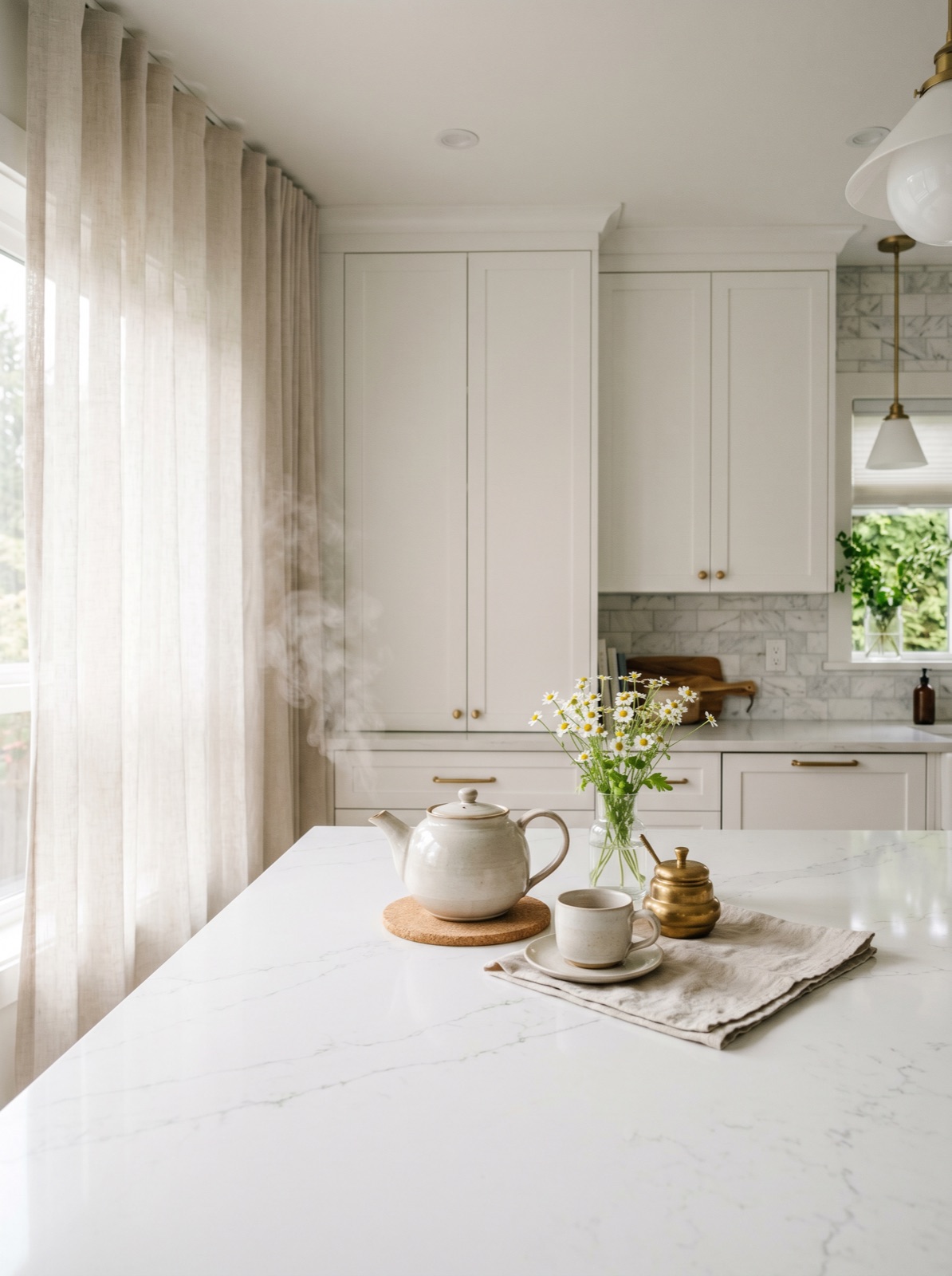
Yaletown 1-bedroom, 580 sq ft. The kitchen is 7 feet of counter and one small sink. Every inch earns its keep.
If you own a condo in Metro Vancouver, your kitchen probably looks something like that. Choosing countertops for a small condo kitchen in Vancouver is a different problem than a detached home in Dunbar — you are balancing visual weight against light, daily wear against a slab size that feels almost jewelry-scale, and a straightforward install against a strata building’s elevator bookings and quiet hours. The good news: the same fabrication decisions that make a condo kitchen look calm also tend to make it easier to live in.
Here is how we think about it at our Richmond facility when a homeowner from a Coal Harbour high-rise, a Brentwood tower, or a Richmond central two-bedroom walks in with their floor plan.
Why small condo kitchens need different countertop thinking
Three things change when the kitchen shrinks.
Visual weight matters more. A dark, heavily veined slab that looks like a statement piece in a 250-square-foot kitchen can close a 60-square-foot galley. With less cabinetry and less floor to absorb pattern, the counter reads as a larger percentage of what your eye sees.
Light reflection does real work. Most Vancouver condos have one window doing most of the lifting — a north-facing balcony in a False Creek tower, or a southeast exposure in Burnaby’s Metrotown district. A lighter countertop pushes that natural light around the room rather than absorbing it.
Daily wear per square foot is higher. Your 7-foot run of counter is doing the same job a 20-foot U-shape does in a suburban kitchen — prep, landing, coffee station, mail drop, laptop perch. Choose a material that shrugs off constant use without needing babied care.
Material choices that actually work
Quartz (engineered). The workhorse for condo kitchens. Because quartz is resin-bound, it is non-porous — Cambria states plainly that their surfaces require “no sealing, polishing, or reconditioning” (Cambria care). Caesarstone, Silestone, Vicostone, and Cambria all offer a wide range of light, consistent, soft-veined colors that photograph and live well in small spaces. Pattern consistency means a single small slab looks intentional, not accidental.
Porcelain large-format slabs. For galley kitchens where you want one continuous surface from wall to wall, large-format porcelain can run a single seamless slab across 10 feet or more. Fewer seams, very light visual weight, and well-suited to the Scandi-leaning aesthetic common in newer Yaletown and Brentwood builds.
Light quartz with marble-look veining. The compromise most Vancouver condo owners land on — the visual softness of marble without the porosity or maintenance. Look for collections in warm white, soft dove gray, or cream, with veining that’s present but not dramatic.
What to avoid. Very dark quartz with high-contrast veining closes the space visually. Natural granite or marble with heavy, busy patterns can overwhelm a short run. Exotic blues, dark greens, and black-with-white-lightning movement have their place in a 300-square-foot kitchen; in a 60-square-foot galley they fight the room.
If you’re deciding between engineered stone and natural granite, our deeper comparison of quartz vs granite for Vancouver kitchens covers heat, stains, and resale trade-offs with manufacturer specs.
Color and pattern for small spaces
Condo-scale kitchens reward restraint.
- Warm whites and off-whites read as modern without the clinical chill of pure white, and they pair with both white-shaker and natural-wood cabinetry common in recent Vancouver builds.
- Subtle veining over bold — a soft gray vein across a warm white base looks considered at 7 feet; a dramatic book-matched vein needs room to breathe.
- Continuity with the backsplash — running the same countertop material up the wall as a 4-inch or full-height backsplash reduces visual breaks and makes the kitchen feel taller. This matters more in condos with 8-foot ceilings than in vaulted detached homes.
- Match island to perimeter — if you have a small peninsula, keeping it the same material as the perimeter keeps the eye moving. Contrasting islands work better when there’s more floor to justify them.
Edge profiles for condos
Small kitchens look best with thin, modern edges. A square or eased edge reads lighter than a chunky 1.5-inch bullnose. In a galley kitchen where the counter is eye-level for anyone standing in the living room, the edge profile is surprisingly visible — a chunky traditional edge makes the space feel heavier; a square-or-eased profile disappears into the slab.
Our full guide to countertop edge profiles and what they cost walks through every option. The short version for condos: square, eased, or 1/8-inch bevel. Skip the ogee and the bullnose unless you’re matching existing traditional cabinetry.
Waterfall on a galley peninsula — yes or no?
Sometimes yes, often no. A waterfall edge — where the countertop material continues down the side of an island or peninsula to the floor — is one of the most requested design details in Vancouver condos. It works on the right peninsula and fails on the wrong one.
Yes, if: your peninsula is open on one or both short sides, you have a relatively quiet slab (less pattern noise reading vertically), and you’re willing to lose the open storage or knee space on the waterfall side.
No, if: that peninsula is your primary seating — the waterfall cuts seat clearance and makes barstools awkward. In a tight condo where the peninsula doubles as prep surface and dining table, preserving the leg room under the overhang usually beats the aesthetic upgrade.
We go deeper on the trade-offs in our article on waterfall edge countertops, including how the end-panel veining decision changes the cost.
Strata and strata-council realities
Every Vancouver condo renovation runs through a strata council. Specifics vary building by building — a 1990s Yaletown concrete tower has different rules than a 2022 Brentwood build — but a few patterns show up repeatedly.
- Work hour restrictions. Many Vancouver stratas limit renovation work to weekday daytime hours (commonly something like 9 a.m. to 5 p.m., sometimes 9 to 4, with no weekend or evening work). Always check your specific bylaws.
- Elevator bookings. Slabs are heavy and awkward. Most buildings require an elevator reservation with padded protection for delivery and install day.
- Floor coverings. Protective paper, plastic, or Masonite from elevator to unit is typically required.
- Indemnity and insurance. Many strata councils require a copy of the fabricator’s liability insurance before granting work approval, and sometimes a damage deposit.
None of this is a problem when you plan for it. Read your strata bylaws early and flag them during the template visit. BC’s Strata Property Act sets the general framework — for readable plain-language context, the Condominium Home Owners’ Association of BC (CHOA) publishes guides on strata renovations.
Template and install: condo logistics
Fabrication timeline for a condo kitchen runs similar to a house — typically 1 to 2 weeks from template to install, with the on-site install usually completing in 1 to 2 days if access is clear.
What slows a condo install: elevator not booked, fabrication-truck parking not arranged with the building manager, loading-dock hours that don’t match the crew’s start time, or a locked amenity room blocking the path from elevator to unit.
What speeds it up: a single point of contact at the strata, confirmed elevator slots for both template day (light foot traffic) and install day (heavy slab carry), and the unit cleared of dishes and small appliances before the crew arrives.
Budget considerations for a condo kitchen
Small-kitchen budgeting carries a counter-intuitive reality: the slab cost drops, but the fixed costs don’t.
A condo kitchen might use 20 to 30 square feet of finished countertop — roughly a third of a typical detached home’s kitchen. Material cost scales down proportionally. Fixed costs — template visit, cutting, edge fabrication, delivery, install minimum — stay similar. The per-square-foot total installed often runs higher than the same material in a large kitchen.
This is not a reason to cheap out. It is a reason to pick the slab color right the first time, get everything done in a single template-and-install pass, and compare quotes on the total installed number — not the per-square-foot rate, which can hide fixed fees.
To see how condo kitchens come together in Yaletown, Richmond, or Burnaby, our countertop gallery has recent small-footprint installs, and our materials overview shows the light-warm-white quartz and porcelain collections Vancouver condo owners gravitate toward.
Planning a Kitchen or Bath Countertop Project in Metro Vancouver?
Alpine Countertops has been crafting premium quartz, granite, marble, and porcelain surfaces in our Richmond facility since 2015. We serve homeowners across Vancouver, Burnaby, Richmond, Surrey, West Vancouver, North Vancouver, Coquitlam, New Westminster, and Langley.
Book a free design consultation:
– 📞 604-630-5700
– 📍 Fabrication facility: Richmond, BC
– 🌐 Browse our gallery · View countertop materials · Get in touch
Alpine Countertops — Professionals Bringing Style to Life.