
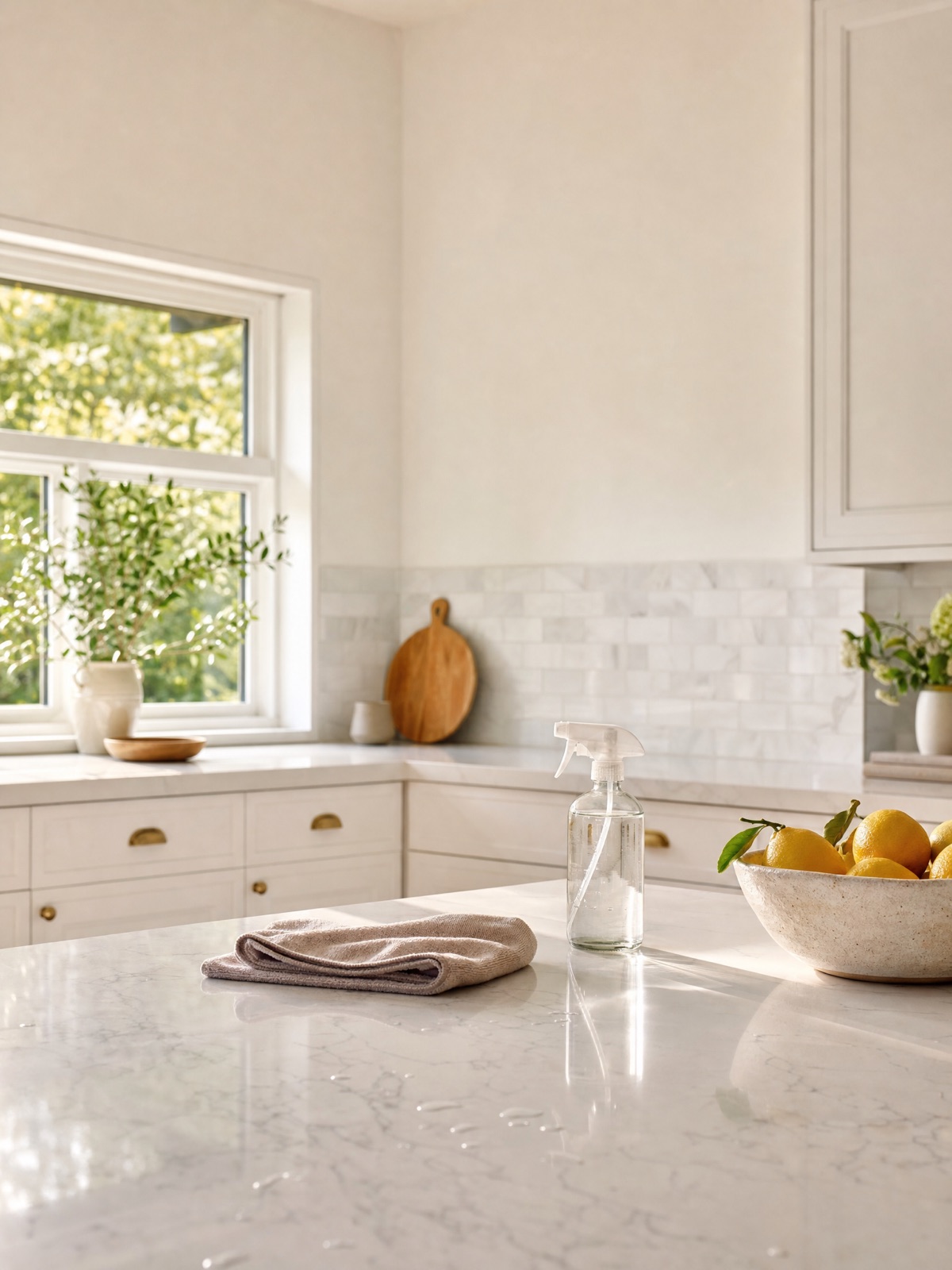
Quartz Countertop Care & Maintenance: The Complete Vancouver Guide
Engineered quartz is the most forgiving countertop surface most Metro Vancouver kitchens will ever have. It is non-porous, it never needs sealing, and day-to-day it asks for very little — usually just warm water and a few drops of mild dish soap. The trouble is that most online care advice is written for harder water, hotter climates, and a single brand, then applied to every quartz top as if the rules were universal. They are not: the brands genuinely disagree on cleaners, and Vancouver’s unusually soft tap water changes what those white marks on your counter actually are. This guide is the version a fabricator would give you — what quartz needs daily, what quietly damages it, how the major brands differ, and what is specific to caring for quartz here on the South Coast. Alpine Countertops has fabricated and installed quartz across Metro Vancouver since 2015, and everything below is either drawn from manufacturer guidance or flagged where the industry does not agree.
Quick reference: quartz care at a glance
- Daily clean: warm water and a few drops of mild dish soap on a soft or microfibre cloth. That is what Caesarstone, Cambria, Silestone and HanStone all recommend.
- Never needs sealing. Engineered quartz is non-porous. Sealing it does nothing.
- Always use a trivet. Quartz is heat-resistant, not heatproof — the resin binder can scorch or discolour from direct heat.
- Avoid: abrasive pads and powders, harsh or high-alkaline chemicals (oven cleaner, bleach left to sit, drain cleaner, paint stripper), and leaving spills — especially anything coloured or acidic — to dry on the surface.
- Cutting: use a board. Quartz resists scratches but is not scratch-proof, and a ceramic knife or a dragged pan can mark it.
- Those white “water spots” in Vancouver are usually soap film or dishwasher residue, not mineral scale — our tap water is very soft. More on that below.
- Brand-specific: whether you can use vinegar or Bar Keepers Friend depends on who made your slab. Check your brand before reaching for either.
Daily cleaning
For everyday cleaning, the four major quartz brands sold in Canada converge on the same simple routine: a few drops of mild dish soap in warm water, applied with a soft cloth or microfibre, then wiped dry. There is no need for a branded “quartz cleaner,” though several exist and are fine if you prefer the convenience. HanStone also permits a rubbing-alcohol-and-water solution or Simple Green diluted 1:30 for light cleaning. Cosentino markets Q-Action as its dedicated Silestone cleaner. None of this is mandatory — soap and water does the job.
The habits that matter more than the cleaner you choose are simple ones. Wipe spills as they happen rather than letting them dry, because dried-on residue is what creates most of the “stains” people later try to scrub off. Use a soft cloth, not a scouring pad. And dry the surface after cleaning if you want to avoid streaks and film — particularly with our soft water, which can leave a faint cloudy residue from soap rather than from minerals.
For a longer walk-through of routine quartz cleaning, see our existing guide on how to clean and care for quartz countertops.
What to avoid
Quartz is durable, but a handful of things will damage it — and most warranty problems we see trace back to this short list.
- Abrasive pads and scouring powders. Steel wool, green scouring pads, and gritty powders can dull or scratch the polished surface. Cambria explicitly warns against products such as Comet, Soft Scrub and S.O.S pads. HanStone bans abrasive cleansers including the Bar Keepers Friend Soft Cleanser and powder. (Bar Keepers Friend is genuinely brand-specific — see the brand notes below.)
- Harsh and high-alkaline chemicals. Oven cleaner, paint stripper, drain cleaner, nail-polish remover, and concentrated bleach can attack the resin or strip the finish. If a strong cleaner accidentally contacts the surface, rinse it off promptly with water.
- Direct heat. Setting a hot pot, pan, or oven tray straight onto quartz risks scorching or discolouring the resin. Always use a trivet or hot pad. There is a dedicated section on heat below.
- Letting spills dry. Quartz will not absorb a stain the way unsealed natural stone can, but coloured or acidic liquids — wine, coffee, turmeric, citrus, strongly coloured cleaners — left to dry can leave surface marks that are harder to remove later.
- Permanent markers and adhesives. These sit on the surface and can be stubborn; deal with them quickly rather than letting them set.
- Cutting directly on the surface. Use a board. It protects both the counter and your knives.
Why quartz never needs sealing
This is one of the clearest dividing lines between engineered quartz and natural stone. Quartz countertops are roughly 90% ground quartz bound with a polymer resin (about 6–10% of the slab). That resin fills what would otherwise be pore space, so the finished slab is effectively non-porous. Cambria states it plainly on its own care page: its quartz “never requires sealing, polishing, or reconditioning.” Because liquids cannot penetrate the surface, there is nothing for a sealer to protect — applying one simply leaves a residue you then have to clean off.
If you also have granite, marble or quartzite in your home, the rules are different — those are natural stones with real porosity and do need periodic sealing. We cover that in the granite care guide, the marble care guide, and the countertop sealing guide. Just do not let advice written for natural stone migrate onto your quartz.
Heat, scratch and impact limits
The quartz mineral itself can take enormous heat — well over 1,000°F — but the polymer resin that binds the slab together is the weak link, and that is what reacts to a hot pan. Engineered quartz is heat-resistant but not heatproof.
The honest position on temperature is that the manufacturers do not all publish the same number, so we will not pretend there is one. Caesarstone’s Canadian guidance advises never placing extremely hot items — it cites roughly 300°F (about 150°C) as a ceiling — directly on the surface, and to always use a hot pad or trivet. A separate Caesarstone US article stresses that the resin can be affected by sustained heat well below that, noting the surface is “heat resistant, not heat proof.” Cambria and Silestone both require a trivet but do not publish a specific temperature; Silestone notes that thermal shock from sudden heat can cause cracking. The practical takeaway is consistent across every brand even though the numbers vary: do not put hot cookware straight onto quartz, and keep a trivet within reach of the stove. If you want to understand what heat damage looks like and what can be done about it, see our spoke on heat marks on quartz.
On scratches, quartz is hard and resists everyday wear, but it is not scratch-proof. Ceramic knives, dragged stoneware, and grit under a sliding appliance can leave marks. Use a cutting board and lift rather than drag heavy items. Light surface scuffs are sometimes improvable at home, but aggressive abrasives can dull the finish and may affect your warranty — our quartz scratch repair guide covers what is safe to attempt versus when to call a fabricator.
On impact, quartz is tough but can chip at an unsupported edge or around a sink or cooktop cut-out if struck hard. Chips at vulnerable edges are a repair best handled by a fabricator, who can colour-match a filler to the slab.
Removing common marks
Most marks on quartz are surface residue rather than absorbed stains, so they respond to patience rather than force. Work from the gentlest method up.
| Mark | First try | If that fails |
|---|---|---|
| Dried food, general grime | Warm water and mild dish soap; let it soften, then wipe | Plastic scraper held flat to lift, then re-wash |
| Grease | Warm soapy water; a degreasing dish soap | A little diluted Simple Green (HanStone permits 1:30); rinse |
| Cloudy film / “water spots” | Re-clean with soap and water, then dry; usually soap or dishwasher residue, not minerals | See the water spots and mineral marks guide |
| Dried wine, coffee, tea | Soapy water and a soft cloth | Check your brand before any stronger cleaner |
| Ink, marker, adhesive | Soft cloth with a little rubbing alcohol | Repeat; avoid scrubbing with abrasives |
| Rust / metal marks | Soapy water first | Brand-dependent: Caesarstone permits its powder cleaner for rust; HanStone bans abrasive cleansers — check your brand |
| Limescale (well water only) | Soapy water | Silestone permits a baking-soda-and-white-vinegar paste for limescale; not all brands do — see below |
Two cleaners deserve special caution because the answer depends entirely on who made your countertop. Bar Keepers Friend: Caesarstone permits its powder cleanser specifically for rust and metal marks; HanStone bans its abrasive Soft Cleanser and powder outright; Cambria and Silestone state no position, so treat it as not approved for those unless you confirm otherwise. Vinegar: Caesarstone’s Canadian blog permits a 50/50 vinegar-and-water rinse and Silestone’s own care sheet permits it for occasional stain and limescale treatment, while Cambria and HanStone are silent. Even where permitted, use vinegar as an occasional spot treatment rather than a daily cleaner, since prolonged acid exposure can dull resin over time. Never assume “vinegar is fine on quartz” as a blanket rule.
Brand-by-brand notes
One advantage of buying from a fabricator that carries several brands is that we are not tied to one manufacturer’s rulebook. Here is how the major quartz brands’ published care guidance compares — including where they disagree, because that disagreement is real and worth knowing.
- Caesarstone. Daily cleaning with warm water and mild detergent. Permits its powder cleanser (or oxalic acid) on a damp cloth for rust and metal marks. Its Canadian blog permits a 50/50 vinegar-and-water rinse. On heat, it advises always using a trivet and cites roughly 300°F as a do-not-exceed figure, while separately noting the resin is affected by sustained lower heat. Caesarstone also publishes that its surfaces meet NSF/ANSI 51 food-contact standards and hold GREENGUARD Gold certification for low chemical emissions.
- Cambria. Daily cleaning with warm water, a soft cotton cloth, and mild soap if desired. Warns against abrasive cleansers (Comet, Soft Scrub, S.O.S pads). States clearly that its quartz never requires sealing, polishing or reconditioning. Requires a closed-weave hot pad or solid trivet under hot cookware, with no published temperature figure. Cambria’s care pages do not state a position on vinegar or Bar Keepers Friend, so we do not claim one on its behalf.
- Silestone (Cosentino). Daily cleaning with soap and warm water, or any pH-balanced household cleaner; Cosentino also offers Q-Action as a dedicated cleaner. Notably, Silestone’s own care sheet permits vinegar for stain treatment, and recommends a baking-soda-and-white-vinegar paste left on for 10 to 20 minutes for limescale and hard-water marks — a useful exception for Fraser Valley well-water homes. Requires a trivet for extreme heat and warns that thermal shock can crack the surface.
- HanStone. Daily cleaning with mild dish soap and water, a rubbing-alcohol-and-water solution, or Simple Green diluted 1:30, using a non-abrasive or microfibre cloth. Explicitly bans abrasive cleansers, including the Bar Keepers Friend Soft Cleanser and powder. Its care page does not address vinegar or a specific heat temperature, so we treat those as unstated rather than guessing.
- Vicostone. Like the others, Vicostone is engineered, non-porous and never needs sealing, and its general care follows the same soap-and-water daily routine with a trivet for heat and no abrasives. We carry Vicostone and recommend following the universal quartz rules above unless Vicostone’s own documentation for your specific colour says otherwise.
The pattern across all of them: soap and water daily, a trivet always, no abrasives, never seal. The disagreements are confined to vinegar and Bar Keepers Friend — so for those two, follow your own brand’s guidance rather than generic advice.
Quartz care in Metro Vancouver
This is where local knowledge actually changes the advice. The single most common quartz worry we hear — “I keep getting white water spots, do I have hard water?” — usually has the opposite answer here.
Metro Vancouver tap water is very soft. The region’s water comes from the Capilano, Seymour and Coquitlam mountain reservoirs, and the Greater Vancouver Water District’s 2024 water quality report puts treated hardness at roughly 2.5 to 4.8 mg/L as calcium carbonate, depending on which reservoir serves your tap. That is among the softest municipal water in North America — far below the threshold where hard-water mineral scale forms. So on a Vancouver, Burnaby, Richmond, North or West Vancouver, Coquitlam or New Westminster counter, a white cloudy film is far more likely to be soap residue, cleaner residue, or dishwasher rinse-aid and salt carryover than tap-water mineral deposits. The fix is usually to re-clean with plain soap and water and dry the surface — not to attack it with descalers. We walk through how to tell film from mineral marks in the water spots and mineral marks guide.
Fraser Valley well water is the real exception. Parts of the Fraser Valley — including areas of Abbotsford and the Township of Langley — draw from groundwater wells, which can be considerably harder (Abbotsford’s groundwater has been reported in the range of roughly 50 to 250 mg/L as calcium carbonate). Households on well water genuinely can see mineral deposits, and that is the one scenario where a mild descaling approach — such as Silestone’s permitted baking-soda-and-vinegar paste — is appropriate on quartz that allows it. If you are on municipal Metro Vancouver supply, you almost certainly are not dealing with scale.
Two more local notes. Quartz suits our damp, wet winters precisely because it is non-porous — it does not absorb moisture or harbour mildew the way a porous surface might. And for coastal kitchens in White Rock or West Vancouver, quartz handles marine humidity without issue, though any wood substrate beneath the counter is worth keeping dry (a cabinetry concern, not a quartz one). Planning a new kitchen? Our city pages for Vancouver, Burnaby, Richmond and Surrey cover material choices area by area.
When to call a professional
Plenty of quartz care is genuinely DIY. But a few situations are worth a fabricator’s hands rather than a home experiment, because the wrong attempt can make the problem permanent or affect your warranty.
- Chips at an edge, sink, or cooktop cut-out. These need a colour-matched filler and a steady hand to look right. See our countertop repair guide.
- Visible scratches you can feel with a fingernail. Surface scuffs may buff out; a real gouge usually will not, and abrasive DIY attempts risk dulling the surrounding finish.
- Heat scorch or discolouration. A scorched resin mark generally cannot be cleaned away. A fabricator can advise whether it is improvable or whether a section needs replacing.
- Cracks, especially at a cut-out. A crack is a structural issue, not a cosmetic one, and is not a DIY repair.
- A mark you cannot identify or remove with soap and water after a careful, non-abrasive attempt — before you escalate to anything stronger, ask.
Alpine fabricates in our own Richmond facility, which means we can match your slab, advise on what is repairable, and handle anything that is not. We have worked with these brands for over a decade and can tell you honestly when a fix is worth attempting and when it is not.
Frequently asked questions
Do I ever need to seal a quartz countertop?
No. Engineered quartz is non-porous, so sealing does nothing useful — Cambria, for example, states its quartz never requires sealing, polishing or reconditioning. Sealing is for natural stone such as granite and marble, not quartz.
Can I use vinegar to clean my quartz?
It depends on the brand. Caesarstone permits a diluted 50/50 vinegar-and-water rinse, and Silestone permits vinegar for occasional stain and limescale treatment. Cambria and HanStone do not state a position, so do not assume it is safe on those. Even where allowed, use vinegar occasionally rather than daily, since prolonged acid contact can dull resin over time.
Why do I get white spots on my quartz if Vancouver water is soft?
Because in Metro Vancouver those spots are usually not mineral scale at all. Our tap water is very soft (about 2.5 to 4.8 mg/L), so a cloudy white film is far more often soap residue, cleaner residue, or dishwasher rinse-aid and salt carryover. Re-clean with plain soap and water and dry the surface. Genuine mineral deposits are mainly a Fraser Valley well-water issue.
How hot is too hot for quartz?
Quartz is heat-resistant but not heatproof. The brands publish different figures — Caesarstone’s Canadian guidance cites roughly 300°F as a ceiling, while it separately notes the resin is affected by sustained lower heat — but every manufacturer agrees on the practical rule: never set hot cookware directly on the surface, and always use a trivet or hot pad.
Is quartz safe for food preparation?
Yes. Quartz is non-porous, so it does not absorb liquids or harbour bacteria the way a porous surface can. Major brands such as Caesarstone hold NSF/ANSI 51 food-contact certification and GREENGUARD Gold certification for low chemical emissions. That said, use a cutting board to protect the polished finish, not for safety reasons.
Can scratches and chips in quartz be repaired?
Sometimes. Light surface scuffs may improve with gentle methods, but deeper scratches and edge or cut-out chips are best handled by a fabricator who can colour-match a filler to your slab. Aggressive DIY abrasives can dull the surrounding finish and may affect your warranty — see our scratch repair and countertop repair guides, or call us.
Related guides
This guide is the hub for our quartz care content. Go deeper on a specific problem:
- How to remove water spots and mineral marks from quartz countertops
- How to repair scratches on quartz countertops
- Heat marks on quartz: prevention and what can be repaired
- How to clean and care for quartz countertops (our original cleaning walk-through)
Caring for other surfaces in your home? See our companion guides:
- Granite countertop care guide
- Marble countertop care guide
- Countertop repair guide
- Countertop sealing guide
Planning a new quartz kitchen? See our quartz countertops in Vancouver page, city guides for Vancouver, Burnaby, Richmond and Surrey, our quartz vs. granite comparison, and our quartz countertop cost guide.
Get help from Alpine
If you have a mark you cannot shift, a chip that needs matching, or you are weighing quartz for a new kitchen, we are glad to help. Alpine Countertops has fabricated and installed stone surfaces across Metro Vancouver and the Fraser Valley since 2015, from our own facility in Richmond — BBB A+ accredited, with our own install crews and no middlemen.
Phone: 604-630-5700
Email: info@alpinecountertops.com
Showroom: 230-11181 Voyageur Way, Richmond BC V6X 3N9 (by appointment)
Book a free consultation or browse finished work in our designs gallery.