
Waterfall Edge Countertops: When the Look Is Worth It (And When It Isn’t)
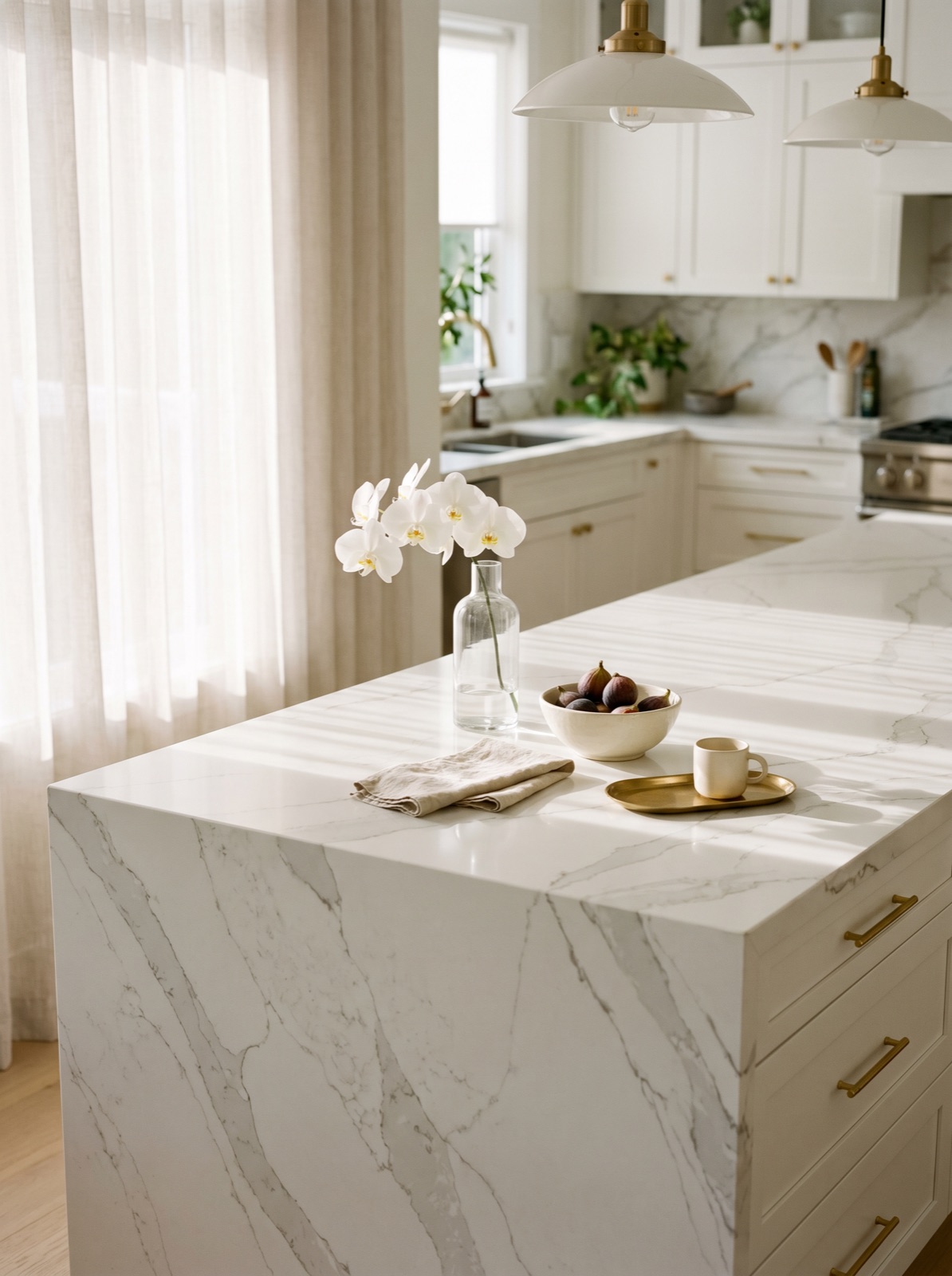
A white quartz slab cascades from the countertop’s edge, down the side of the island like frozen water. You’ve seen it in every magazine kitchen since 2018. The question is whether it’s right for YOUR Vancouver kitchen.
A waterfall edge countertop is one of the most photographed, most requested, and most misunderstood details in modern kitchen design. It’s held its place in our 2026 kitchen countertop trends roundup for a reason — and it’s also one of the most expensive features you can add. Below is what we tell Metro Vancouver clients when they ask us whether to commit: what it is, how it’s fabricated, where it shines, and where it falls flat.
What is a waterfall edge?
A waterfall edge is a countertop that continues down the side of an island or peninsula — usually on one or both ends — instead of stopping flush at the edge and letting the cabinet face show.
Technically, it’s built from a mitred joint: the horizontal countertop and the vertical side panel are each cut at a 45-degree angle, then joined at the corner so the stone appears to bend and fall. Done well, the seam nearly disappears and the pattern flows uninterrupted from the top surface down to the floor.
That continuity — the “frozen water” effect — is the whole point.
How it’s fabricated
Most fabricators cut waterfall mitres on a CNC machine. Caesarstone’s own guidance describes the method directly: “Manufacturers use a specialized technique called CNC laser cutting to create mitered edges. These mitered joints are cut at a precise 45-degree angle, allowing the top and side pieces to join perfectly without a visible seam” (Caesarstone, waterfall countertop guide).
In the shop, the two 45-degree faces are dry-fitted, glued with a colour-matched epoxy or polyester adhesive, clamped, and cured. Once set, the joint is hand-polished to hide the seam line. Installation then treats the island as three connected pieces that must land square and level — any twist in the cabinet base shows up immediately at the corner.
This is skilled work. It’s also slow work, which is why it costs more (see below).
Why the look works (when it works)
Waterfall islands do three things well:
- They create a visual anchor. Open-concept Vancouver condos and West Side renovations often lack architectural punctuation; a waterfall island becomes the hero object in the room.
- They make a kitchen feel architectural. The slab reads as a single sculpted form rather than a box with a top on it. The eye follows the vein from floor to counter without interruption.
- They showcase premium marble-look slabs. If you’ve paid for a dramatic Calacatta quartz with bold veining, a waterfall edge is where that investment is most visible. Showing only the top 1 1/4” thickness at the side of the island hides most of what you bought.
When the slab is right, the room is right, and the fabrication is clean, waterfall is genuinely beautiful.
When a waterfall edge is the wrong call
It’s also frequently the wrong call. We talk clients out of waterfall as often as we talk them into it.
- Galley and narrow kitchens. If the island also has to seat three people, a waterfall end blocks the overhang you need for knees. You lose seating to gain a photograph.
- Busy or highly variable patterns. Natural stone with dramatic, non-repeating veining almost never book-matches cleanly at a 90-degree corner. Caesarstone flags this explicitly: highly variable veining “is unsuitable for this design.”
- Small islands. Anything under roughly 72” long tends to look stubby with a waterfall — the panel reads as a wall, not a flow. The effect needs runway to breathe.
- Breakfast-bar overhangs. A cantilevered overhang on the side where you’re also dropping a waterfall loses the structural support the side panel would otherwise provide. Either the overhang gets hidden corbels (visually awkward) or the overhang gets trimmed back.
- Traditional kitchens. Waterfall reads contemporary. In a shaker-and-subway-tile traditional layout, it can feel airlifted in from a different project.
If any of those apply to your kitchen, there’s no shame in a standard edge. A well-chosen countertop edge profile — eased, bevel, or ogee — can be every bit as deliberate.
Cost: what a waterfall adds
Waterfall is a real upcharge, and anyone quoting you a flat “it’s only a little more” is not being straight with you.
Two credible sources, same ballpark. Bob Vila’s cost breakdown compares a standard 3 ft × 5 ft island counter at roughly $2,000 against a waterfall version at roughly $5,655 — a premium driven by extra slab, additional installation, and CNC fabrication (Bob Vila, waterfall countertop costs). Caesarstone cites the fabrication surcharge alone at “up to $2,000 or more” on top of standard material and install rates of $40 to over $100 per square foot (Caesarstone guide).
In practical terms for a Metro Vancouver project: expect a waterfall island to add roughly 30–80% to the countertop portion of your island budget, depending on slab, size, and whether you do one end or two. We quote it itemized so you can see exactly what the decision costs before you commit.
Best materials for a waterfall edge
Not every slab wants to be a waterfall.
- Quartz is the most forgiving. Consistent, engineered veining in products like Caesarstone Calacatta Nuvo or Silestone Eternal Calacatta Gold book-matches predictably at the mitre. It’s the default recommendation for a reason.
- Porcelain / sintered stone is the most interesting emerging option. Dekton’s slabs run up to 3200 × 1440 mm (Dekton format spec) — large enough that some island configurations can be cut from a single slab with continuous veining across the mitre. Porcelain is also the right call outdoors and for ultra-thin 12 mm looks.
- Natural marble is where it gets honest. A vein-matched Calacatta marble waterfall is genuinely beautiful, and genuinely high-maintenance — marble etches on contact with citrus and wine. If you’re considering it, read our marble vs quartz comparison for bathroom vanities first; the same trade-offs apply, amplified, on a kitchen island.
- Granite rarely waterfalls well. Its patterns are too unpredictable for a clean book-match. Our quartz vs granite guide for Vancouver kitchens covers why this difference matters even when you’re not doing a waterfall.
Seam placement and vein-matching
If you’re committing to waterfall, how your fabricator lays out the slab is more important than the slab itself.
Caesarstone’s language for the pattern technique is “book-matching” — cutting the horizontal and vertical pieces so the veins continue across the 45-degree corner as one uninterrupted image (Caesarstone). At Alpine, we photograph every dramatic slab laid flat before cutting, overlay the planned cuts in the image, and walk the client through exactly where the vein lands at the mitre. It’s a 15-minute conversation that saves a $6,000 regret.
Questions worth asking any fabricator you interview:
- Can I see the actual slab before you cut it?
- Where will the mitre joint fall on the vein?
- Will the side panel be book-matched to the top, or cut separately?
- How do you handle the seam on the floor side — butted to the floor, or set back?
Care: does a waterfall need different maintenance?
Day to day, no. A quartz waterfall cleans the same way the rest of your quartz counter does — the care routine in our guide to cleaning quartz countertops covers it.
The one thing to watch is the mitre joint itself. A well-sealed joint is inert; a poorly-sealed joint can collect moisture at the floor edge, especially in bathrooms or hard-washed kitchens. If you ever see the seam line darkening or opening, call your fabricator — this is a warranty-relevant issue, not a DIY fix.
Is a waterfall edge worth it for your kitchen?
Waterfall is a statement. It costs like a statement, and it should do a statement’s work in your room. If you have a long island, a dramatic slab, a contemporary kitchen, and the budget for it, yes — the look is worth it. If any of those four are missing, there are more satisfying places to spend the money.
We’d rather help you choose well than sell you a detail you’ll second-guess. If you want to see waterfall islands we’ve actually built in Metro Vancouver homes — quartz, porcelain, and a handful of brave marbles — browse the Alpine gallery before you decide.
Ready to translate one of these ideas into your own kitchen or bath? Alpine Countertops turns trend inspiration into real, livable surfaces for Vancouver homes.
Planning a Kitchen or Bath Countertop Project in Metro Vancouver?
Alpine Countertops has been crafting premium quartz, granite, marble, and porcelain surfaces in our Richmond facility since 2015. We serve homeowners across Vancouver, Burnaby, Richmond, Surrey, West Vancouver, North Vancouver, Coquitlam, New Westminster, and Langley.
Book a free design consultation:
– 📞 604-630-5700
– 📍 Fabrication facility: Richmond, BC
– 🌐 Browse our gallery · View countertop materials · Get in touch
Alpine Countertops — Professionals Bringing Style to Life.