
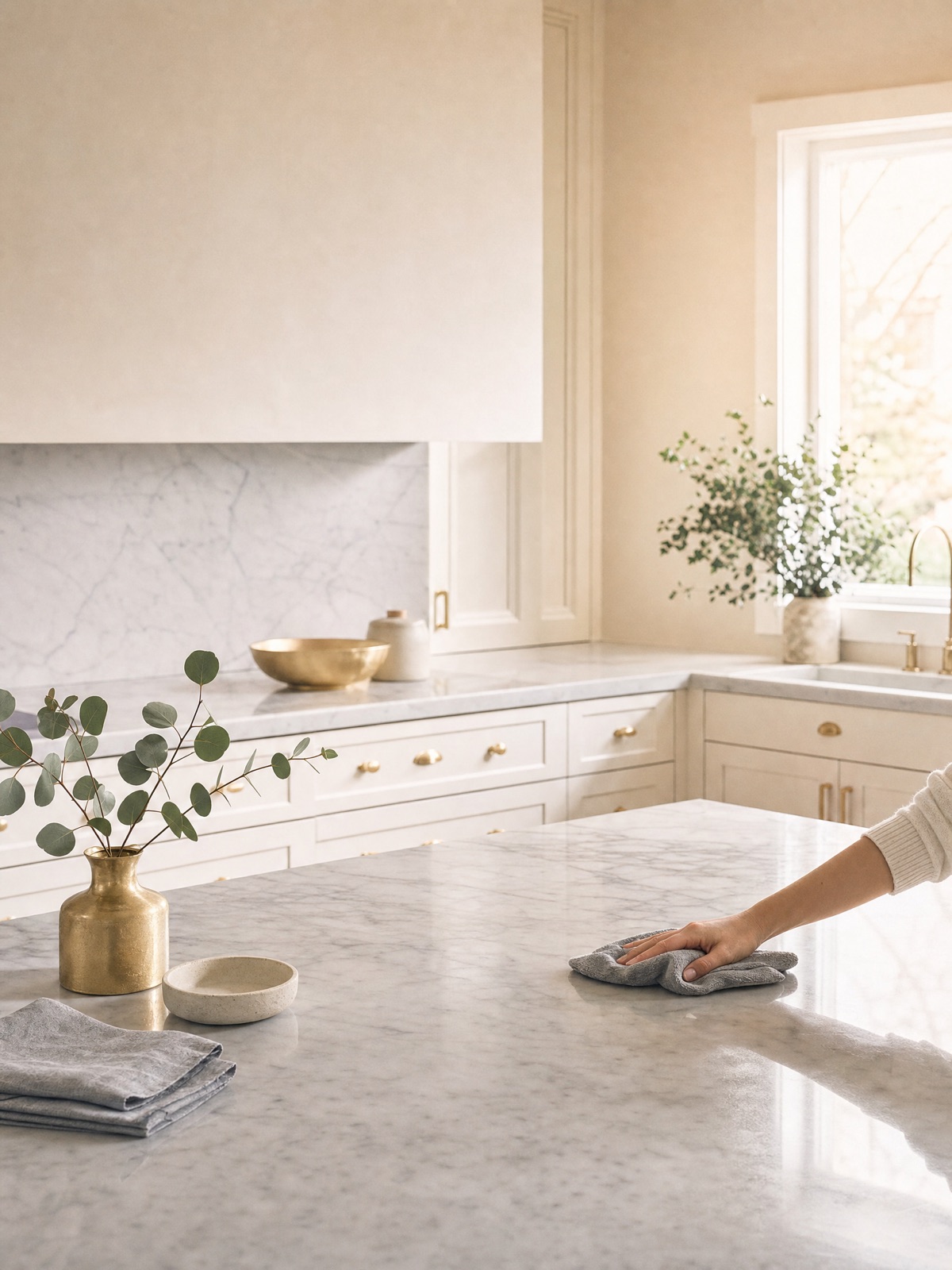
Marble Countertop Care & Maintenance: The Complete Vancouver Guide
Marble is the most beautiful and the most misunderstood stone in a Metro Vancouver kitchen. Homeowners fall for the soft, deep veining of a Carrara or Calacatta slab, install it, and then panic the first time a glass of red wine or a squeeze of lemon leaves a dull mark behind. Here is the thing almost no care guide explains clearly: that dull mark is usually not a stain at all. Marble has two completely separate vulnerabilities — etching and staining — and they have different causes and different fixes. Confuse them and you will reach for the wrong solution. This guide, written from a fabricator’s perspective, walks you through both, plus daily cleaning, sealing, the question of patina, and exactly when a mark is worth calling a professional about.
Alpine Countertops has fabricated and installed natural stone across Metro Vancouver since 2015. We are BBB A+ accredited, we run our own fabrication facility in Richmond, and our crews handle marble from templating through installation. We are direct with clients about what marble can and cannot tolerate, because a homeowner who understands the stone is a homeowner who stays happy with it for decades.
Quick reference: marble care at a glance
- Clean with pH-neutral products only — a stone-safe cleaner, or a few drops of mild dish soap in warm water and a soft cloth. Nothing acidic.
- Never use vinegar, lemon, or citrus cleaners on marble. Unlike some quartz brands, marble genuinely reacts with these. They etch the surface.
- Etching and staining are different problems. An etch is a dull mark where acid has chemically roughened the polished surface — lighter than the surrounding stone, and you can often feel it. A stain is absorbed liquid sitting in the pores — darker, and you cannot feel it.
- Fix an etch by re-polishing (a marble polishing powder for light etches, professional refinishing for deep ones). Fix a stain with a poultice that draws the absorbed liquid back out. Do not swap these.
- Seal marble periodically. An impregnating sealer slows absorption and buys you time to wipe spills — but it does not stop etching, because etching is surface chemistry, not absorption.
- Blot spills, do not wipe them. Wiping spreads an acidic or staining liquid across more surface.
- Some marble owners embrace the patina. A lived-in, softly etched marble surface is a legitimate aesthetic choice, common in European kitchens. You do not have to chase perfection.
Etching versus staining: the distinction that changes everything
This is the single most important concept in marble care, so it is worth getting right before anything else.
Marble is a calcareous stone — it is composed mainly of calcium carbonate. The Natural Stone Institute classifies stone as either calcareous (calcium-carbonate based, acid-sensitive) or siliceous (quartz and silicate based, acid-resistant). Marble, limestone, travertine, and onyx are calcareous. Granite and quartzite are siliceous. This matters because acids react chemically with calcium carbonate. When an acidic liquid — wine, lemon, vinegar, tomato, fruit juice, or many common household cleaners — touches polished marble, it dissolves a microscopically thin layer of the surface and leaves a dull, often slightly rough patch. That is an etch. It is a change to the stone’s surface itself, not a discolouration sitting on top of or inside it.
A stain is the opposite mechanism. Marble is porous, so a liquid that is left sitting can soak down into the pores and get trapped beneath the surface, leaving a darker discolouration. Oil, coffee, wine pigment, and ink are common culprits. The colour is in the stone, not on it.
The quick test most homeowners can do at home:
- Lighter than the surrounding stone, dull, and you can feel a change in texture — that is an etch.
- Darker than the surrounding stone, and the surface still feels smooth and even — that is a stain.
One spill can leave both. A glass of red wine spilled and left overnight can etch the polished surface (the wine’s acidity) and stain it (the pigment soaking in). When that happens you treat them in sequence: draw the stain out first, then re-polish the etch. We cover that combination in detail in our spoke guide on removing wine, coffee, and acid stains from marble.
Daily cleaning: keep it boring on purpose
The right daily routine for marble is deliberately plain, and that is the point. Every flourish you add — a “natural” citrus spray, a vinegar rinse, an all-purpose cleaner with a bright scent — is a chance to etch the stone.
For everyday cleaning, use a dedicated pH-neutral stone cleaner, or a few drops of mild dish soap in warm water, applied with a soft or microfibre cloth. Wipe the surface, then dry it with a clean cloth so you are not leaving soap film behind. That is the entire routine. In Canada, pH-neutral stone cleaners such as Method Daily Granite Cleaner (sold at Home Depot Canada and on Amazon.ca) and Weiman Granite & Stone Cleaner (sold at Canadian Tire, Walmart.ca, and Amazon.ca) are widely available and safe for sealed marble; despite the “granite” branding, these are formulated as pH-neutral cleaners for natural stone generally. If you prefer the simplest option, mild dish soap and warm water is exactly what works.
Wipe spills as they happen rather than letting them sit. The longer an acidic or pigmented liquid stays on marble, the more likely it is to etch or absorb. We will not give you a stopwatch figure for how many minutes you have — that number varies with the spill, the stone, and the seal, and precise timings are not something we can responsibly promise. The honest rule is simply: deal with spills promptly, and your marble will reward you.
What to avoid
This is the list that protects your investment. On marble, the following are genuinely harmful, not merely suboptimal:
- Vinegar — acidic, etches marble. (Note: a couple of quartz manufacturers actually permit a vinegar-water rinse on their non-porous engineered surfaces. Marble is not quartz. On marble, vinegar etches.)
- Lemon, lime, and other citrus — acidic, etches.
- Wine, especially red, and tomato — acidic enough to etch, and pigmented enough to stain.
- Most “all-purpose” and citrus-scented sprays — many are mildly acidic or alkaline. Unless a label specifically says pH-neutral and stone-safe, keep it off marble.
- Abrasive powders and pads — scouring cleansers, Comet-type powders, and rough scrub pads will scratch and dull a polished marble finish.
- Bleach and ammonia-based glass cleaners — too harsh for regular use on calcareous stone.
- Leaving spills to sit — the simplest avoidable mistake.
A useful mental model: if you would put it in a salad dressing or use it to descale a kettle, it does not belong on marble.
Sealing: what it does, and the one thing it does not do
Marble is porous, so it benefits from an impregnating (penetrating) sealer. The sealer soaks into the top layer of stone and lines the pores, slowing how quickly liquids absorb. That gives you more time to blot a spill before it stains, and it makes the surface easier to keep clean.
Here is the crucial limit, and it is the single most over-promised point in marble marketing: sealing slows staining, but it does not stop etching. Etching is a chemical reaction between acid and the calcium carbonate at the very surface of the stone. A penetrating sealer works below the surface, in the pores. It does nothing to prevent an acid from dulling the polished finish on top. A perfectly sealed marble countertop will still etch if you leave lemon juice on it. Anyone who tells you a sealer makes marble “acid-proof” is overselling. Sealing is real and worthwhile — just for staining, not etching.
How often to reseal is genuinely debated. Recommendations range from a few times a year for porous calcareous stone (This Old House) to every one to five years for many surfaces (Bob Vila), and premium sealers built on fluorocarbon aliphatic resin can last several years longer than basic products. Rather than follow a fixed calendar, use the water-bead test: put a few drops of water on the marble. If it beads up, the seal is intact. If it soaks in and darkens the stone within a few minutes, it is time to reseal. In Canada, penetrating sealers such as Miracle Sealants 511 Impregnator (Home Depot Canada, Amazon.ca) are readily available, or Alpine can reseal for you.
The patina question: perfection versus character
Before you commit to chasing a flawless surface, it is worth knowing that many marble owners do the opposite. In a great deal of European and heritage kitchens, marble is expected to develop a soft, matte patina over years of use — a constellation of light etches and a gentler sheen that reads as lived-in rather than damaged. There is a real aesthetic camp that finds a perfectly uniform polished marble counter less appealing than one that shows its age honestly.
This is a genuine choice, not a consolation prize. If you love the look of aged marble, you can simply clean it correctly, blot spills, and let the surface mellow — no polishing powder required. If, on the other hand, you want it to stay crisp and reflective, you will be re-polishing etches periodically, and you may be happier with a honed (matte) finish that hides etching far better than a polished one, or with a different stone entirely. Knowing which camp you are in before you choose marble saves a lot of frustration. We talk this through with every marble client during the consultation.
Removing common marks: match the fix to the problem
Because etches and stains are different, the fixes are different. Here is the short version; the linked spokes give full step-by-step methods.
- Light etch (dull spot, lighter, you can feel it). Restore the polish with a marble polishing powder / etch remover, worked into the spot with a damp cloth per the product’s directions. This re-hones the dulled patch back toward the surrounding sheen. Full method: how to remove etching from marble.
- Deep or widespread etching. Large, deep, or numerous etches need professional refinishing — honing and repolishing the surface by a stone restoration pro. This is not a DIY job.
- Stain (darker mark, smooth to the touch). Draw the absorbed liquid out with a poultice — an absorbent paste (such as a stone poultice powder or baking soda mixed to a paste) applied over the stain, covered, and left to dry so it pulls the liquid back to the surface. Different stains may need different poultice liquids. Full method: removing wine, coffee, and acid stains from marble.
- Both at once (e.g. dried red wine). Poultice the stain first, then re-polish the etch.
A marble polishing powder or etch remover (one option sometimes named is MB-11) can handle light etches, though availability varies in Canada — local stone-care suppliers often carry an equivalent, so ask for “a marble polishing or etch-removal powder” rather than assuming a big-box store stocks a specific brand.
Marble in Metro Vancouver kitchens and bathrooms
Where marble goes in your home matters more here than the local water does, so let us clear up the water question first. Metro Vancouver’s tap water is very soft — roughly 2.5 to 4.8 mg/L hardness as calcium carbonate, drawn from the Capilano, Seymour, and Coquitlam mountain reservoirs. That is among the softest municipal water in North America. For marble, soft water is neither a risk nor a benefit: the threats to marble are acid and abrasion, not water hardness. So you can ignore most of the “hard water spotting” advice written for other regions. (Households in parts of the Fraser Valley on groundwater wells — areas of Abbotsford and Langley Township — can have harder water, but even there, hardness is not the marble concern. Acid is.)
The decision that actually matters is kitchen versus bathroom:
- Kitchens are the demanding environment. This is where the acids live — citrus, wine, vinegar, tomato, coffee — and where heat and knives come out. Polished marble on a busy kitchen run will etch; that is simply what happens. If you want marble in a Metro Vancouver kitchen, go in with eyes open: choose a honed finish to disguise etching, reserve marble for a feature island or a baking station rather than the whole kitchen, or accept the patina. Many of our clients put marble on a butler’s pantry or baking counter and a hard-wearing quartz on the main runs — the best of both.
- Bathrooms and vanities are far gentler on marble. There is little acid exposure, no knives, and no hot pans — mostly water, soap, and cosmetics. Marble shines here, and a vanity is where we most often recommend it without hesitation. If you are weighing the options, our comparison of marble versus quartz for a bathroom vanity lays out the trade-offs side by side.
Metro Vancouver’s damp winters and, in coastal pockets like West Vancouver and the North Shore, marine air do not damage solid marble. What they can affect is any wood substrate beneath it, which needs to be properly sealed and ventilated — something we check during templating.
Brand and finish notes
Marble is a natural stone, so unlike engineered quartz it is not a single manufactured product with one care sheet. Its behaviour depends mostly on its finish and, to a lesser degree, its variety:
- Polished finish — the glossy, reflective look. Shows off the veining best, but also shows etching most clearly, because an etch is a loss of that gloss.
- Honed finish — a matte, satin surface. It hides etching far better, since there is less gloss to lose, which is why honed marble is a smart choice for kitchens. The trade-off is that a honed surface can show stains and oily marks a little more readily, so sealing matters.
- Carrara, Calacatta, and other varieties all share marble’s calcareous chemistry — they all etch from acid. Whiter, more porous marbles can also show stains more obviously. The care rules in this guide apply across the board.
One cross-material caution worth repeating: do not apply quartz or granite advice to marble. Some engineered quartz brands permit a vinegar-water rinse; some granite owners use products that are fine on siliceous stone. Marble is calcareous and acid-sensitive, and it needs its own, stricter rulebook. If you also have quartz in the home, our guide on how to clean quartz countertops covers that surface separately.
When to call a professional
Plenty of marble care is genuinely DIY. Daily cleaning, blotting spills, light resealing, drawing out a fresh stain with a poultice, and buffing a small light etch with polishing powder are all within reach for a careful homeowner. Call in a professional when:
- Etching is deep, large, or widespread — refinishing a polished marble surface evenly takes professional honing and repolishing equipment.
- A stain will not lift after one or two poultice attempts, or you are unsure what caused it.
- There is a chip, crack, or lippage (an uneven seam) — structural repairs on marble are specialist work.
- You want the finish changed — for example, having a polished surface professionally honed so it stops showing etches.
- You are choosing or replacing marble and want honest guidance on where it will and will not hold up in your home.
As a fabricator, Alpine’s perspective is prevention first: the right finish, the right placement, and realistic expectations prevent most marble disappointment before it starts. If you are past that point and have damage, we can advise on whether it is a refinish, a repair, or a replacement.
Frequently asked questions
What is the difference between an etch and a stain on marble?
An etch is chemical damage to the surface: acid has dulled and slightly roughened the polished finish, leaving a mark that is usually lighter than the surrounding stone and that you can often feel. A stain is absorbed liquid trapped in the pores below the surface, leaving a darker mark that the surface still feels smooth over. They have different causes and different fixes — re-polishing for an etch, a poultice for a stain — so identifying which one you have is the first step.
Can I use vinegar to clean my marble countertop?
No. Vinegar is acidic and will etch marble, dulling the finish. This is one of the most common and most damaging pieces of misapplied advice, because vinegar is sometimes recommended for other surfaces — a couple of quartz brands even permit a vinegar-water rinse on their non-porous material. Marble is calcareous and reacts with acid. Clean it only with a pH-neutral stone cleaner or mild dish soap and warm water.
Does sealing marble stop it from etching?
No, and this is widely misunderstood. A penetrating sealer slows how fast liquids soak into marble’s pores, which helps prevent staining and buys you time to blot spills. But etching is a chemical reaction at the very surface of the stone, and the sealer works below the surface. A well-sealed marble counter will still etch if acid sits on it. Seal for stain resistance; manage etching separately through correct cleaning, finish choice, and re-polishing.
Is marble a bad choice for a Vancouver kitchen?
Not bad — but it asks for informed owners. Kitchens are where acids and heat live, so polished marble will etch over time. If you love marble, you have good options: choose a honed (matte) finish that hides etching, limit marble to a feature island or baking area, embrace the patina, or pair marble accents with a hard-wearing quartz on the main runs. For a low-maintenance whole-kitchen surface, quartz or granite is the easier choice. Metro Vancouver’s soft water, for the record, is not a factor either way.
How do I remove a red wine mark from marble?
First work out what you are dealing with. If the spill sat long enough, you may have both a stain (dark pigment absorbed into the pores) and an etch (a dull spot from the wine’s acidity). Draw the stain out with a poultice, then re-polish the etch with a marble polishing powder once the stain is gone. Our step-by-step guide on removing wine, coffee, and acid stains from marble covers the full sequence.
How often should I reseal marble?
There is no single correct interval — published advice ranges from a few times a year to once every one to five years, because it depends on the stone’s porosity, the finish, and how hard the surface is used. Skip the calendar and use the water-bead test instead: drop a little water on the marble, and if it soaks in and darkens the stone within a few minutes rather than beading, it is time to reseal. Premium fluorocarbon-resin sealers last longer between applications than basic products.
Related guides
Go deeper on a specific marble task:
- How to remove etching from marble countertops — identify the etch and re-polish it.
- How to clean marble countertops without etching them — the safe daily routine and the acid blacklist.
- Removing wine, coffee, and acid stains from marble — poultice for the stain, polish for the etch.
Caring for other surfaces in your home:
- Quartz countertop care guide
- Granite countertop care guide
- Countertop sealing guide — sealers, intervals, and the water-bead test in depth.
- Countertop repair guide — chips, cracks, and burns across materials.
Thinking about marble for your home?
- Marble countertops in Vancouver — varieties, sourcing, and what we recommend.
- Marble vs. quartz for a bathroom vanity — a side-by-side comparison.
Get help from Alpine
Whether you are choosing marble, trying to rescue a stained or etched surface, or deciding between refinishing and replacement, we are glad to give you a straight answer. Call 604-630-5700 or email info@alpinecountertops.com to talk it through, or book a free in-home consultation. We will look at your surface, explain your options honestly, and help you get the most out of your stone. You can also reach us through our contact page or browse current materials on our products and suppliers page.